
Hear from Our Customers
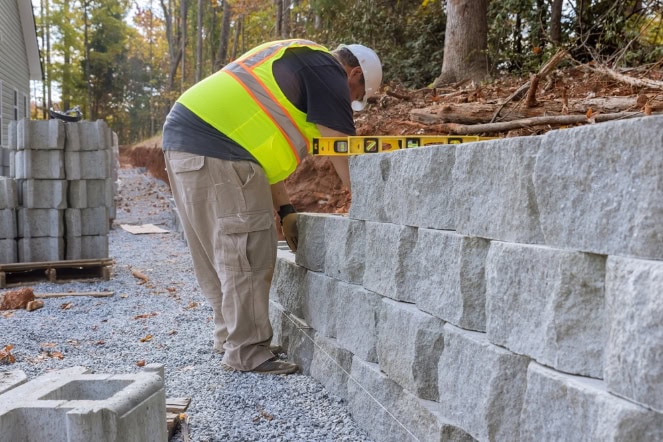
Most retaining wall problems in Thornbury don’t start with the wall they start with what’s behind it. When drainage isn’t engineered into the design from the beginning, water builds up in the soil, clay expands, hydrostatic pressure grows, and eventually the wall moves. That’s what happens to walls built without a real drainage plan, and it’s the most common reason homeowners in this area end up rebuilding within a few seasons.
When it’s done right, the difference is immediate and lasting. The slope that used to wash out every March stays put. The yard that dropped away too steeply to use becomes a level space you can actually do something with. Property appraisers consistently put the return on a well-built retaining wall at 100 to 200 percent of cost and in Thornbury, where lot character matters and outdoor space is part of what you paid for, that return is real.
Thornbury sits at 350 to 400 feet above sea level, which means the freeze-thaw cycle hits harder here than it does in the flat, coastal-plain communities in eastern Delaware County. Water seeps into soil, freezes, expands, and loosens the earth and when spring comes, that loosened soil is far more vulnerable to washing away. We design every wall for Thornbury’s terrain and account for all of that before the first block goes in.
We’re based in Aston, PA Delaware County, same as you. Owner Renato Spennato holds active Pennsylvania contractor license PA057623, ranked in the top 11% of over 125,000 licensed contractors statewide by BuildZoom. That’s not a marketing claim it’s a publicly verifiable credential you can look up before you ever call.
What actually separates us from most of what you’ll find in the Glen Mills and Cheyney area is simpler than any credential: we do not subcontract. The crew that assesses your Thornbury property is the crew that builds your wall. There’s no handoff, no stranger showing up on installation day, and no situation where the person responsible for your project becomes unreachable after the check clears.
That accountability matters in a community like Thornbury, where neighbors talk and a wall that fails on a hillside property affects more than just the homeowner who paid for it.
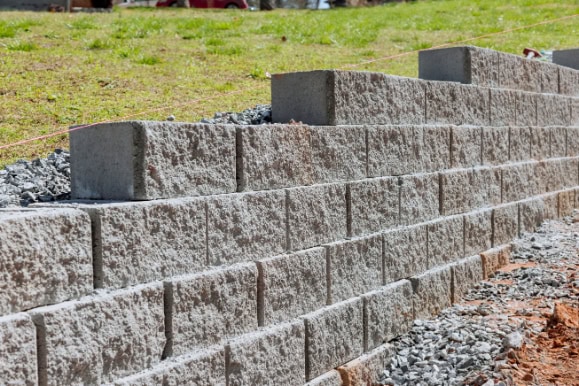
It starts with an on-site visit. Not a phone estimate, not a ballpark based on square footage an actual walk of your property where the slope, drainage patterns, soil conditions, and project goals get assessed in person. Thornbury’s clay-heavy soil and rolling terrain require that kind of attention upfront. What looks like a straightforward slope on paper can have drainage dynamics that change the entire approach once we’re standing on it.
From there, the material and drainage plan comes together. This is where the structural decisions get made which wall system fits your property’s demands, how the drainage layer behind the wall gets engineered to handle Thornbury’s wet springs and freeze-thaw cycles, and whether your site requires a permit filing with Thornbury Township’s Cloudpermit system. Walls four feet or taller require a building permit and engineer-sealed plans under Pennsylvania’s Uniform Construction Code. We handle the permit process as part of the project you don’t need to decode the township’s requirements on your own.
Installation follows a specific sequence: base preparation, compacted backfill in layers, drainage aggregate behind the wall, and stepped block or stone placement that locks the structure in place. When the job is done, the site gets cleaned up and you get a walkthrough. The same team that started the project finishes it no exceptions.
Ready to get started?
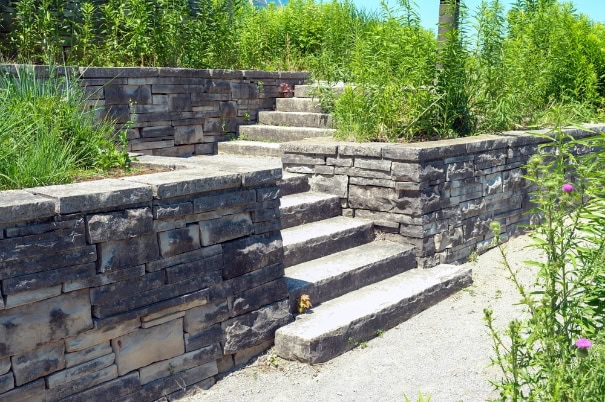
Material selection isn’t one-size-fits-all in Thornbury, and it shouldn’t be. If your property has historic stone construction a farmhouse, a stone outbuilding, or a mill-era foundation wall along the Chester Creek corridor a standard modular block wall is going to look out of place. Natural stone and boulder walls aren’t just aesthetically appropriate to Thornbury’s historic character; they’re structurally suited to hillside terrain and can last 40 to 100 years when properly built. For properties where the structural demands are high and architectural compatibility matters, this is often the right call.
VERSA-LOK concrete block systems are another strong option for Thornbury’s conditions. The mechanical pinning system creates interlocking stability without mortar, and the design requires no frost footings which matters in a township where the freeze-thaw cycle is a real structural variable, not an afterthought. VERSA-LOK systems are rated for 30 to 50 years and hold up well through Delaware County winters. Treated timber walls are sometimes quoted as the budget option, but their 10 to 30 year lifespan means the apparent savings tend to disappear over a 20-year horizon.
Every project also includes a full assessment of what Thornbury Township’s permitting process requires for your specific wall. Zoning permits, building permits for walls over four feet, grading permits where site conditions apply the township uses a formal Cloudpermit system and actively regulates retaining walls in its zoning ordinance. Skipping that process creates real problems at resale. We manage it so you don’t have to.
The short answer is: probably yes, even for a shorter wall. Thornbury Township has a formal permitting process administered through its cloud-based Cloudpermit system, and the township’s zoning ordinance specifically defines and regulates retaining walls as structures. Even walls under four feet in height may require a zoning permit depending on placement and site conditions.
For walls four feet or taller, Pennsylvania’s Uniform Construction Code requires a building permit, and the permit application must include plans sealed by a registered Pennsylvania architect or engineer. A separate grading permit may also be required depending on how your site drains and how much earth is being moved. If your property fronts a state road Route 352 or Route 926, for example a State Road Occupancy Permit may apply as well. Skipping any of these steps can result in fines, forced removal, or complications when you go to sell the property. We handle the permit process as part of every project it’s not an add-on, and it’s not something you should have to figure out on your own.
For Thornbury specifically, the freeze-thaw cycle is a real structural variable not just a seasonal inconvenience. At 350 to 400 feet above sea level, Thornbury sits higher than most of eastern Delaware County, and cold air drainage means overnight frost events can be more pronounced here than in lower-lying communities closer to the Delaware River. Any wall material that wasn’t chosen with that in mind is going to show stress faster than the contractor who installed it will admit.
Natural stone walls, when properly built with adequate drainage behind them, can last 40 to 100 years and handle freeze-thaw cycles extremely well. VERSA-LOK concrete block systems are engineered specifically for climates like Pennsylvania’s the mechanical pinning design doesn’t require frost footings, which removes one of the most common failure points in colder regions. Treated timber is often quoted as the affordable option, but its 10 to 30 year lifespan means you’re likely rebuilding within the ownership period of most Thornbury properties. The material conversation should always start with what the wall needs to do structurally and how long you need it to last not what’s cheapest on day one.
Clay soil is one of the most important variables in retaining wall design, and Delaware County has plenty of it. Clay expands when it absorbs moisture and contracts when it dries out which means the soil behind your wall is constantly moving with the seasons. Without a drainage system specifically engineered to remove water from behind the wall before pressure builds, that expansion cycle puts lateral stress on the structure that compounds over time.
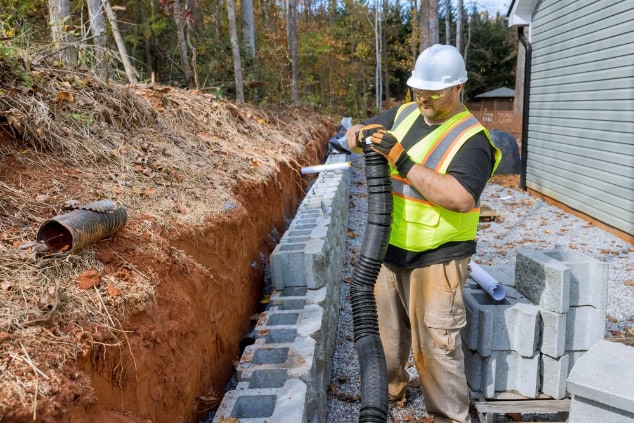
In Thornbury, where the terrain channels water downhill toward Chester Creek and its tributaries during wet springs, this isn’t a theoretical risk. It’s the reason walls fail. A properly designed retaining wall in this area includes a drainage aggregate layer directly behind the wall face, a perforated drain pipe at the base to carry water away from the structure, and a filter fabric to prevent soil from migrating into the drainage layer over time. None of that is visible once the wall is finished, but all of it is what separates a wall that holds for 30 years from one that starts bowing by year four. We plan drainage before anything else it’s the foundation of the design, not a line item added at the end.
Retaining wall pricing varies significantly based on height, length, material, and site complexity and Thornbury properties tend to have more site complexity than flat suburban lots in other parts of Delaware County. The rolling terrain, clay soil conditions, and older property stock in this township mean that drainage engineering and base preparation often require more work than a basic estimate accounts for.
As a general range, most residential retaining wall projects run between $3,500 and $10,000, with per-linear-foot pricing typically falling between $40 and $345 depending on the wall system and what the site demands. Most quality contractors carry a project minimum in the $1,500 to $3,000 range. Natural stone and boulder walls sit at the higher end of that spectrum, VERSA-LOK systems fall in the mid-range, and treated timber comes in lower upfront though the replacement cost over 20 years often reverses that comparison. The most accurate number for your specific property comes from an on-site assessment, not a phone estimate. Any contractor quoting you a firm price without walking your slope and assessing your drainage situation isn’t giving you a real number.
It matters structurally, and the distinction affects how the wall needs to be designed and built. A garden wall is primarily decorative it defines a space, adds visual structure to a planting bed, or creates a low border. It’s not holding back significant amounts of soil or managing active water pressure. A retaining wall, by contrast, is an engineered structure. It’s holding back earth, managing grade changes, and in many cases redirecting water. The engineering behind it drainage layer, compacted base, wall batter, block selection is what makes it work long-term.
On sloped Thornbury properties, especially those along the hillside terrain near Chester Creek or on former farmland that was graded during residential development, the distinction matters because getting it wrong is expensive. A decorative wall installed where a structural retaining wall was needed will fail and when it does, the repair cost is typically higher than building it correctly the first time would have been. If you have a grade change of more than a foot or two, or if water is actively moving through the area you’re trying to wall off, you’re in retaining wall territory. An on-site assessment will confirm which applies to your property.
There are a few clear signs that a wall has moved past the repair threshold. If you’re seeing significant leaning more than one inch of outward movement for every foot of wall height the structure has likely lost its engineered integrity and repair is unlikely to restore it long-term. Horizontal cracking near the middle of the wall, large gaps between blocks or stones, and soil actively pushing through or around the wall face are all indicators that the drainage system behind the wall has failed and the structure is under pressure it wasn’t designed to handle.
In Thornbury, walls built without adequate drainage behind them tend to show these symptoms after a few heavy spring seasons the combination of clay soil expansion, Chester Creek watershed runoff, and freeze-thaw cycling accelerates the failure timeline significantly compared to walls in flatter, drier conditions. A wall that’s simply showing surface weathering or minor cosmetic wear is often repairable. A wall that’s moving, cracking structurally, or showing signs of drainage failure behind it usually needs to come down and be rebuilt correctly with the drainage system that should have been there from the beginning. An on-site assessment will give you a clear answer on which situation you’re dealing with.
Useful Links