
Block Retaining Walls Delaware County PA

Stop Losing Ground. Start Using Your Yard.

Your slope isn’t going to fix itself — and in Delaware County, PA, the clay soil and freeze-thaw winters make every season harder on an aging or failing wall. We install concrete block retaining walls built to handle what Delco throws at them, so you get a yard that holds, lasts, and actually looks good.
A stone retaining wall with blooming lavender plants on top showcases thoughtful landscape design, set beside a lush green lawn and a charming stone building in the background.

Active PA Contractor License

We hold a verified active Pennsylvania contractor license, ranked in the top 11% of over 125,000 licensed PA contractors by BuildZoom.

One Crew, No Subcontractors

Your project runs with one experienced team from start to finish — no juggling crews, no gaps in accountability, no surprises.

Permits Handled for You

We manage the permit process across Delaware County's 49 municipalities, so you don't have to figure out who to call or what to file.

Drainage Built Into Every Wall

Every wall we install includes a proper drainage system — because in Delco's clay soil, that's not optional, it's what keeps the wall standing.
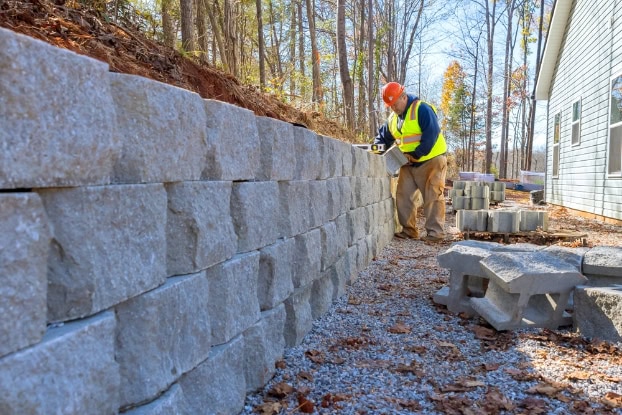
A construction worker in a safety vest and helmet measures a newly built stone retaining wall, showcasing expert hardscape design next to a house. Tools and concrete blocks rest on the gravel path, while trees enhance the landscaping in the background.

Segmental Retaining Walls Delaware County

The Wall That Actually Holds — For Decades

Concrete block retaining walls — also called segmental retaining walls — are the most common choice for residential properties throughout Delaware County, and for good reason. Systems like Allan Block, Versa-Lok, and Belgard are engineered specifically for this application, offering a 50-plus year lifespan when installed correctly. They’re stronger than timber, more cost-effective than natural stone for larger projects, and available in textures and colors that look far better than most people expect. What most homeowners don’t realize is that the block itself is only part of the equation. The base, the drainage system, and the backfill compaction are what determine whether a wall holds for 50 years or starts leaning in 10. We build the whole thing right — not just the part you can see.

Hear from Our Customers

Concrete Block Retaining Wall Delaware County

What a Properly Built Block Wall Gets You

Beyond stopping erosion — a well-built retaining wall gives you usable space, better drainage, and a yard that holds its value through every season.
That slope you've been ignoring becomes level, usable outdoor space for entertaining, gardening, or play.
Your topsoil stays where it belongs, even after the heavy spring rains that hit Delco every year.
You stop watching your mulch wash down the hill and into the street after every storm.
A block wall rated for 50-plus years means you're solving this once — not patching it again in a decade.
Modern block finishes from Allan Block, Versa-Lok, and Belgard look nothing like cinder block — buyers notice the difference.
You get a wall that's built to code, permitted, and documented — no liability risk, no surprises at resale.
A bold, black circle with a large white number 1 centered inside—perfect for highlighting top picks in masonry or hardscape design projects.

Share project details

Call us or get a free online quote to help us identify your project needs.

A bold white number 2 centered inside a solid black circle on a transparent background, perfect for use in landscaping or landscape design projects.

We'll follow up

If you requested an online quote, you can expect a callback within 24-48 hours of your request.
A bold black number 3 centered inside a solid black circle evokes the strength and precision often seen in masonry and hardscape design, set on a transparent background.

The floor is yours

Connect with an expert and share all project specifics.
A bold, green number 4—ideal for landscaping or hardscape design—centered inside a solid black circle on a transparent background.

Plan your project

Like what you hear? We'll provide next steps and expert guidance.
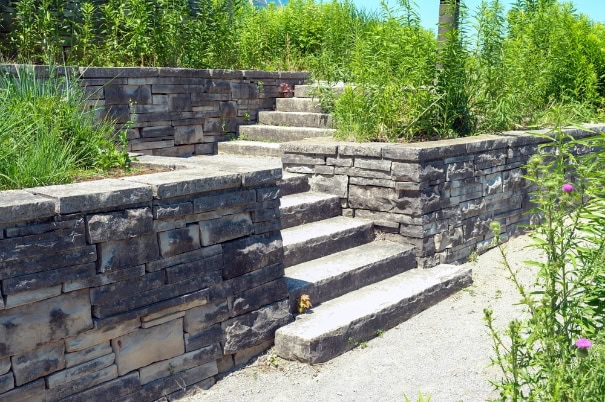
Stone steps and terraced retaining walls showcase thoughtful hardscape design, surrounded by green plants and tall grass under a bright blue sky on a sunny day.

Allan Block Versa-Lok Belgard Delaware County

Not All Block Systems Are Built the Same

When homeowners start researching concrete block walls, they often come across three names: Allan Block, Versa-Lok, and Belgard. These aren’t interchangeable with whatever’s on sale at the hardware store. Each system is engineered specifically for retaining wall construction, manufactured to ASTM standards for structural performance and freeze-thaw durability — which matters a great deal in Pennsylvania winters. Allan Block uses a hollow-core design that performs particularly well through repeated freeze-thaw cycles. Versa-Lok’s solid block and pin system create a natural backward lean with each course, adding structural stability without requiring any special tools or techniques. Belgard leans more design-forward, offering a wide range of textures and colors that work well when aesthetics are a priority. All three systems are a significant step above generic block. When we spec a wall for your property, we match the system to the site conditions, the wall height, and what you want it to look like when it’s done.

Block Retaining Wall Cost Delaware County PA

What Block Retaining Walls Cost in Delco
Most concrete block retaining walls in Delaware County fall somewhere between $56 and $92 per linear foot installed at four feet tall — which puts a 25-foot wall in the range of $5,000 to $6,500 depending on site conditions, drainage requirements, and the block system selected. Taller walls cost more, not just because of materials, but because lateral soil pressure increases significantly with height — a six-foot wall holds back roughly 225% more force than a four-foot wall, which means deeper footings and geogrid reinforcement layers. The number homeowners rarely factor in is the cost of getting it wrong. A wall built without proper drainage or base preparation fails in 10 to 15 years in Delco’s clay soil. Rebuilding runs $5,000 to $15,000. Doing it right the first time is almost always the less expensive option over time. We’re straightforward about pricing during your estimate. No lowball quotes with change orders buried in the fine print.
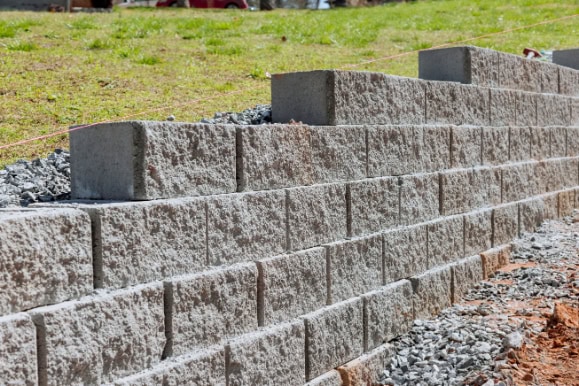
A close-up view of a newly constructed masonry retaining wall made of stacked concrete blocks, with gravel at the base and grass on the slope above, showcases expert hardscape design.
Block Retaining Walls Delaware County Pa FAQs

Common Questions About Our Service

In most cases, yes — if your wall is going to be four feet or taller. Pennsylvania’s building code generally requires a permit at that height, and some of Delaware County’s 49 municipalities set the threshold even lower, particularly for walls near property lines or anything supporting a driveway or structure. Building without a required permit isn’t just a technicality — if it comes up during a home sale or inspection, you could be required to demolish and rebuild the wall at your own expense. We handle the permit process as part of every project. We know the building departments across Delco and we take that off your plate entirely.
A properly installed concrete block wall — using a quality system like Allan Block, Versa-Lok, or Belgard — has a lifespan of 50 years or more. The key phrase there is “properly installed.” That means a compacted gravel base, a drainage system behind the wall, geogrid reinforcement on taller walls, and blocks that meet ASTM standards for freeze-thaw durability. Walls that skip the drainage step or use substandard materials tend to fail within 10 to 15 years, especially in Delaware County’s clay soil where saturation and expansion put constant pressure on the structure. The block is the visible part. The system underneath is what makes it last.
Delaware County’s soil is predominantly clay, and clay expands 15 to 20 percent when it becomes saturated. When that expansion has nowhere to go, it pushes directly against the back of your retaining wall. Over time, that pressure — called hydrostatic pressure — is what causes walls to lean, crack, and eventually fail. The fix is straightforward: a column of clean gravel behind the wall, a perforated drainage pipe at the base, and proper grading to route water away from the structure. Properties near Ridley Creek, Crum Creek, or Chester Creek tend to see this problem more acutely because the water table and drainage patterns in those areas are more active. We treat drainage as a required step, not an upgrade.
Both are quality engineered systems designed specifically for retaining walls, and both are significantly better than generic concrete block. The main differences come down to construction method and application. Allan Block uses a hollow-core design that performs well through repeated freeze-thaw cycles — a real advantage in Pennsylvania winters. Versa-Lok is a solid block that uses a pin system to lock each course in place, creating a natural backward lean that adds structural stability, which makes it a strong choice for taller walls or situations where shear resistance matters. Belgard is worth considering when design flexibility is the priority — it offers the widest range of textures and colors. In practice, the right choice depends on your wall height, site conditions, and what you want it to look like.
For a small decorative wall under two or three feet with no drainage concerns and no permit requirements, a capable DIYer can sometimes pull it off. But most retaining walls in Delaware County aren’t that simple. The base compaction, drainage system, geogrid placement for walls over four feet, and permit compliance all require knowledge and equipment that most homeowners don’t have. The risk isn’t just a wall that looks off — it’s a wall that fails and takes a chunk of your yard with it, or one that needs to be torn out because it wasn’t built to code. The cost of a professional installation is almost always less than the cost of rebuilding a failed DIY wall.
A few things to look for: if the wall is leaning more than an inch or two out of plumb, if you’re seeing horizontal cracks running along the face, if sections have started to bow or separate, or if water is consistently pooling at the base — those are signs the wall’s structural integrity is compromised. Timber and railroad tie walls that are 20 or more years old are almost always past the point of repair; they’re simply at end of life. Concrete block walls with isolated cracking or minor displacement can sometimes be repaired, but it depends on whether the drainage system behind the wall is still functional. We can assess your existing wall during a site visit and give you an honest read on whether repair makes sense or whether replacement is the better investment. For more on that, see our retaining wall repair page.
A bold, black circle with a large white number 1 centered inside—perfect for highlighting top picks in masonry or hardscape design projects.

On-Site Design Meeting

We visit your property, assess the slope and soil, discuss your goals, and figure out what the wall actually needs to hold.

A bold white number 2 centered inside a solid black circle on a transparent background, perfect for use in landscaping or landscape design projects.

Material and Drainage Planning

We select the right block system for your site and plan the drainage — the part most contractors skip or underbuild.

A bold black number 3 centered inside a solid black circle evokes the strength and precision often seen in masonry and hardscape design, set on a transparent background.

Full Installation, Start to Finish

Excavation, compacted gravel base, block installation, drainage tile, geogrid where required, and cap blocks — one crew, no gaps.