
Hear from Our Customers
Most outdoor kitchens in this area fail within five to seven years not because of poor design, but because the materials weren’t built for what Delaware County winters actually do. Temperatures here swing from the mid-teens to the sixties repeatedly through a single season, and that freeze-thaw cycle destroys cheap masonry, cracks stone veneer, and heaves poorly prepared bases. Fixing it costs $3,000 to $8,000 or more. Getting it right the first time is the smarter investment.
Aldan’s housing stock tells the story clearly. Most homes here are Victorian-era builds or post-WWII Cape Cods many of them sitting on lots that have never been professionally hardscaped. These backyards aren’t small so much as they’re underdesigned. A well-planned outdoor kitchen doesn’t require a sprawling suburban yard. It requires someone who knows how to work with the space you actually have not the space a catalog assumes you have.
When the build is done right, your backyard stops being the part of the property you walk past and starts being the part you plan around. Weekend cookouts, evenings outside with the family, a space that genuinely extends the living area of your home that’s what a properly built outdoor kitchen delivers. In Aldan’s competitive real estate market, where homes move in about 30 days, it’s the kind of improvement that holds real value when it matters.
We’re based in Aston and serve Delaware County exclusively which means Aldan isn’t a side market. It’s the center of what we do. We know the clay-heavy soil conditions in this part of the county, the permit process through Aldan Borough’s Zoning Officer, and the drainage challenges that come with older residential lots like the ones lining Providence Road and Clifton Avenue.
What makes the difference on a project like this isn’t just the materials it’s who’s managing the work. Outdoor kitchens involve masonry, gas, electrical, and sometimes plumbing. When those trades are farmed out to different subcontractors who’ve never met each other, things fall through the cracks. Our model is one experienced crew from start to finish. The people who pour the base are the same people who install the countertop and do the final walk-through with you.
That’s not a process quirk it’s the reason projects finish on time and the reason homeowners can actually reach us after the job is done.
It starts with a conversation about your yard and how you use it. Sun exposure, traffic flow, proximity to the house, existing trees all of it shapes the design. Aldan lots are compact, and a layout that works on a half-acre in Broomall won’t work the same way on a typical block in this borough. The design process accounts for your actual space, not a generic version of it.
Once the design is set, we handle the permitting. Aldan Borough requires a zoning permit for outdoor kitchen structures under Chapter 256 of the Borough Code, and Pennsylvania law requires licensed tradespeople for gas, electrical, and plumbing connections. We pull the permits, coordinate the licensed trades, and manage the inspections. You don’t have to navigate the Borough’s Zoning Officer or track down a separate gas fitter on your own.
One thing worth knowing about timing: masonry and hardscaping can’t be done safely below 40°F, which limits the build season in Delaware County to roughly April through October. Homeowners who want a kitchen ready for summer need to start the planning process in late winter January or February to lock in a build slot before the season fills up. There’s no commitment required to have that early conversation, and it’s the difference between being ready for July and being pushed to next year.
Ready to get started?
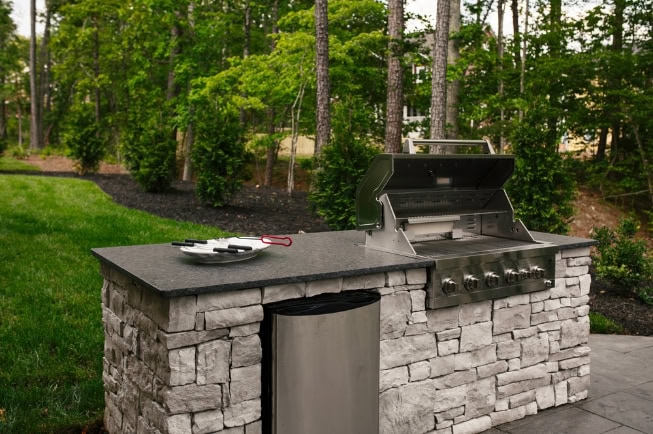
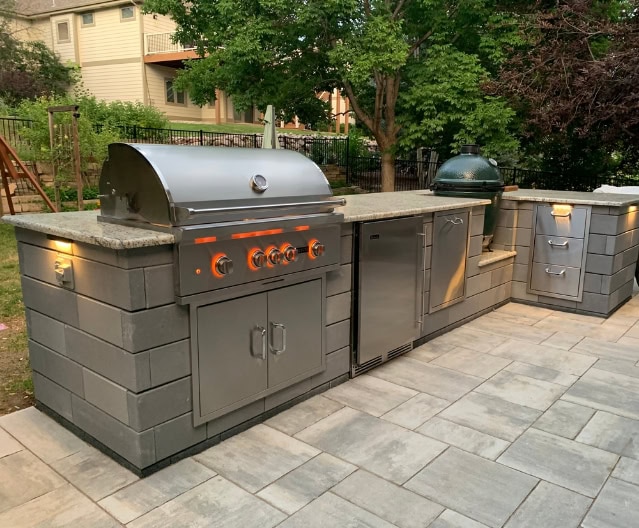
Every outdoor kitchen we build in Aldan is spec’d for this climate. That means frost-proof stone veneer, marine-grade cabinetry, stainless steel appliances, and base preparation designed to resist frost heave. These aren’t premium upgrades they’re the baseline for anything that’s going to hold up through a Delaware County winter without cracking or shifting.
The design itself is built around your specific property. Compact lots require thoughtful layouts where the grill sits relative to the back door, how much counter space is realistic, whether a sink and refrigerator make sense for how you actually entertain. We’ve built outdoor kitchens across Delaware County, including in the older residential neighborhoods that make up most of Aldan’s 0.6 square miles, and the approach is always the same: design for the space you have, not the space a showroom assumes.
Appliance selection, countertop material, lighting for evening use, and gas versus propane configuration are all part of the conversation. So is drainage something that’s easy to overlook on older residential lots but critical for a structure that’s going to be there for decades. When the project is complete, you get a final walk-through with the same crew that built it, a clear picture of what was installed, and a team you can actually reach if something comes up later.

Yes and any contractor who tells you otherwise is either cutting corners or doesn’t know Aldan’s code. Under Chapter 256 of the Borough Code, outdoor kitchen structures are classified as accessory structures in Aldan’s R-1 Residence District, which means a zoning permit is required before construction begins. The application goes to the Borough’s Zoning Officer, and the structure must meet minimum yard setback requirements.
Beyond the zoning permit, Pennsylvania law requires licensed tradespeople for gas line connections, electrical work, and plumbing. These aren’t optional they’re legal requirements, and skipping them creates liability issues that show up at resale when a home inspector or title company asks for documentation. We handle the entire permit and trade coordination process on every project we build in Aldan, so you’re not left trying to figure out which forms to file or which licensed trades to independently hire.
The range is wide because the scope varies significantly. A straightforward built-in grill station with countertop space and a stone veneer base typically starts around $15,000. A fully equipped outdoor kitchen with a grill, side burner, refrigerator, sink, bar seating, and custom lighting can run $35,000 to $50,000 or more depending on appliance selection and materials.
For Aldan homeowners, the more important number is the long-term one. Outdoor kitchens built with materials appropriate for Pennsylvania’s freeze-thaw climate hold up for decades. Ones built with cheaper materials inadequate base preparation, non-frost-proof veneer, standard-grade cabinetry often need partial reconstruction within five to seven years, which can cost $3,000 to $8,000 on top of what you already spent. The upfront difference between doing it right and doing it cheap is smaller than most homeowners expect. The back-end difference is significant.
The freeze-thaw cycle is the main thing to design around in Delaware County. Temperatures here can swing from the mid-teens to the upper fifties multiple times in a single winter, and that repeated expansion and contraction is what destroys materials that weren’t selected with this climate in mind. The most common failure points are stone veneer that wasn’t rated for frost exposure, base layers that weren’t properly prepared to resist heave, and cabinetry that absorbs moisture and degrades over time.
For veneer, frost-proof natural stone or porcelain-based products rated for freeze-thaw conditions are the right call. For the structural base, proper compaction and drainage are non-negotiable water that pools beneath a structure and freezes will move it. Marine-grade polymer or stainless steel cabinetry handles Pennsylvania’s wet seasons far better than wood-based alternatives. Countertop materials like granite or porcelain tile perform well here as long as the substrate beneath them is solid. We spec every Aldan build for this climate specifically not for a warmer-weather market where these failure modes don’t apply.
For most residential outdoor kitchen projects in Aldan, the active construction phase runs two to four weeks depending on scope. A simpler grill station setup is typically on the shorter end. A full outdoor kitchen with multiple appliances, custom masonry, electrical, and plumbing connections takes longer especially when permit processing and licensed trade scheduling are factored in.
The total timeline from first consultation to finished build is usually eight to twelve weeks when you account for design, permitting, material lead times, and scheduling. That’s why starting the conversation in late winter matters. Aldan Borough’s permit process takes time, masonry season doesn’t open until temperatures are consistently above 40°F, and build slots fill up quickly once spring arrives. Homeowners who reach out in January or February are in a much better position to have a finished outdoor kitchen by Memorial Day than those who call in April expecting a June completion.
Yes and honestly, smaller lots require better design, not less of it. The compact residential lots that define most of Aldan’s housing stock, particularly in the Victorian-era and Cape Cod neighborhoods that make up the borough, are workable spaces. The key is designing a layout that fits how you actually use the yard rather than trying to fit a catalog configuration into a space it wasn’t designed for.
A well-designed outdoor kitchen on a smaller lot focuses on function per square foot. That might mean a linear layout along a fence line rather than an L-shape, or prioritizing the appliances you’ll actually use over ones that look good in a showroom. Counter space, traffic flow between the kitchen and the seating area, proximity to the back door these decisions matter more on a compact lot than on a sprawling one. We’ve built functional, well-used outdoor kitchens on properties throughout Delaware County’s older residential boroughs, and the design conversation always starts with your specific yard, not a template.
The data on this is consistently strong. Industry benchmarks place the return on a professionally built outdoor kitchen at 55% to 200% at resale, with the National Association of Realtors citing 100% ROI as a widely referenced figure. In practical terms, that means a $25,000 outdoor kitchen adds somewhere between $13,750 and $50,000 in perceived home value with the actual number depending heavily on build quality, design, and how well it fits the property.
For Aldan specifically, the context matters. The median home value here is around $305,000, and homes in the borough have been moving in roughly 30 days. In a market that competitive, a professionally built outdoor kitchen is a genuine differentiator it’s one of the few improvements that’s immediately visible, immediately usable, and immediately appealing to buyers who are evaluating outdoor spaces carefully. The caveat is build quality: an outdoor kitchen that’s cracking, heaving, or showing weather damage after a few Delaware County winters doesn’t add value it raises questions. A well-built one that still looks solid after ten years tells a different story entirely.
Useful Links