
Hear from Our Customers
Standing water in Aldan isn’t just an eyesore. When your yard pools within feet of your foundation and most lots here don’t give you much more room than that you’re looking at hydrostatic pressure building up against your basement walls with every heavy rain. That turns into seepage, then mold, then a repair bill that makes a drainage system look like a bargain.
Aldan’s housing stock makes this more common than people realize. Most homes here were built between the 1920s and 1960s, long before modern stormwater standards existed. The original grading around these homes has shifted over decades of Pennsylvania freeze-thaw cycles. What drained adequately in 1955 may now be directing water straight toward your foundation instead of away from it.
There’s also the neighbor factor. In a borough packed at over 7,000 people per square mile, one property’s drainage problem is often directly connected to the next. A properly designed system resolves the issue at your property line it doesn’t just move the water onto the lot next door. That matters both for your relationship with your neighbors and for staying on the right side of Aldan Borough’s own stormwater ordinance.
We’re based in Aston, PA a Delaware County contractor that has been working in this county for over 15 years. That’s not a detail to gloss over. The most visible competitor showing up in Aldan drainage searches is headquartered in Wilmington, Delaware, with Pennsylvania service pages built for search reach. There’s a real difference between a company that knows this county and one that has a landing page for it.
Our team has worked on properties throughout Delaware County’s dense inner-ring boroughs homes like the ones on Clifton Avenue and Providence Road in Aldan, with the same aging infrastructure, tight lots, and Darby Creek watershed dynamics that define drainage challenges here. When you call, you’re reaching a crew that has seen these conditions firsthand, not one reading about them for the first time on a site visit.
Grading and drainage are handled as one integrated system here, not two separate services with two separate crews. That matters on older properties where the grade itself is part of the problem.

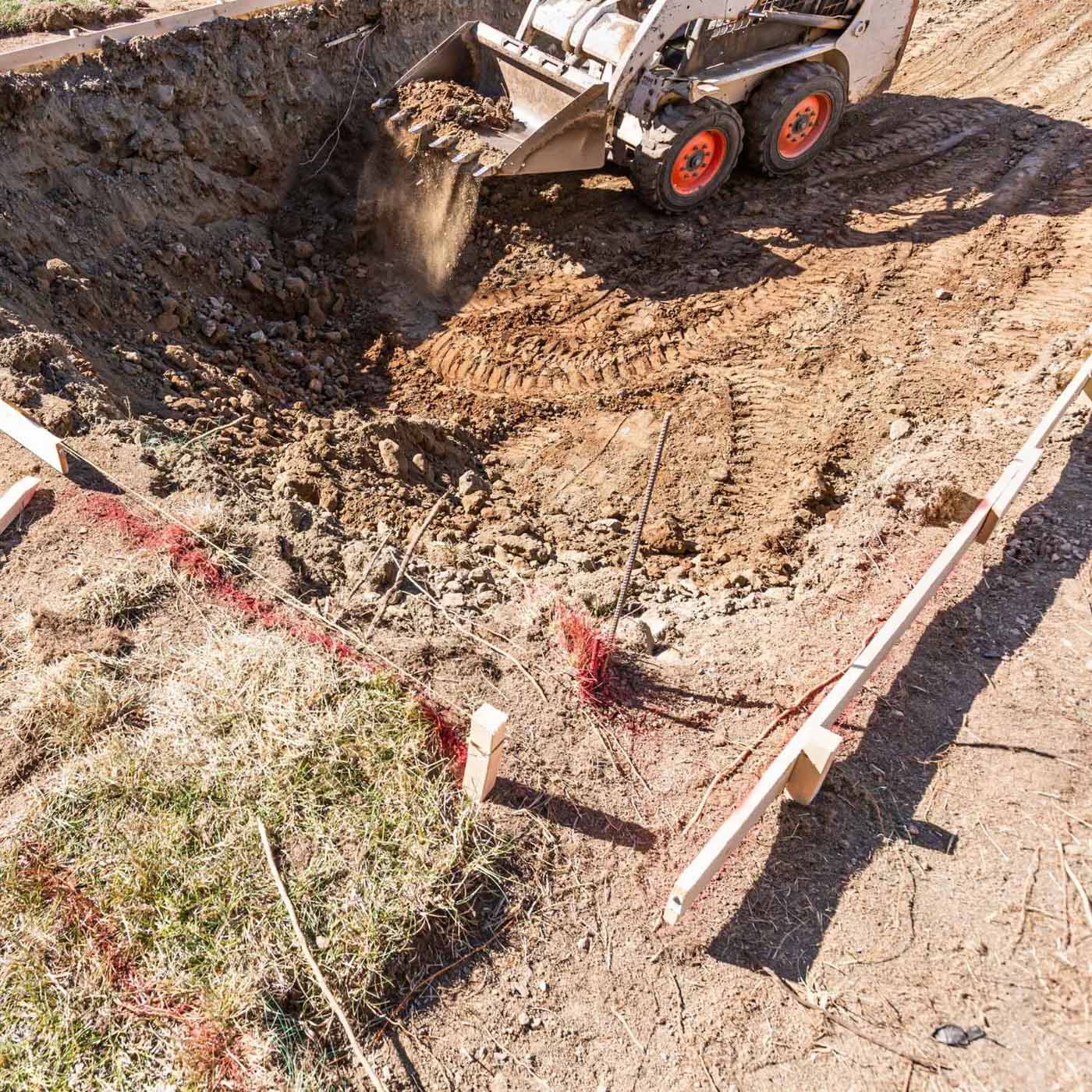
It starts with a site evaluation not a sales pitch. We walk your property, read how water is actually moving across it, and identify where the problem originates. In Aldan, that often means assessing decades of grade shift on a lot that was already small to begin with. The goal at this stage is to understand what’s actually happening before recommending anything.
From there, we design a solution around your specific property. That might be a French drain with a proper discharge point, surface regrading to correct the slope, a catch basin, or some combination. No two Aldan properties are identical, even if the homes look similar from the street. Before any work begins, we handle the permit requirements and in Aldan, those are real. Borough code requires a terrain modification permit for any grading work and a stormwater modification permit for any system that alters how water flows on your property. Skipping that process isn’t a shortcut; it’s a liability.
Installation is handled by the same crew that assessed the property. Once the system is in, we restore and clean up the disturbed areas. You’re left with a yard that drains correctly and documentation that the work was done to code.

Ready to get started?
Drainage systems for Aldan properties have to account for things that don’t apply in larger townships with newer homes and bigger lots. The Darby Creek watershed runs through this area, and it’s been identified by the Delaware County Conservation District as a corridor where over-development and aging stormwater infrastructure create persistent flooding pressure. When the municipal system is at capacity during a heavy rain which happens regularly in this watershed your private drainage system is the only thing standing between your yard and your basement.
We install French drains, surface swales, catch basins, dry wells, and full grading corrections depending on what the property actually needs. Every system is designed with Aldan’s lot constraints in mind: discharge points that work within the property boundary, grading that solves the problem without pushing water onto an adjacent home, and materials selected to hold up through Delaware County’s freeze-thaw winters.
The work also accounts for Aldan Borough’s code requirements from the start. The borough’s surface drainage standards require that yard grading direct water away from structures meaning a yard that drains toward your foundation isn’t just a problem, it may be a code violation. Getting it corrected properly, with the right permits in place, protects your home and keeps you on the right side of the borough.

Yes and this is one of the most important things to confirm before hiring anyone for drainage work in Aldan. The borough’s municipal code requires a terrain modification permit for any grading or regrading work, and a separate stormwater modification permit for any project that alters, diverts, or affects the natural flow of stormwater on your property. That covers the vast majority of drainage installations, including French drains, catch basins, and dry wells.
Skipping the permit process isn’t just a paperwork issue. If the work is done without proper permits and the borough finds out through a neighbor complaint, a code inspection, or a future property sale you could be required to remove the system entirely, regardless of whether it’s working. There’s also liability exposure if an unpermitted system redirects water onto an adjacent property. We handle the permit process as part of every project in Aldan, so you’re not left managing that on your own or hoping it doesn’t come up later.
For most residential properties in Delaware County, French drain installation runs somewhere between $5,000 and $9,500 depending on the length of the system, how deep it needs to go, and what the discharge situation looks like. On the lower end, you’re typically looking at a straightforward linear run with a clear outlet. On the higher end, you’re dealing with longer runs, more complex grading corrections, or properties where the discharge point requires more engineering.
In Aldan specifically, the tight lot sizes and proximity to neighboring properties can add complexity that affects cost the system has to be designed carefully to resolve the problem within your property boundary. That’s not a reason to avoid the project; it’s a reason to get it assessed properly upfront so the estimate reflects what’s actually needed. Foundation repair in Delaware County typically runs $10,000 to $30,000 or more. A drainage system that prevents that damage is one of the better investments you can make on an older Aldan home.
This is one of the most common questions from homeowners in older Delaware County boroughs, and the answer almost always comes back to grade shift. The original grading around homes built in the 1920s through 1960s which describes most of Aldan’s housing stock was designed to direct water away from the foundation. But over decades of Pennsylvania freeze-thaw cycles, the soil expands, contracts, and settles. What used to slope away from your house may now slope toward it, or toward a low spot in your yard that holds water for days.
It’s also worth noting that the underground drainage infrastructure in parts of Aldan is aging clay and cast iron materials that crack, collapse, and lose function over time. If your yard drainage used to rely on a subsurface system that’s now compromised, the water has nowhere to go except the surface. A proper site evaluation will identify whether the issue is grade-related, infrastructure-related, or both and that diagnosis determines the right fix.
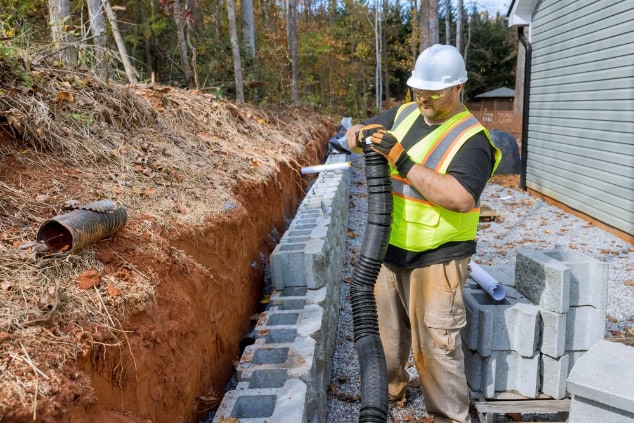
A French drain is a subsurface system a perforated pipe wrapped in filter fabric, buried in gravel, that collects water underground and channels it to a discharge point. Regrading is a surface correction reshaping the slope of your yard so that water naturally flows away from your home and toward a proper outlet. Both solve drainage problems, but they solve different versions of the problem.
If your yard is pooling because the surface slope is directing water toward your house or toward a low spot, regrading may be the primary fix. If water is saturating the soil and building up pressure against your foundation even when the surface looks fine, a French drain addresses what’s happening below grade. On many Aldan properties older homes with decades of grade shift and aging subsurface infrastructure the answer is both, addressed together as one system. That’s exactly why we treat grading and drainage as a single project rather than two separate services. Installing a French drain on improperly graded ground produces a system that underperforms from day one.
Not legally, and not without real consequences. Aldan Borough’s stormwater ordinance requires that drainage modifications not adversely affect neighboring properties or the public storm drainage system. In a borough where lots are separated by feet rather than acres, this matters more than it would in a larger township. A drainage system that solves your water problem by redirecting runoff onto the adjacent property isn’t a solution it’s a liability, and it’s a violation of the borough’s own code.
This is one of the reasons a proper site assessment and permit process matter so much in Aldan. A well-designed system identifies where the water needs to go before the first shovel hits the ground whether that’s a street inlet, a dry well, or a designated discharge point on your property. We design drainage systems with the discharge question answered upfront, so the finished system resolves the problem at your property without creating a new one next door. In a dense borough like Aldan, that’s not optional it’s the baseline.
Spring and fall are the most practical windows for drainage installation in Delaware County, and both have different advantages. Spring is when drainage problems reveal themselves most clearly a wet March or April shows you exactly where water pools, where it flows, and how long it sits. Getting the work done in late spring, after the ground has thawed and dried enough to work with, means you’re protected before the next heavy rain season.
Fall is the other strong window, and it’s often underused. Installing before the ground freezes gives the system time to settle properly before winter, and it means you’re not starting the next spring with the same problem you ended the last one with. What you want to avoid is waiting until mid-winter, when frozen ground makes excavation difficult and more expensive, or delaying past the point where another freeze-thaw cycle does additional damage to already-compromised grading. For Aldan homeowners dealing with aging infrastructure and Darby Creek watershed drainage pressure, getting ahead of the season is almost always the better call.
Useful Links