
Hear from Our Customers

When excavation and grading are done right, the most immediate thing you notice is what stops happening. The basement stays dry after a hard rain. The low spot in the backyard that turned into a swamp every spring is gone. The retaining wall holds instead of leaning. That’s not a small thing when you live in Village Green-Green Ridge, which carries a high flood risk classification and sits on clay-heavy soil that absorbs water slowly, swells during wet seasons, and contracts in the dry months creating the kind of long-term ground movement that quietly destroys original grading over time.
For homes built in the 1950s and 1960s throughout this area, this isn’t hypothetical. It’s what’s actually happening under and around the foundation. The grading that was installed when the house was new didn’t account for decades of clay soil behavior, and it certainly wasn’t designed to meet today’s drainage expectations. Correcting it means excavating to the right depth, regrading with proper slope, and building in drainage that manages water at the source not just redirecting it somewhere else on the property.
The other thing that changes is your ability to actually use your outdoor space. Whether you’re planning a patio, a retaining wall, a pool, or just a backyard that doesn’t turn into a muddy mess every time it rains, it all starts with the ground beneath it. Get that right, and everything built on top of it lasts. Skip it, and you’re replacing it in five years.
We operate out of Aston Township the same township Village Green-Green Ridge sits in. That’s not a marketing line. It means when we show up on Pennell Road or anywhere near Five Points, we already know what the soil does in a wet spring, what Aston Township’s Building Code Department requires before work begins, and what the lots in this neighborhood actually look like to work on. There’s no adjustment period.
Renato Spennato leads every project personally. Customers notice it reviews consistently mention him by name, and one BuildZoom reviewer called it “arguably the best contractor experience I have had as a homeowner.” That kind of feedback doesn’t come from a company that sends a crew and disappears. It comes from someone who stays accountable from the first call to the final grade.
We hold a verified Pennsylvania contractor license and rank in the top 11% of more than 125,000 licensed contractors in the state by BuildZoom score. The work speaks for itself, but the credentials back it up.

It starts with a site assessment. Before any equipment moves, we look at your lot the existing grade, where water is moving, what’s underground, and what the project actually requires. For homes in Village Green-Green Ridge, that assessment almost always turns up the same story: original grading that’s shifted over decades, clay soil that’s compacted unevenly, and drainage that’s been working against the foundation for years. Knowing that going in shapes everything that follows.
From there, we handle the permitting. Aston Township requires a permit from the Building Code Department before work begins, and retaining walls four feet or higher require an engineered design. We manage that process so you’re not chasing down forms or trying to figure out what the township needs and when. Pennsylvania law also requires a PA One Call (811) before any digging starts that’s handled on our end before a single machine touches the ground.
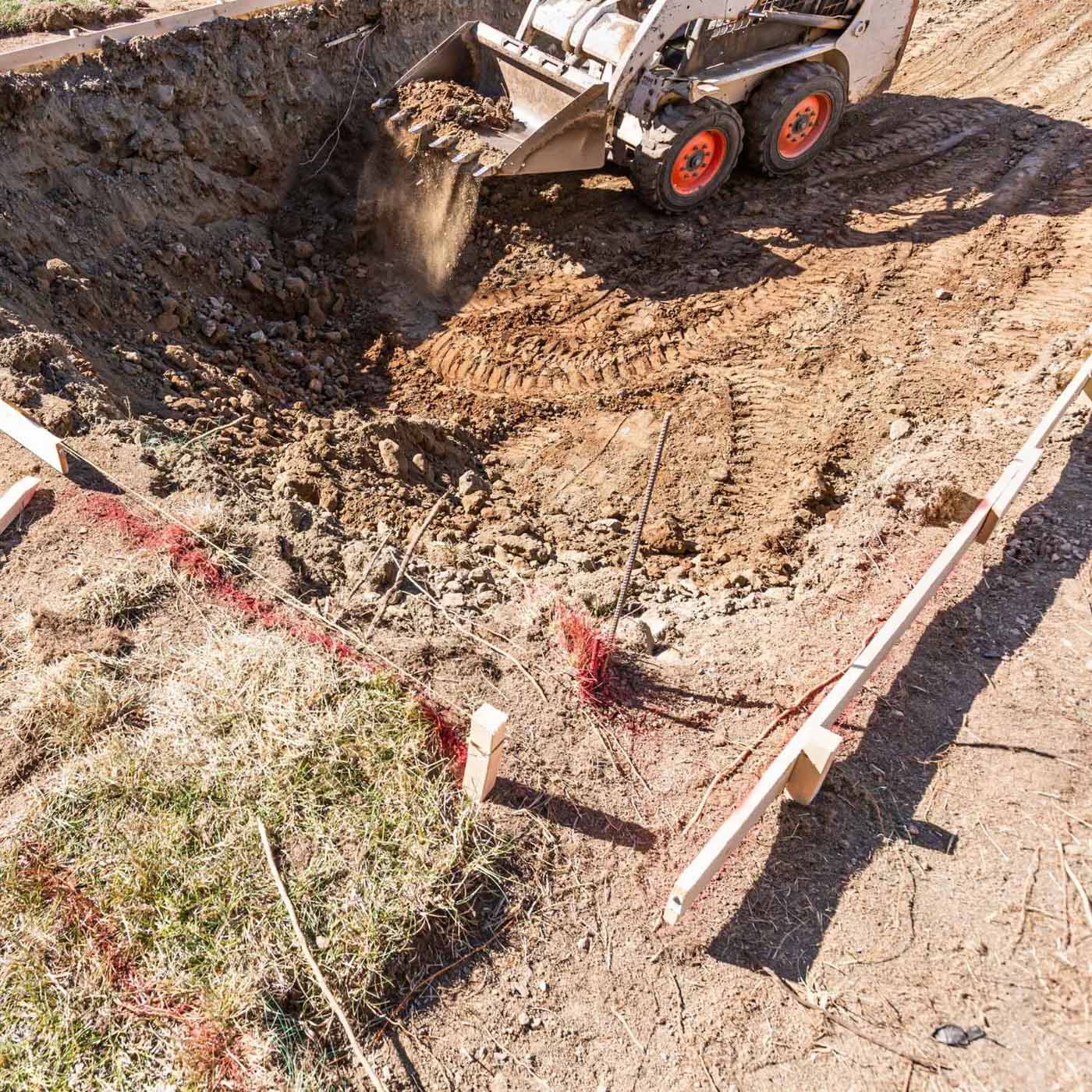
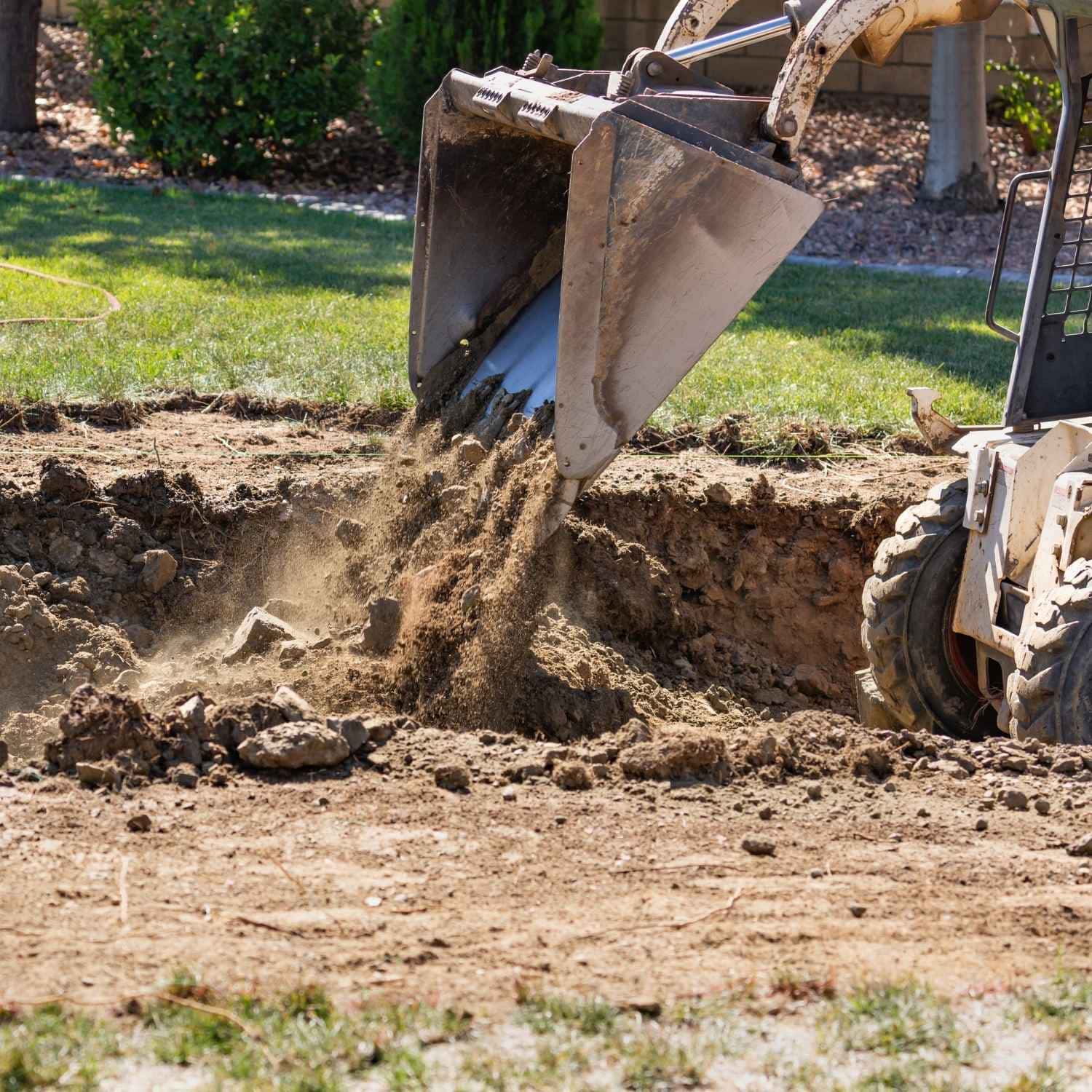
Once permits are in place, excavation and grading proceed in the correct sequence: dig to depth, establish proper drainage slope, compact the base, and verify that water moves away from the structure rather than toward it. If your project continues into a retaining wall, patio, or finished outdoor space, that work follows on the same job same team, no handoffs. The final result is a graded, stable, properly draining site that’s ready for whatever comes next, whether that’s a new patio or just a yard that finally works the way it should.
Ready to get started?
Most excavation contractors in this area including a few others based right here in Aston Township stop at the dig. They grade the lot and move on, leaving you to coordinate whoever comes next for the retaining wall, the drainage system, the patio, or the landscaping. We don’t work that way. The excavation is the foundation, and we build on it.
For Village Green-Green Ridge homeowners, the scope of work typically includes site excavation, land grading, drainage correction, and retaining wall construction often in combination. Homes built in the 1960s on small lots with clay soil and aging original grading don’t usually have just one problem. When the grading has failed, the retaining wall has usually shifted too, and the drainage has been compensating for both. Addressing it as a single project produces a better result than fixing each piece separately over several years.
Beyond the structural work, we also handle the finished outdoor layer: patios, outdoor kitchens, masonry, and landscaping. If your project starts with drainage and ends with a patio or outdoor living space, that entire sequence stays with one team. For lots ranging from 5,000 square feet to a quarter acre which covers most of Village Green-Green Ridge that kind of coordinated scope management matters. Less room for error, fewer people involved, and one person accountable for the finished result.
Yes and in Aston Township, that requirement applies to essentially all construction work, including excavation, grading, and retaining wall installation. Permits must be obtained from the Aston Township Building Code Department before work begins and posted on-site prior to the start of the job. Every inspection requires 48 hours advance notice to the township, so the sequencing of permit approval and inspection scheduling has to be planned into the project timeline from the beginning.
There’s one additional requirement worth knowing specifically: retaining walls four feet or higher in Aston Township require an engineered design as part of the permit application. This catches a lot of homeowners off guard, especially when they’re replacing an older wall that was originally built without one. Pennsylvania law also requires a PA One Call (811) before any digging starts it’s not optional, and it applies to residential projects just as much as commercial ones. We handle the permit process and the 811 call as part of every project, so you’re not left navigating Aston Township’s requirements on your own.
The most common cause in Village Green-Green Ridge is a combination of two things: clay-heavy soil that drains slowly, and original grading that has shifted over the decades. Most homes here were built in the 1950s through the 1970s, and the grading installed at that time has had 50 to 70 years to settle, compact unevenly, and change slope. What was once graded to direct water away from the foundation may now be doing the opposite sending runoff directly toward it.
Clay soil compounds the problem. Unlike sandy or loamy soils, clay absorbs water slowly, swells when saturated, and holds moisture long after the rain stops. When that clay is underneath a yard that no longer drains properly, water has nowhere to go except against your foundation or into low spots on the lot. The fix isn’t a sump pump that treats the symptom. The fix is regrading the lot to establish proper drainage slope, correcting any drainage infrastructure that’s failed, and in some cases installing a drainage system that moves water off the property entirely. That’s the kind of work that actually resolves the problem rather than managing it indefinitely.
Nationally, residential excavation averages around $3,975, with most projects falling somewhere between $1,600 and $6,700 depending on scope, soil conditions, and what the project requires beyond the dig itself. In the Philadelphia metro area which includes Delaware County labor rates run roughly 15 to 25 percent higher than the national average, and Delaware County carries a regional cost multiplier that reflects that. So for a Village Green-Green Ridge homeowner, budgeting toward the higher end of those ranges is realistic, particularly if drainage correction, retaining wall work, or finished outdoor construction is part of the project.
The factors that move the number most significantly are the condition of the soil (clay-heavy soil like what’s common in this part of Delaware County is harder to work with than sandy or mixed soil), the depth and scope of the excavation, and whether the project requires additional work like drainage system installation or engineered retaining wall design. The best way to get a real number is a site assessment the variables on a 5,000-square-foot lot in Village Green-Green Ridge are different enough from a larger suburban lot that a generic estimate won’t tell you much. We provide assessments based on what’s actually on your property, not a formula.
Spring and fall are the most active windows for excavation and grading work in Village Green-Green Ridge, and for good reason. Spring is when homeowners who dealt with basement flooding or drainage problems over the winter are most motivated to fix them and it’s also when the ground is workable again after the freeze. Fall is strong for the same reason in reverse: homeowners who want drainage issues corrected before the next winter rush to get it done before the ground freezes.
Summer is steady for site preparation tied to outdoor living projects patios, pools, outdoor kitchens because dry weather allows for better soil compaction and more predictable grading results. Winter excavation is possible but more difficult and more expensive, since frozen ground increases the effort required significantly. The practical takeaway: if you’re planning a spring project, the time to schedule is in the winter. Slots fill quickly once the ground thaws, and contractors who are actually good at this work in Village Green-Green Ridge don’t have open availability in April. Getting on the calendar in January or February is the difference between a spring start and a summer wait.
In many cases, yes and it’s often the most effective long-term solution for homes that were built before modern drainage codes. The majority of homes in Village Green-Green Ridge date to the 1950s through 1970s, and their original grading was installed to standards that didn’t anticipate decades of clay soil movement or current expectations for foundation water management. When that grading has settled or shifted, water that should be moving away from the foundation is instead pooling against it and no amount of interior waterproofing fully compensates for that.
Proper regrading establishes the correct slope away from the foundation on all sides of the home, which is the first and most important step. Depending on the severity of the issue, that may be paired with a drainage system a French drain, a channel drain, or a catch basin that intercepts surface and subsurface water before it reaches the foundation. The combination of corrected grade and functional drainage infrastructure addresses the cause rather than the symptom. It’s worth noting that this kind of exterior grading and drainage work is typically less expensive than interior waterproofing systems, and it doesn’t require ongoing maintenance the way a sump pump does.
Most don’t at least not the excavation-only contractors operating in this area. Companies like Scavo Solutions and M&C Enterprises, both based in Aston Township, specialize in excavation and grading but don’t carry retaining wall construction or drainage system installation as part of their scope. That means if your project involves all three which is common in Village Green-Green Ridge, where failing retaining walls, poor drainage, and settled grading tend to show up together on older properties you’re coordinating multiple contractors and hoping the handoffs go smoothly.
We handle excavation, grading, retaining wall construction, and drainage correction as a combined scope. On lots ranging from 5,000 square feet to a quarter acre, which describes most of the residential properties in Village Green-Green Ridge, that integration matters more than it would on a larger site. When the same team is responsible for the grade, the wall, and the drainage, there’s no gap between what one contractor finished and what the next one started and no one pointing fingers at each other when something doesn’t line up. One team, one scope, one result.
Useful Links
Other Services we provide in Village Green-Green Ridge