
Hear from Our Customers
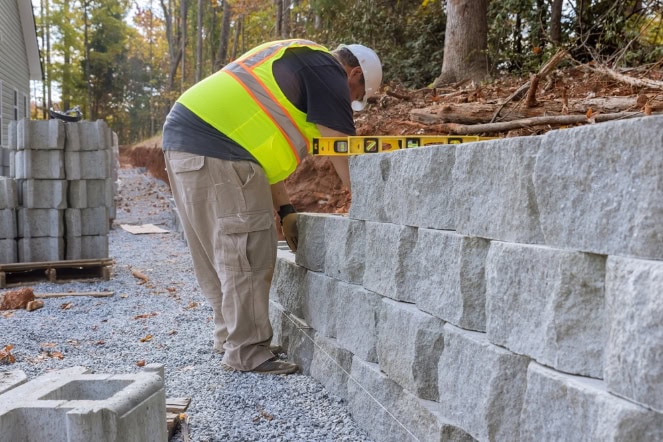
Most of the homes in Village Green-Green Ridge were built between 1940 and 1969. That means a lot of the retaining walls on these properties are pushing 50, 60, even 70 years old. Timber that’s been rotting quietly for a decade. Block walls that started bowing after a few hard winters. These aren’t cosmetic issues they’re structural ones, and they tend to get worse fast once the soil behind them starts moving.
The clay soil throughout southern Aston Township is one of the biggest factors here. Clay expands when it gets wet and contracts when it dries out, which puts constant cyclical pressure on any wall holding it back. Add in Delaware County’s freeze-thaw cycle dozens of hard freezes between November and March and you’ve got a wall that’s fighting a battle every single season. A wall that wasn’t built with that reality in mind won’t win that fight for long.
When a retaining wall is done right, the difference is immediate. You get a yard that doesn’t wash out after a heavy rain. You get usable flat space where there used to be a slope that collected leaves and did nothing. And you get a structure that isn’t going to need to be rebuilt in five years because someone skipped the drainage plan.
We’re based in Aston, PA the same township that governs Village Green-Green Ridge. That’s not a coincidence, and it’s not just a talking point. It means we know what Pennell Road looks like after a hard winter. We know what clay soil does to a wall that wasn’t properly backfilled. We know Aston Township’s Building and Code Department and what they require before a single block goes in the ground.
We hold active Pennsylvania contractor license PA057623 and carry a BuildZoom score of 102 placing us in the top 11% of over 125,000 licensed contractors in the state. More importantly, there are no subcontractors on your job. The same crew that walks your property and designs the drainage plan is the same crew that shows up every day until the wall is finished.
That matters in a community like Village Green-Green Ridge, where the work speaks for itself. Verified reviews on Yelp, Angi, and BuildZoom reflect what that model produces work that holds, communication that doesn’t disappear, and a contractor who’s still reachable after the job is done.
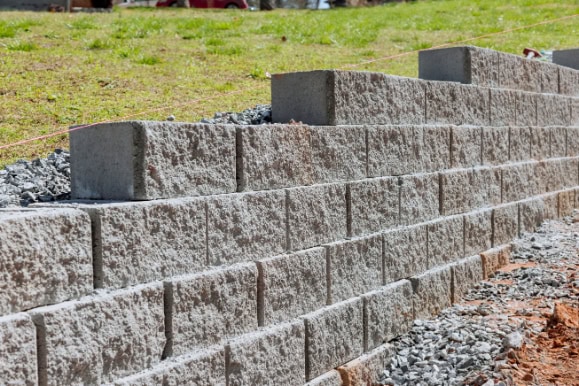
It starts with an on-site visit not a phone estimate, not a ballpark from photos. We walk the property, look at the slope, check the soil, and identify where the water is going when it rains. That last part matters more than most homeowners expect. Drainage isn’t a detail we add at the end it’s the first thing that gets planned, because a wall without a drainage strategy is just a future repair bill.
From there, you get a written quote that covers materials, labor, drainage components, and timeline. No vague ranges, no surprises when the invoice shows up. If your wall is four feet or taller, Aston Township requires an engineered design plan as part of the permit application and yes, a permit is required for every retaining wall in the township, not just the tall ones. That’s township ordinance, and it’s stricter than Pennsylvania’s statewide baseline. We handle the permit submission and coordinate the inspection so that piece doesn’t fall on you.
Installation follows a deliberate sequence: excavation, base preparation, drainage layer, block or stone placement, and backfill. Each stage is done before the next one starts. The site stays clean throughout. When the job is finished, you’re left with a wall that’s permitted, inspected, and built for the specific conditions on your property not a generic install that looked fine on the day it was done.
Ready to get started?
Not every retaining wall in Village Green-Green Ridge needs the same solution. A two-foot garden border on a flat side yard is a completely different project than a five-foot structural wall holding back a sloped driveway on a 1960s bi-level. Material choice, drainage design, and wall height all interact and getting that combination right is what separates a wall that lasts 30 years from one that needs to be rebuilt in five.
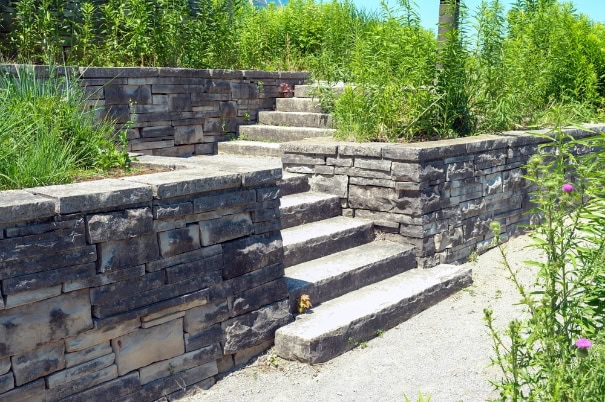
For most residential properties in this area, the options come down to a few proven materials. VERSA-LOK concrete block is one of the most practical choices for Delaware County’s climate it requires no frost footings, handles freeze-thaw cycles well, and allows for curves, corners, and steps without complicated framing. Natural stone is another strong option for properties where the aesthetic matters as much as the function; a properly built dry-stack stone wall can outlast the house it’s protecting. Boulder walls work well on larger slopes where the scale calls for something more substantial. Treated timber is the most affordable starting point, though it carries a shorter lifespan typically 10 to 20 years in Pennsylvania’s wet-dry cycles.
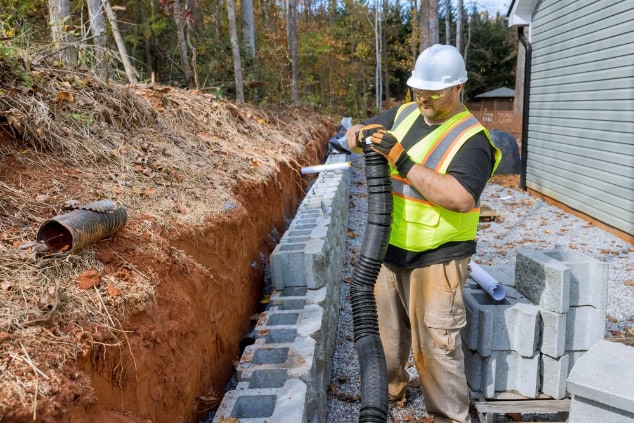
Every project we build includes drainage planning as a core component, not an add-on. Perforated pipe, gravel backfill, and weep holes are part of how we build the wall not upgrades you negotiate for. For Village Green-Green Ridge homeowners dealing with aging hardscape on properties that have more than doubled in value since 2000, that kind of build quality is what protects the investment you’ve already made.
Yes and this is one area where Aston Township is stricter than you might expect. Under township ordinance § 1420.06, a permit is required for all retaining wall construction in Aston Township, regardless of height. Pennsylvania’s statewide building code would exempt walls under four feet from the permit requirement, but Aston Township’s local ordinance overrides that baseline. Every wall needs township approval before work begins.
If your wall is four feet or taller, there’s an additional requirement: the permit application must include an engineered design plan sealed by a licensed professional. That means you’ll need a structural engineer involved in the planning process, not just a contractor with a good eye. We handle the permit submission and coordinate with the township’s Building and Code Department so that process doesn’t become your problem to manage. Going without a permit isn’t just a code violation it can create serious complications when you sell the property.
Retaining wall costs in Village Green-Green Ridge typically range from around $40 to $345 per linear foot, depending on the material, wall height, site conditions, and how much drainage work is involved. Most residential projects in Delaware County come in somewhere between $3,500 and $10,000, though larger structural walls or projects requiring engineered plans will run higher.
The biggest variables are material and drainage complexity. A VERSA-LOK block wall on a straightforward slope costs less than a natural stone wall on a site with significant water management challenges. Properties in Village Green-Green Ridge especially those with clay-heavy soil and older drainage infrastructure sometimes require more extensive gravel backfill and piping than a newer property would. The only way to get an accurate number is an on-site visit, where the actual slope, soil, and drainage situation can be evaluated. Phone estimates in this category tend to be unreliable.
For Delaware County’s freeze-thaw conditions, the materials that perform best are those that don’t rely on mortar joints or rigid connections that crack under frost pressure. VERSA-LOK concrete block is a strong choice specifically because it uses a pinning system rather than mortar, and it doesn’t require frost footings which matters when the ground is cycling between frozen and thawed dozens of times between November and March.
Natural dry-stack stone performs well for the same reason no mortar means no mortar joints to crack. A properly built dry-stack stone wall has flexibility built into its structure, which allows it to absorb minor soil movement without failing. Poured concrete and mortared block walls can work, but they’re more vulnerable to cracking when clay soil shifts. Treated timber is the most affordable option but has the shortest lifespan in Pennsylvania’s wet climate expect 10 to 20 years before replacement becomes necessary. The right answer depends on your wall’s height, load, and location on the property.
The honest answer is that most walls on properties in Village Green-Green Ridge that are showing visible problems have already been declining for longer than they look. Leaning, cracking, bulging, or soil washing through gaps are late-stage symptoms by the time you can see them clearly, the drainage failure or structural compromise that caused them has usually been building for years.
A wall that’s leaning more than one inch for every four feet of height is generally considered beyond repair by most engineering standards. Timber walls that are soft, splintering, or pulling away from the soil are past the point of patching. Block walls with significant bowing or horizontal cracking through multiple courses typically need to come out rather than be reinforced. The most useful thing you can do is have someone walk the wall and look at what’s happening behind it not just at the face. Water staining, soil displacement, and root intrusion behind the wall tell a clearer story than the surface does.
Drainage is the single most important factor in how long a retaining wall lasts, and it’s also the part that gets skipped most often when someone is trying to cut costs. When water builds up in the soil behind a wall, it creates hydrostatic pressure lateral force that pushes against the wall from behind. That pressure can generate thousands of pounds of force against a structure that was only designed to handle the weight of the soil itself. The wall doesn’t fail all at once; it bows gradually, then cracks, then goes.
Proper drainage means a few specific things in practice. A layer of clean gravel directly behind the wall gives water a path to move rather than accumulate. Perforated pipe at the base of that gravel layer collects the water and routes it away from the wall. Weep holes at regular intervals through the wall face provide pressure relief when water does build up. In Village Green-Green Ridge, where clay soil holds water rather than letting it drain naturally, these components aren’t optional extras they’re what makes the difference between a wall that holds for 30 years and one that needs to be rebuilt in eight.
It can and for properties in Village Green-Green Ridge, the math is pretty straightforward. Median home values in the area have gone from around $131,600 in 2000 to over $331,000 today. That appreciation means homeowners here are sitting on significantly more equity than they were two decades ago, and a functional, well-built retaining wall protects that equity in a couple of concrete ways.
First, it prevents the kind of slope erosion and drainage damage that quietly degrades a property’s condition and shows up as a problem during a home inspection. Second, a wall that converts an unusable backyard slope into a level, functional outdoor space adds real square footage to how the property lives and appraisers recognize that. Property appraisers estimate returns of 100 to 200 percent on well-designed retaining walls, meaning a $7,000 wall investment can reasonably add $14,000 or more in appraised value. For a homeowner who’s been in their Village Green-Green Ridge property for 15 or 20 years, that’s not a small consideration it’s a meaningful return on a project you’d probably want done anyway just to stop the erosion.
Useful Links
Other Services we provide in Village Green-Green Ridge