
Hear from Our Customers
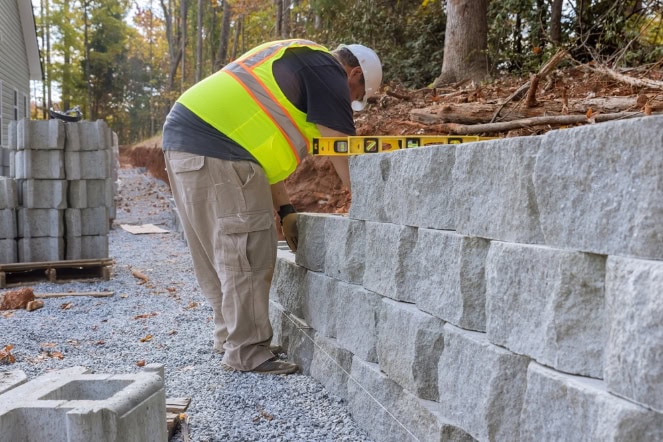
Most retaining walls don’t fail because of bad materials. They fail because nobody thought about what happens when water builds up behind them. In Prospect Park, that’s not a minor detail Delaware County’s clay-heavy soil holds moisture, expands under pressure, and then freezes. Do that for ten or twenty winters and even a decent wall starts to bow, crack, and shift. When drainage is engineered into the wall from the beginning, that cycle stops doing damage.
Prospect Park’s housing stock is mostly mid-century a lot of homes here were built in the 1920s through the 1950s, and the original retaining walls that came with them are well past their intended lifespan. Railroad tie walls rot from the base up. Old concrete block walls crack and separate. If you’ve been patching the same wall for a few years, you already know it’s only a matter of time. A properly built replacement gives you 30 to 100-plus years depending on the material and it won’t need to be touched again.
The other thing that changes is your yard itself. A lot of Prospect Park lots are small, and a sloped or eroded section can eat up a meaningful chunk of usable space. Once that grade is stabilized and leveled, you get that space back room for a patio, a garden, a flat lawn, or just a yard that doesn’t wash out every spring.
We’re based in Aston, PA connected to Prospect Park directly via I-95 and PA Route 420, which runs right through the borough. This isn’t a regional company routing calls through a dispatch center. We’re a local Delaware County operation, and you’ll talk to Renato Spennato from the first call through the final walkthrough.
The same crew that assesses your property is the crew that builds your wall. No subcontractors, no handoffs, no wondering who’s actually going to show up. We hold an active Pennsylvania contractor license (PA057623) and carry a BuildZoom score of 102 ranking in the top 11% of over 125,000 licensed contractors statewide. That’s a verifiable credential, not a marketing claim.
If something comes up after the job is done, you have a direct line to the person who built it. That’s not a standard you’ll find across the board in this industry and if you’ve dealt with a contractor who went quiet after completion, you already know why it matters.
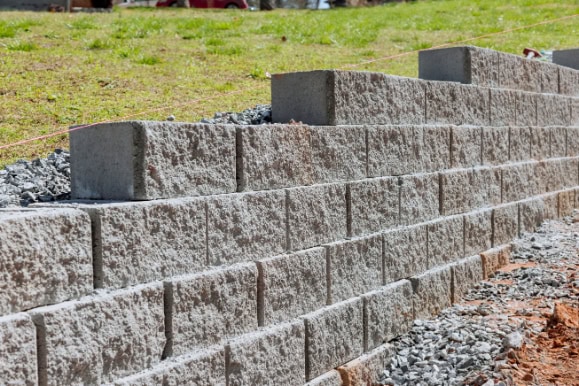
It starts with an on-site visit not a phone estimate, not a ballpark based on square footage. We come to your property, look at the slope, read the drainage patterns, check the soil conditions, and talk through what you’re trying to accomplish. That assessment is what makes the quote accurate and the build right. Skipping it is how projects go sideways.
From there, the design and material selection happen together. For Prospect Park properties, that conversation always includes drainage specifically, how water is going to move away from the wall and off your property without redirecting onto your neighbor’s. In a dense borough with small lots, that matters more than people realize. The right material whether that’s concrete block, natural stone, boulders, or a VERSA-LOK segmental system gets selected based on the actual demands of your site, not just what’s easiest to install.
Before any work starts, we handle the permit side. In Prospect Park, walls under four feet generally fall below the state’s building permit threshold, but the borough has its own zoning review process, and anything over four feet requires a full building permit with a scaled plot plan submitted to the borough. Getting that wrong can mean fines, forced removal, or complications when you go to sell. Once permits are in order, the build follows a clear timeline and you’ll know what that timeline is before the first shovel goes in the ground.
Ready to get started?
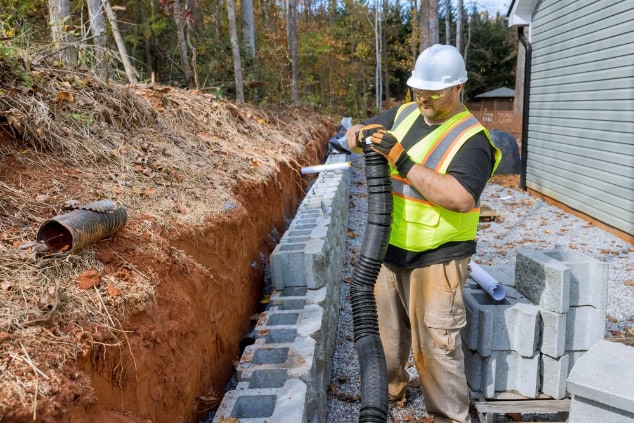
Every retaining wall we build starts with drainage gravel backfill and perforated drainpipe installed behind the wall to relieve hydrostatic pressure before it becomes a structural problem. In Delaware County’s climate, with 42 inches of annual rainfall and a freeze-thaw cycle that runs from November through March, that’s not optional. It’s the difference between a wall that lasts decades and one that needs to be rebuilt in five years.
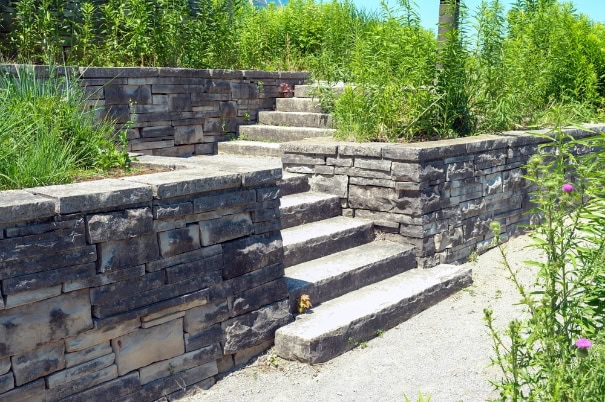
Material selection is matched to the job. Concrete block walls carry a 30 to 50-plus year lifespan and work well for most residential applications. Natural stone runs 40 to 100-plus years and suits properties where aesthetics are a priority alongside function. Boulder walls handle significant grade changes and heavy loads. VERSA-LOK segmental systems offer design flexibility for walls with curves, corners, stairs, or columns and they don’t require frost footings, which simplifies installation on tighter Prospect Park lots where access and space are limited.
For homeowners in the Interboro School District communities Prospect Park, Glenolden, Norwood, and Tinicum the terrain and soil conditions are consistent across all four boroughs, and we work across all of them. If you’re replacing an old railroad tie wall, dealing with a slope that’s been losing soil for years, or building something new to reclaim usable yard space, the process and the standards are the same: drainage first, right material for the site, built to last.
At the state level, Pennsylvania generally exempts retaining walls under four feet in height from building permits measured from the lowest grade to the top of the wall. But Prospect Park Borough has its own zoning review process, and that applies regardless of height. Any wall over four feet requires a full building permit, and the borough requires a written application with a scaled plot plan showing the size and location of the structure on your property.
Getting this wrong has real consequences. Building without the right approvals can result in fines, a stop-work order, or a forced removal and it can create complications when you go to sell the property. We navigate the permit process as part of every project. You don’t have to figure out which form goes to which office or whether your wall height triggers additional review. That’s handled before the first shovel goes in the ground.
Retaining wall costs vary significantly depending on height, material, length, and drainage requirements and the range is wide. Nationally, costs run from around $40 to $345 per linear foot. For a typical residential project in Prospect Park something like a concrete block wall 25 feet long and four feet high the average lands around $5,000 to $6,000, though more complex builds with natural stone or significant drainage work will run higher.
What drives price up most consistently is height and drainage complexity. A taller wall requires more material, deeper excavation, and more robust drainage engineering. In Delaware County, where clay soil and annual rainfall create persistent hydrostatic pressure, skipping or underbuilding the drainage system to save money upfront usually leads to a failed wall within a few years and reconstruction costs of $3,000 to $8,000 or more. Getting the drainage right the first time is where the real cost savings are over the life of the wall.
The most common cause of retaining wall failure is poor or absent drainage. When water builds up behind a wall and has nowhere to go, it creates hydrostatic pressure and that pressure pushes outward. In Prospect Park and throughout Delaware County, clay-heavy soil compounds the problem because it holds moisture instead of letting it drain, and it expands and contracts with every freeze-thaw cycle. A wall without proper drainage behind it is fighting that pressure every winter with no relief.
The signs that a wall is past its useful life are usually visible: leaning or bowing in the face of the wall, cracks running horizontally across the blocks or stones, gaps opening between sections, or soil actively washing out from behind or beneath the wall. For Prospect Park homes built in the 1920s through 1950s, original railroad tie walls are especially vulnerable they rot from the base up, and by the time the damage is obvious on the surface, the structural integrity is already compromised. If your wall is showing any of these signs, a repair may buy time, but a full assessment will tell you whether replacement is the more cost-effective path.
For Delaware County’s climate which includes heavy spring rainfall, clay soil that retains moisture, and a freeze-thaw cycle that runs from November through March material selection matters a lot. Natural stone is the longest-lasting option, with a lifespan of 40 to 100-plus years when properly installed and drained. It handles freeze-thaw stress well and doesn’t degrade the way organic materials like railroad ties do over time.
Concrete block and VERSA-LOK segmental systems are strong performers in this climate as well, with lifespans of 30 to 50-plus years. VERSA-LOK systems are particularly useful on Prospect Park lots where space is tight, because they can handle curves, corners, stairs, and columns without frost footings, which simplifies installation. Boulder walls are a good fit for significant grade changes and heavy load applications. The material that’s right for your property depends on the specific height, drainage requirements, and site conditions not just which option looks best in photos.
For a typical residential retaining wall project a straightforward installation with standard drainage work the build itself usually takes two to five days on-site. Larger projects, walls with significant height, or installations involving stairs, corners, and columns will take longer. The bigger variable is usually the lead time before the build starts, not the build itself.
In Delaware County, spring is the busiest season for retaining wall work freeze-thaw damage becomes visible after winter, and homeowners are ready to move on repairs and new installations. Quality contractors in the area typically book four to eight weeks out during peak season, which means homeowners who wait until May or June to call are often looking at a late summer start. If you’re planning a project for spring or early summer, getting the on-site assessment done in late winter puts you ahead of that backlog. We set a clear timeline at the design meeting, so you know the schedule before any work is committed.
Yes and the return is more straightforward than most home improvement projects. Property appraisers generally estimate a 100 to 200 percent return on investment for well-designed, professionally installed retaining walls, because they solve a real structural problem while also adding usable outdoor space. In Prospect Park, where median home values have climbed from under $100,000 in 2000 to over $264,000 today, protecting and building on that equity with durable hardscaping is a sound investment.
The practical value is also worth considering on its own terms. Prospect Park lots are small the entire borough covers less than a square mile and houses nearly 6,500 residents. A sloped or eroded section of yard can represent a significant percentage of your total outdoor space. A retaining wall that stabilizes that grade and creates a flat, usable surface gives you back room that was effectively lost. Whether that becomes a patio, a garden bed, or just a lawn that doesn’t wash out every spring, the functional improvement is immediate. And when it comes time to sell, a structurally sound yard with proper drainage and professionally built hardscaping is a visible, appraiser-recognized asset.
Useful Links
Other Services we provide in Prospect Park