
Hear from Our Customers
When water sits in your yard for days after a storm, it’s not just an eyesore it’s pressure building against your foundation. In Lower Chichester, where most homes were built between the 1900s and 1930s, that kind of persistent moisture finds its way into basements, crawl spaces, and wall systems that were never designed to handle modern stormwater loads. A properly installed drainage system changes that. Water moves away from your home the way it should, and you stop holding your breath every time the forecast calls for rain.
The flat coastal plain terrain that runs through this part of southern Delaware County makes drainage genuinely harder than it is in hillier parts of the region. There’s no natural grade doing the work for you. That means any drainage solution here has to be engineered not just a trench with some pipe thrown in, but a system with correct slope, the right discharge point, and grading that actually supports it. When that’s done right, you get a yard that drains, a foundation that stays dry, and outdoor space you can actually use again.
The long-term math matters too. Foundation repairs in this area run $10,000 to $30,000 or more. A drainage system that prevents that damage isn’t an expense it’s one of the smarter investments you can make in a home you’ve put years into.
We’re based in Aston, PA right next door to Lower Chichester. We’ve been working in this part of Delaware County for over 15 years, on properties that look a lot like yours: older homes, flat lots, soil that holds water longer than it should, and drainage systems that were either never installed correctly or have been failing quietly for decades.
We’re not a regional chain dispatching crews from two counties away. When we show up in Lower Chichester or anywhere else in the Chichester corridor, we already know what the ground does here after a heavy rain. We know how Pennsylvania’s freeze-thaw cycles affect drainage pipe buried in this soil. And we know that a house built in the 1920s has different needs than a new construction project which means the solution has to fit the property, not just the textbook.
One crew handles your job from the first assessment to the final grade. No subcontractors, no handoffs, no one showing up who doesn’t know what was agreed on.

Before any digging starts, we assess your property. That means reading how water actually moves across your lot where it pools, where it’s coming from, and what’s causing it to stay. In Lower Chichester, that assessment almost always involves looking at both the drainage infrastructure and the grade, because flat coastal plain terrain means the two problems are usually connected. If the slope around your home is directing water toward the foundation, a French drain alone won’t fix it.
Once we understand what’s actually going on, we design a solution around that. That might be a French drain with a corrected grade, a catch basin at the true low point of your yard, a dry well, or a combination. We pull any required permits through Lower Chichester Township, handle the 811 utility locate before any excavation begins, and make sure the discharge point for your system is compliant with the township’s stormwater requirements. These aren’t extras they’re standard practice on every job.
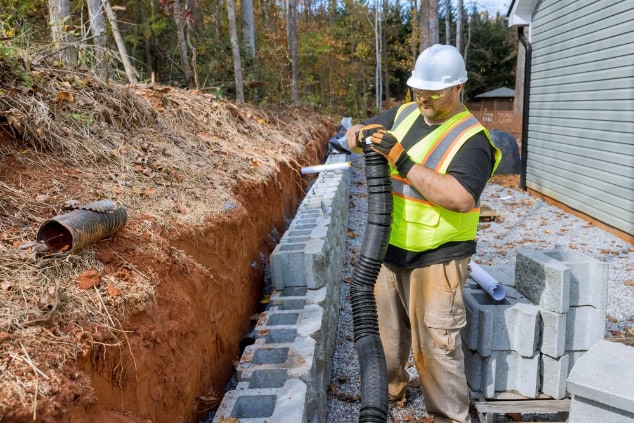
Installation is clean and deliberate. We use proper pipe bedding, the right burial depth for Pennsylvania winters, and quality materials that hold up through freeze-thaw cycles not just the first few seasons. When the work is done, your yard is restored. You shouldn’t be able to tell we were there except that the water is gone.

Ready to get started?
We handle the full range of residential drainage work French drain installation, catch basin placement, dry well systems, surface regrading, downspout drainage, and combinations of all of the above. What you get depends entirely on what your property needs, and that starts with an honest assessment, not a menu of upsells.
For most homes in Lower Chichester, the drainage conversation starts with grade. Homes built in the 1900s through the 1930s have settled over decades, and the original grading if it was ever done to standard has shifted. Water that should be moving away from your foundation is often moving toward it instead. Correcting that grade is frequently the most important part of the job, and it’s something a lot of contractors skip because it takes more work than dropping a drain line.
Every drainage system we install is built for this region’s climate. That means pipe bedding and burial depth that account for Pennsylvania freeze-thaw, materials that don’t degrade in the ground after a few winters, and discharge points that don’t just push your water problem onto a neighboring property or into a non-compliant outlet. Lower Chichester Township participates in Pennsylvania DEP’s stormwater permit program, and we design every system with that in mind. The goal is a drainage solution that works long-term and doesn’t create new problems down the road.

The most common reason is the terrain itself. Lower Chichester sits on the coastal plain near the Delaware River flat, low-elevation ground where water doesn’t have anywhere to go naturally. Unlike properties on a slope where gravity moves water away, flat yards here require engineered drainage to function. When that infrastructure isn’t there, or when it’s failed over time, water just sits.
The other factor in this area is soil. Coastal plain soils tend to be clay-heavy and slow to drain, which means even a moderate rainstorm can leave standing water that takes days to absorb. If your yard has both flat terrain and clay-dense soil which describes a lot of properties in Lower Chichester standing water after rain is almost inevitable without a proper drainage system in place. A site assessment will tell you exactly what’s driving it on your specific lot.
The honest answer is that you usually need both a diagnosis and someone who can do more than one thing. A contractor who only installs French drains is going to recommend a French drain. A contractor who assesses the full picture grade, soil, water source, discharge options is going to recommend what actually fits.
In Lower Chichester specifically, many properties need grading work before or alongside any drain system. If the land around your foundation is sloping toward the house, a French drain will manage some of the water, but it won’t fix the underlying grade problem. On the other hand, some properties just need a well-placed catch basin or a corrected downspout discharge not a full French drain system. The only way to know is to have someone walk the property and read it before recommending anything.
It depends on the scope of the work, but drainage projects that involve significant excavation or changes to how stormwater flows on your property typically require a building permit through Lower Chichester Township. The township also requires contractors to be registered before performing any work there’s a formal registration process with a fee that’s renewed annually.
Beyond the township-level requirements, Pennsylvania law requires a Call 811 utility locate before any digging begins. Skipping that step risks hitting buried utility lines, which creates real liability for homeowners who hire unregistered or non-compliant contractors. When we work in Lower Chichester, we handle the contractor registration, permit applications, and utility locating as part of the standard process not as add-ons. You shouldn’t have to chase that paperwork yourself.
For a residential French drain installation in this area, most homeowners are looking at somewhere between $5,000 and $9,000 depending on the length of the drain run, how much excavation is involved, what the discharge situation looks like, and whether any grading work needs to happen first. More complex projects longer runs, multiple catch basins, significant regrading can push higher.
What’s worth understanding is what you’re comparing that cost against. Foundation repairs in this region typically run $10,000 to $30,000 or more, and that’s before you factor in basement waterproofing, mold remediation, or landscaping damage from chronic water intrusion. For a home in Lower Chichester that’s already 90 to 100 years old, protecting the foundation from ongoing water pressure isn’t optional maintenance it’s how you preserve the value of a property you’ve invested in for years. A site visit gives you a real number for your specific situation.
Yes if it’s installed correctly for this climate. That’s the important qualifier. Drainage systems that aren’t properly bedded, buried at the right depth, or built with materials rated for freeze-thaw conditions can shift, crack, or fail when the ground freezes and thaws through a Pennsylvania winter. It’s one of the most common reasons drainage systems installed by less experienced contractors stop working within a few years.
In Lower Chichester and the broader southern Delaware County area, freeze-thaw cycles are a real stressor. Water that pools near foundations in late fall can freeze against the structure, and drainage pipe without proper gravel wrap or bedding can heave out of position when the ground moves. We install every drainage system with burial depth, bedding, and materials appropriate for this region’s winters not just the spring and fall rainy seasons. A system installed this way should give you years of reliable performance, not a callback the following March.
It can, and in older homes it usually does it’s just a slow process that’s easy to ignore until it becomes expensive. Water that consistently sits within a few feet of a foundation creates hydrostatic pressure against the walls. Over time, that pressure causes basement seepage, wall cracks, and in more advanced cases, structural shifting. For homes in Lower Chichester built in the early 1900s through the 1930s, the original foundation materials often stone, brick, or early-era concrete weren’t designed with modern drainage standards in mind, which makes them more vulnerable to this kind of long-term water exposure.
The visible signs usually come later: efflorescence on basement walls, damp spots after rain, a musty smell that won’t go away, or hairline cracks that slowly widen. By the time those show up, the water has already been working on the structure for a while. Addressing the drainage before those signs appear is significantly less expensive than addressing the foundation damage after. If you’re seeing standing water in your yard regularly, it’s worth having someone assess whether it’s reaching your foundation and what it would take to stop it.
Useful Links
Other Services we provide in Lower Chichester