
Hear from Our Customers
A lot of homes in Lower Chichester were built in the early 1900s worker cottages and row houses with backyards designed for utility, not living. If yours has never been touched, you’re not alone. And the good news is that a well-designed patio on a compact lot can completely change how you use that space a real place to sit outside in the evening, host a cookout, or just decompress after a long day.
The challenge in Lower Chichester specifically is the climate. Southeastern Pennsylvania sees 40 or more freeze-thaw cycles every year, and the closer you are to the Delaware River corridor, the more moisture and drainage pressure your ground absorbs. That’s why patios installed without adequate base depth or proper drainage slope don’t last. The surface looks fine in year one and starts heaving by year three.
When it’s done right, you get a patio that stays level, drains correctly, and doesn’t require you to call someone every spring to fix what shifted over winter. That’s the outcome not just a nice-looking yard, but one that holds up and stays that way.
We’re based in Aston, PA a few miles up the road from Lower Chichester, in the same southern end of Delaware County. This isn’t a Main Line contractor who added Lower Chichester to a dropdown. Renato Spennato has been doing this work in this part of the county for over 15 years, and the soil conditions, drainage challenges, and older housing stock down here near Marcus Hook are exactly what our team works with every season.
One team handles your project from start to finish no rotating subcontractors, no gaps in accountability. You know who’s on your property. You have one person to call. In a community like Lower Chichester, that kind of consistency matters more than any sales pitch.
It starts with a conversation about how you actually use your yard not a template walkthrough, but a real look at your space, your lot size, and what you want out of it. For a lot of Lower Chichester properties, that means working with a compact footprint and older landscaping, which shapes everything from the patio dimensions to the material choice. Once the design makes sense, you get a clear scope and a real timeline before anything starts.
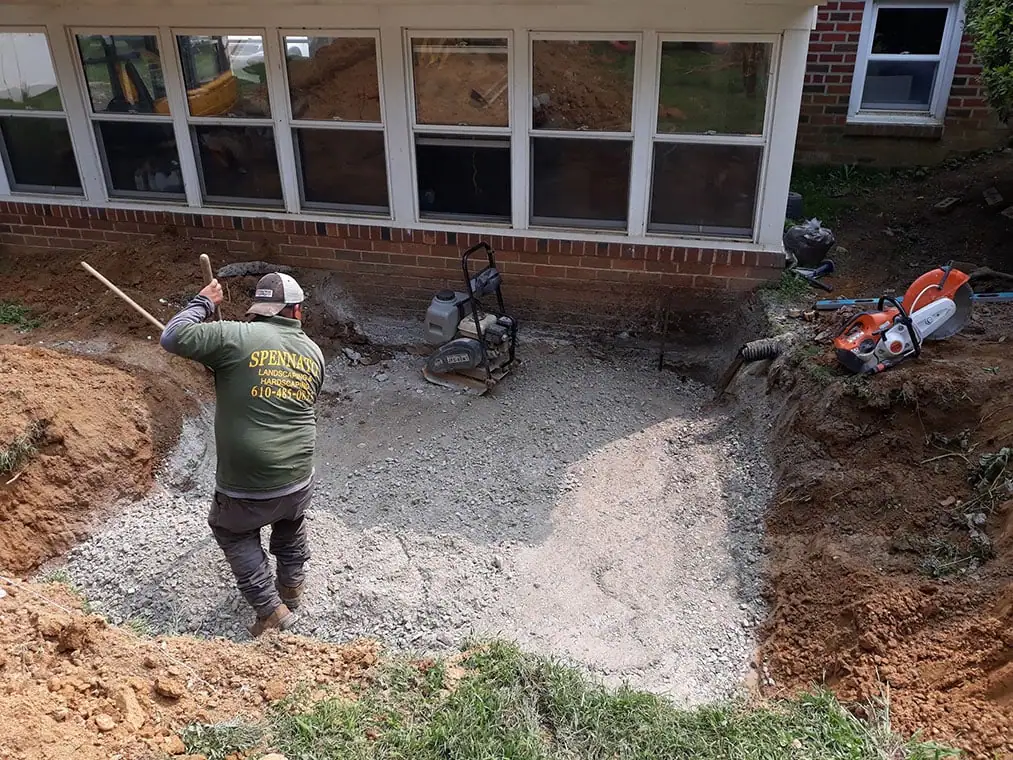
From there, our crew handles excavation, base preparation, and drainage the work you won’t see once it’s done but that determines whether your patio lasts five years or thirty. In a frost-area like southeastern Pennsylvania, the aggregate base needs to be the right depth and properly compacted. That step doesn’t get rushed. Depending on the scope of your project, Lower Chichester Township may require a permit, particularly for larger installations or any covered structures. We walk you through that before work begins not something you find out about after the fact.
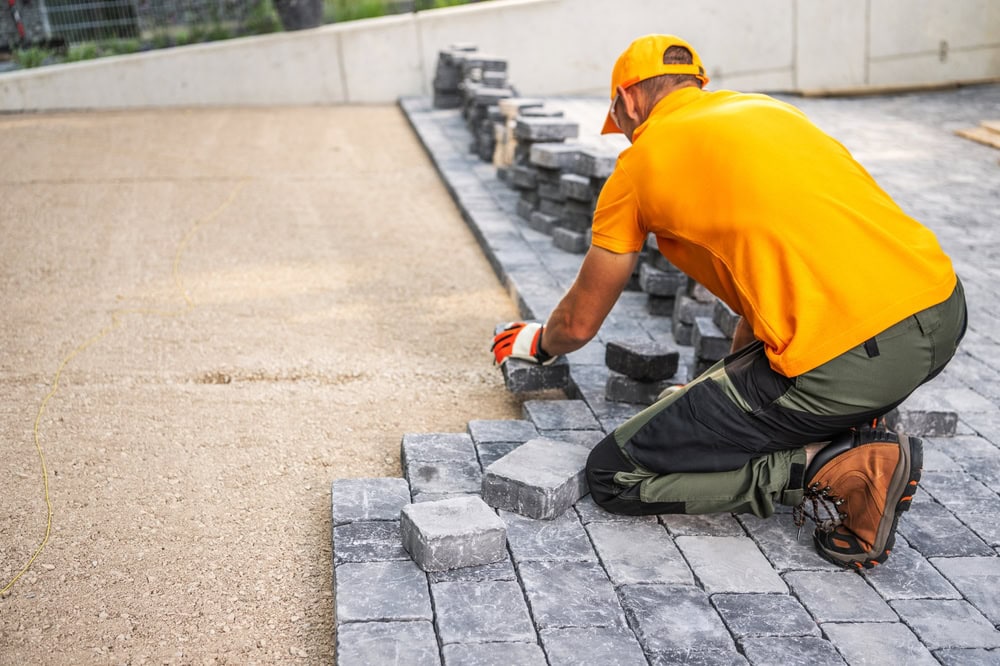
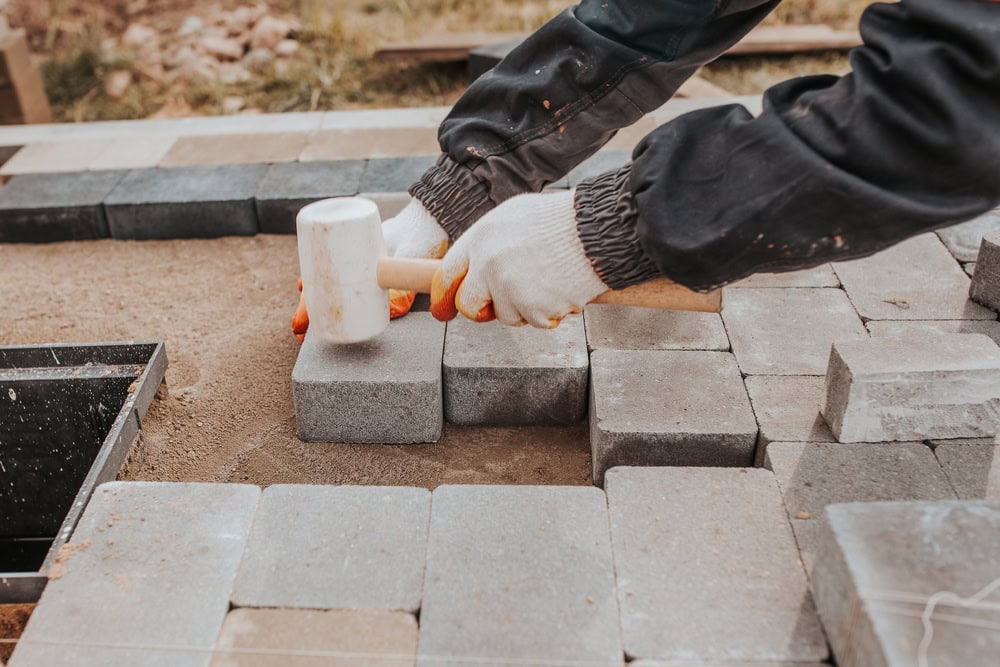
The surface goes in last, whether that’s concrete pavers, Pennsylvania Bluestone, stamped concrete, or another material that fits your yard and your budget. Final cleanup happens before the crew leaves. What you’re left with is a finished patio and a yard that looks like the project was done with care because it was.
Ready to get started?
We work with concrete pavers, natural flagstone and Pennsylvania Bluestone, and stamped or poured concrete and the right choice depends on your yard, your budget, and how much maintenance you actually want to deal with. Pavers are the most durable option for Pennsylvania’s climate: if one shifts or cracks, it can be replaced individually without tearing up the whole surface. For older Lower Chichester homes, natural stone tends to complement the character of the property better than modern concrete options, though stamped concrete is a solid choice when budget is a real factor.
Pricing runs $15 to $50 per square foot, with most residential projects in the $3,500 to $12,000 range. For the compact lots common in Lower Chichester, a well-proportioned 150 to 250 square foot patio often hits the sweet spot enough space to be genuinely useful without overwhelming the yard. Smart layout choices matter more on a tighter lot, and that’s part of what the design conversation covers.
If you’re thinking about a covered patio a pergola or attached shade structure that’s a natural extension of the project and something we can incorporate into the plan. Covered structures attached to the home will require a building permit in Lower Chichester Township, and we handle that as part of the process, not left for you to figure out on your own.

The honest range is $15 to $50 per square foot, with most residential patio projects in Lower Chichester falling somewhere between $3,500 and $12,000. Where you land in that range depends on the size of the patio, the material you choose, and what the site preparation requires things like drainage corrections or working around existing landscaping on an older Lower Chichester property.
For the compact lots that are common here, a 150 to 200 square foot patio is often the right size enough to be functional without dominating the yard. Pavers tend to sit in the middle to upper end of the cost range, while stamped concrete is typically more affordable upfront. That said, pavers hold up better through Pennsylvania’s freeze-thaw cycles and can be repaired individually, which affects the long-term cost picture. The best way to get an accurate number is a site walkthrough.
For southeastern Pennsylvania’s climate which includes 40-plus freeze-thaw cycles per year and the added moisture exposure that comes with being close to the Delaware River concrete pavers are the most durable surface option. They’re installed as individual units, which means the surface can flex slightly with ground movement instead of cracking the way poured concrete does. And if a paver does shift or chip, it can be swapped out without touching the rest of the patio.
Natural flagstone and Pennsylvania Bluestone are also excellent choices for freeze-thaw conditions and tend to suit the character of older Lower Chichester homes well. The key with any material is what’s underneath it a properly compacted aggregate base at the right depth for a frost area is what actually determines whether the patio stays level over time. The surface is what you see. The base is what makes it last.
It depends on the scope of the project. For a standard ground-level patio pavers, flagstone, or concrete laid in the yard a permit may or may not be required depending on the size and whether it affects stormwater drainage on your property. Lower Chichester Township enforces Pennsylvania’s Uniform Construction Code, and larger installations or projects that alter grading are more likely to trigger permit requirements.
If you’re adding a covered structure a pergola or a shade structure attached to the house that almost always requires a building permit in Pennsylvania municipalities. Setback requirements from your property lines also apply and are governed by the township’s zoning ordinance. These aren’t obstacles; they’re just part of doing the project correctly. We review permit requirements before work starts and handle the process so you’re not navigating township paperwork on your own.
The short answer is base failure. When pavers sink, shift, or become uneven after winter, it almost always traces back to what was done or not done underneath the surface before installation. A properly installed patio in a frost area like Lower Chichester requires adequate excavation, a compacted aggregate base at the right depth, and a drainage slope that moves water away from the surface and away from the home’s foundation. When any of those steps are cut short, water gets into the base, freezes, expands, and pushes the surface up.
This is the most common failure mode for patios in southeastern Pennsylvania, and it’s entirely preventable with proper base preparation. The problem is that base work happens underground you can’t see it after the job is done, which is why it’s also where shortcuts are easiest to hide. Asking a contractor specifically about their base depth and compaction process before you hire them is a reasonable and worthwhile question.
Smaller yards are actually where good design matters most. A compact lot doesn’t mean a cramped or disappointing patio it means the layout has to be intentional. For a typical Lower Chichester backyard, a 150 to 250 square foot patio is usually enough to fit a table and chairs, a small seating area, and room to move around without the patio taking over the entire yard.
A few things make a real difference in a smaller space: defining a clear edge with a border course of contrasting pavers or stone gives the patio a finished, purposeful look. Keeping the shape simple a rectangle or gentle curve rather than a complicated multi-level design tends to work better on compact lots. Material choice matters too: natural stone like Pennsylvania Bluestone has a character that suits older homes and smaller spaces without feeling out of scale. If you want to extend usability into spring and fall, a simple pergola overhead can do a lot without adding much footprint.
For a standard residential patio in Lower Chichester say, 200 square feet of pavers or flagstone the actual installation typically takes two to four days once the project is scheduled and materials are on-site. Larger patios, more complex designs, or projects that require significant grading or drainage work can take longer, but most backyard patios in this area fall within that range.
The part that takes longer is the lead time before installation starts. Spring and early summer are the busiest scheduling windows, and crews book up quickly from April onward. Homeowners who reach out in late winter January or February tend to get better scheduling access and more flexibility on timing. If you’re planning around a specific date, like a summer gathering or a family event, building in that lead time is the practical move. Fall installations are also possible in southeastern Pennsylvania, but they should wrap up by mid-October to give the base adequate time to set before the first hard freeze.
Useful Links
Other Services we provide in Lower Chichester