
Hear from Our Customers

When drainage works the way it should, you stop watching the sky every time a storm rolls in. No more standing water sitting for days, no more muddy patches where grass used to grow, no more wondering whether that wet corner near your foundation is something to worry about. You just have a yard that functions and a home that’s protected.
That matters more in Haverford than most people realize. A significant portion of the township’s housing stock was built between the 1920s and 1950s, long before modern stormwater standards existed. The grading that worked when your home was built has had decades to shift, settle, and get altered by landscaping changes, tree removals, and additions. What you’re dealing with now isn’t bad luck it’s a predictable outcome of older construction meeting modern rainfall.
The soils across Haverford Township also don’t help. The Darby-Cobbs watershed runs right through this area, and the silty soils sitting on top of schist and gneiss bedrock move water slowly. Rainfall doesn’t absorb quickly it pools, saturates, and migrates toward the lowest point on your property. A properly designed drainage system accounts for that. It channels water away from where it causes damage and moves it to where it belongs. The result is a yard you can actually use, a foundation that stays dry through a wet Pennsylvania spring, and a property that holds its value the way a Haverford home should.
We’re based in Aston, PA Delaware County, same as you. We’ve been working across Haverford Township for over 15 years, from Havertown and Llanerch to the Main Line communities along Lancaster Avenue. We know the drainage patterns here. We know what the ground near Cobbs Creek does after a heavy rain, and we know what happens to grading on a 1940s Havertown lot when winter freeze-thaw cycles have had their way with it for a few decades.
When you call us, you’re not getting a regional company dispatching a crew from two counties away. You’re getting a Delaware County team that has worked in your neighborhood, understands your soil, and knows what Haverford Township’s stormwater requirements actually look like including the ordinance updates the township passed in December 2024. One team handles your assessment, your design, and your installation. No handoffs, no miscommunication, no strangers showing up without context. Just work done right by people who know this area.
It starts with a real site assessment not a quick walk-around, but an actual evaluation of where water is entering your yard, where it’s pooling, how your current grading is directing flow, and what’s happening near your foundation. In Haverford, that assessment also accounts for things like proximity to Cobbs Creek tributaries, the depth of your water table, and whether underground infrastructure like the Naylors Run culvert system might be contributing to elevated groundwater in your area. These are local conditions that change what the right solution looks like.
Once we understand what’s actually driving the problem, we recommend a solution that fits whether that’s a French drain, a catch basin system, regrading, a dry well, or some combination. We don’t prescribe before we diagnose. Sometimes the fix is simpler than you expect. Sometimes it’s more involved. Either way, you’ll know what we’re recommending and why before any work begins.
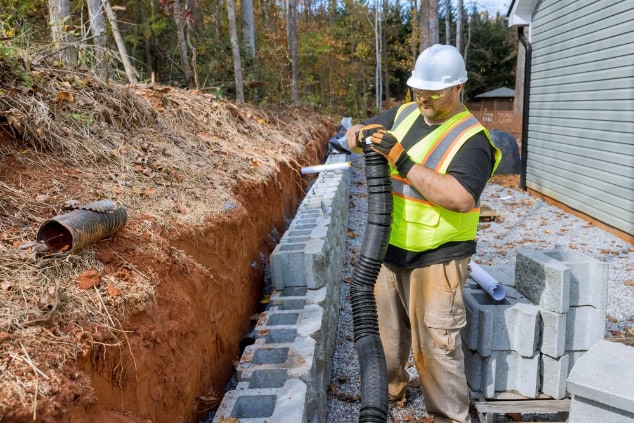
Installation is handled by our own crew the same people who did the assessment. Before we break ground, we call 811 to identify buried utilities, which matters especially in a township with aging infrastructure and underground waterways. After installation, we restore disturbed lawn and landscape areas so your property looks like itself again, not like a job site. Haverford Township’s updated stormwater ordinance also requires that drainage work meet specific discharge and runoff standards we build that compliance into every project, not as an afterthought, but as part of how we work.

Ready to get started?
Not every wet yard needs the same fix, and we’re not going to sell you a French drain if what you actually need is a grading correction. The drainage work we do in Haverford covers the full range: French drain installation, catch basin and inlet systems, dry wells, surface regrading, downspout drainage management, and integrated grading and drainage for properties where water is coming from multiple directions at once.
For homes in the Havertown and Llanerch sections of the township especially those near Naylors Run the issue is often a combination of slow-draining silty soil and a water table that sits higher than most homeowners expect. For properties along the Main Line in Haverford’s 19041 ZIP code, it’s frequently an older estate-style home where decades of landscaping changes have gradually redirected water toward the foundation instead of away from it. The solution in each case is different, and we design accordingly.
Every installation uses materials built for Pennsylvania’s freeze-thaw climate. Pipe, gravel, and filter fabric that hold up through repeated ground movement not components that fail in five years and need to be dug up and replaced. Haverford homes carry serious value, and the drainage system protecting them should be built to the same standard. We also make sure every project meets Haverford Township’s current stormwater management requirements, including the updated ordinances that took effect in late 2024, so there are no compliance issues down the road when you go to sell or make improvements.

French drain installation in the Haverford area typically runs between $3,500 and $10,000 for most residential projects, depending on the length of the drain, how deep it needs to go, where the water discharges, and how much restoration work is needed after installation. More complex situations like properties near Cobbs Creek tributaries where groundwater is elevated, or older Main Line homes where the drainage system needs to integrate with existing hardscape can push costs higher.
Labor makes up the majority of the cost, which is true across the industry. What matters more than the bottom-line number is understanding what you’re getting for it. A properly installed French drain using the right pipe, gravel, and filter fabric for Pennsylvania’s climate should last 30 to 40 years. A cheaper installation with cut-corner materials might hold up for five to ten years before it needs to be dug up and redone. At Haverford’s property values, the math on doing it right the first time is straightforward.
In most cases, standing water in a Haverford yard comes down to one of three things: grading that directs water toward a low point instead of away from the property, soil that absorbs water too slowly to keep up with rainfall, or a combination of both. The silty soils across the Darby-Cobbs watershed have low permeability water doesn’t move through them quickly, which means surface pooling is common after any significant rain event.
For older homes in Havertown and the Llanerch area, grading is often the primary culprit. The original grade may have been adequate when the home was built, but decades of settling, landscaping changes, and freeze-thaw movement have gradually redirected water in the wrong direction. Properties near Naylors Run also deal with a higher water table than residents typically expect, which means the ground is already partially saturated before rain even starts. A proper site assessment identifies which of these factors is driving your specific problem and that diagnosis determines the right fix.
It depends on the scope of the work. Haverford Township has an active stormwater management program and updated its erosion, sediment control, and stormwater management ordinances in December 2024. For most standard French drain or catch basin installations, a formal building permit is not required but the work must still comply with the township’s current stormwater regulations, which govern how drainage systems discharge and how runoff is managed on residential properties.
If your property is near Darby Creek or Cobbs Creek and falls within a mapped floodplain, additional restrictions apply, and work affecting watercourses may require permits from the Pennsylvania DEP. Before any excavation, Pennsylvania law also requires a call to 811 to identify buried utilities this is mandatory, not optional, and especially important in Haverford Township given the aging infrastructure and underground waterways in parts of the community. We handle all of this as part of the project, so you’re not navigating township requirements on your own.
The honest answer is that you need an assessment before you can know for sure. Regrading alone is the right solution when water is pooling because the ground slopes toward your home or toward a low point meaning the problem is directional, and correcting the slope fixes it. A French drain is the right tool when water needs to be actively collected and moved to a discharge point, particularly in areas where the soil is too slow-draining to handle the volume on its own.
In practice, a lot of Haverford properties need both. A 1940s Havertown home might have grading that’s shifted toward the foundation over decades and silty soil that can’t absorb fast enough even after the grade is corrected. The solution in that case is a graded correction combined with a French drain to handle the overflow. We look at the full picture before recommending anything and we’ll tell you plainly if the fix is simpler or less expensive than you expected. That’s a better long-term relationship than overselling a system you don’t need.
Directly, drainage work doesn’t show up as a line item in an appraisal the way a kitchen renovation does. But indirectly, the impact is real and in Haverford’s market, where median home values range from $413,000 township-wide to well over $800,000 in the 19041 ZIP code, the stakes are high enough that it matters.
Unresolved drainage problems show up in home inspections. A wet basement, evidence of water intrusion near the foundation, chronically dead grass from standing water, or eroded landscaping are all things buyers and their inspectors flag and they either kill deals or force price reductions. Fixing drainage before you list removes those objections entirely. Beyond resale, there’s also the compounding damage angle: water that sits against a foundation long enough causes structural issues that cost significantly more to repair than the drainage system that would have prevented them. In a community like Haverford, where homeowners stay long-term and invest seriously in their properties, drainage is maintenance not an upgrade.
A properly installed French drain should last 30 to 40 years in Pennsylvania’s climate. The key phrase there is “properly installed” because the freeze-thaw cycles that Haverford Township experiences every winter are genuinely hard on drainage infrastructure that wasn’t built with them in mind.
When the ground freezes and thaws repeatedly through a Pennsylvania winter, it expands and contracts. That movement shifts grades, stresses pipe connections, and compresses filter fabric if the wrong materials were used. A French drain installed with perforated pipe that can’t handle ground movement, gravel that compacts over time, or filter fabric that clogs within a few years will fail well before the 30-year mark and then you’re excavating and starting over. The difference in material cost between a system that lasts and one that doesn’t is relatively small. The difference in labor cost when you have to dig it up and redo it is not. We use components rated for this climate, installed at the right depth and slope, so the system works the first time and keeps working through whatever Pennsylvania winters throw at it.
Useful Links