
Hear from Our Customers
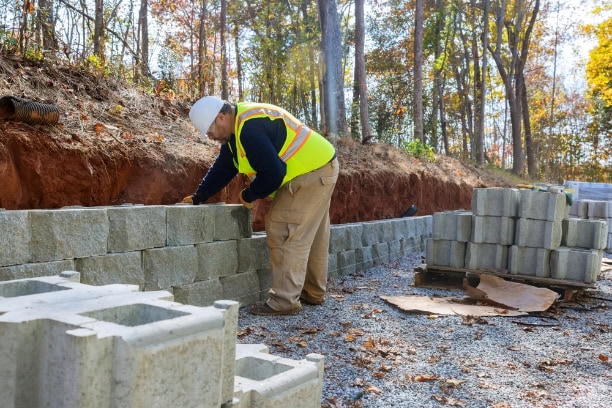
A lot of Haverford homeowners have been living with a slope they’ve written off as unusable. Too steep to mow safely, too eroded to plant anything, too grade-challenged to put a patio or seating area on. A properly built retaining wall changes that. It doesn’t just hold back soil it creates flat, functional outdoor space where there wasn’t any before.
What most people don’t realize until it’s too late is that the wall itself is only part of the job. Delaware County’s clay-heavy soil holds water instead of draining it. That water builds pressure behind a wall slowly, invisibly until the face starts to bow, the blocks start to crack, or the whole thing shifts after a hard winter. The drainage system behind the wall is what determines whether it lasts a decade or a lifetime.
Haverford’s freeze-thaw winters make this even more critical. Water gets into the soil, freezes, expands, and pushes. Every year, that cycle does a little more damage to walls that weren’t built with it in mind. When the drainage is right and the materials are matched to Pennsylvania’s climate, you stop worrying about the wall entirely and start actually using your yard.
We’re a Delaware County–based residential landscaping and hardscaping company. Our owner, Renato Spennato, holds active Pennsylvania contractor license PA057623 and carries a BuildZoom score of 102 placing us in the top 11% of more than 125,000 licensed contractors in the state. That’s not a marketing number. It’s a third-party ranking that research-minded homeowners in Haverford will find when they check.
We run on a single experienced crew. No subcontractors, no crew rotations, no project managers who’ve never touched a shovel. The same people who assess your site, plan your drainage, and pull your permits are the ones building the wall. That matters on properties near Haverford College or along the older streets in Llanerch and Brookline, where the lots have history mature trees with deep root systems, established grades, and existing masonry that needs to be worked around carefully.
When the job is done, Renato is still reachable. Same number, same person.
It starts with a site visit not a phone quote, not a ballpark based on photos. Haverford properties can’t be accurately assessed remotely. The slope, the soil, the drainage patterns, the proximity to trees, the existing hardscaping all of it needs eyes on it before any number gets put on paper. That visit is also when the permit conversation happens, because in Haverford Township, the permitting process is more involved than most homeowners expect.
Haverford Township’s Slope Control Ordinance (Chapter 154A) requires a permit from the Township Engineer before any grading or disturbance of a steep slope separate from the standard building permit. The township’s Zoning Ordinance also caps front yard retaining wall height at 30 inches without a variance from the Zoning Hearing Board. A contractor who doesn’t know those rules exists will leave you with a compliance problem that surfaces when you go to sell. We handle the permit coordination so you’re not navigating that process alone.
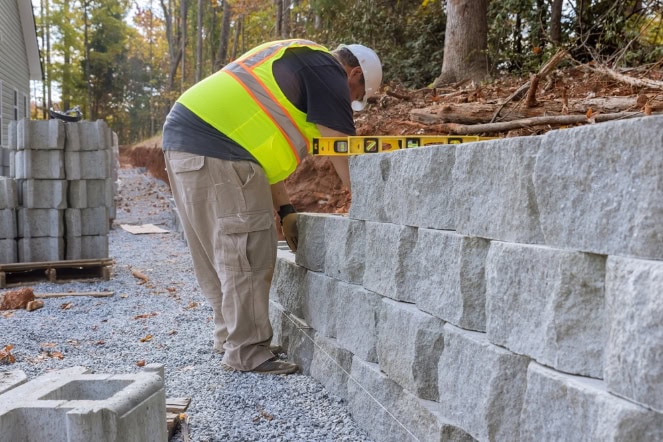
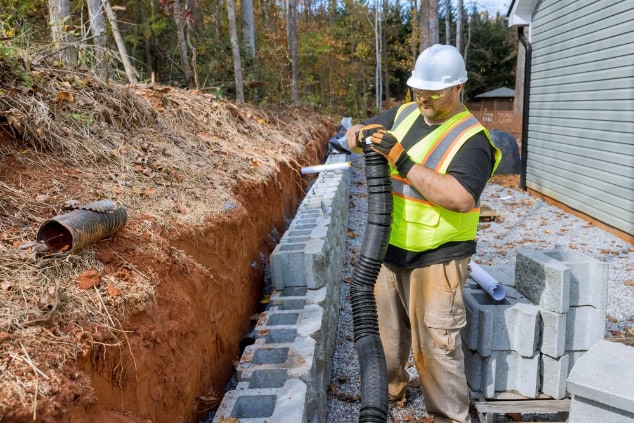
Once permits are in order, excavation is planned around whatever’s already there tree roots, existing walls, utility lines, drainage paths. The drainage system goes in before the first block is set: gravel backfill, perforated pipe, weep holes placed where water actually needs to escape. Then the wall gets built. Final walkthrough covers everything drainage function, wall alignment, site cleanup before the job is considered done.
Ready to get started?
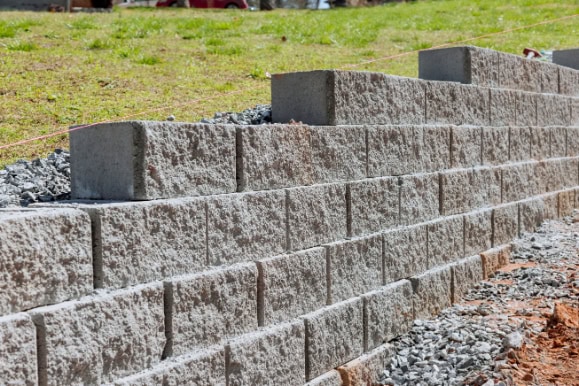
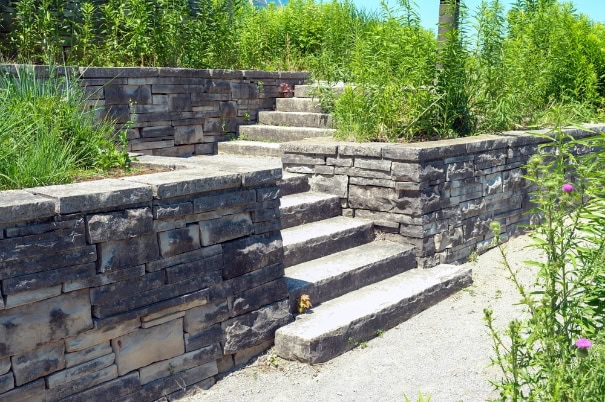
Every retaining wall project starts with material selection that matches the site not whatever’s cheapest or fastest to install. On older Haverford properties where the existing hardscaping has character, natural stone is often the right call. It ties into what’s already there, it handles Pennsylvania winters without cracking, and it can last a century when it’s installed correctly. For properties where the design calls for curves, integrated steps, or walls that need to reach significant heights, VERSA-LOK modular block is a strong option. The pinning system allows for corners, columns, and complex transitions that a basic stacked-block system can’t handle cleanly and it requires no frost footings, which matters in this climate.
Haverford Township updated its stormwater and erosion control ordinances in December 2024. Any project involving significant grading or drainage redirection may now trigger a stormwater review under the updated rules. That’s not a reason to avoid the project it’s a reason to work with a retaining wall contractor who’s current on local code and knows how to move through the process without delays.
Whether you’re dealing with an eroded slope in Manoa, a failing legacy wall in Oakmont, or a backyard grade in Chatham Park that’s never been usable, we approach every project the same way: assess the drainage first, match the material to the site, pull the right permits, and build it to last.
In most of Pennsylvania, retaining walls under four feet tall don’t require a building permit under the state’s Uniform Construction Code. Haverford Township goes further than that baseline, and it’s something a lot of homeowners don’t find out until there’s already a problem.
Haverford’s Slope Control Ordinance (Chapter 154A) requires a separate permit from the Township Engineer before any grading, filling, or disturbance of a steep or very steep slope regardless of wall height. On top of that, the township’s Zoning Ordinance caps front yard retaining wall height at 30 inches without a variance from the Zoning Hearing Board. Walls that cross property boundary lines also require a variance under Section 182-727. Haverford Township also requires a Certificate of Use and Occupancy for property sales, and unpermitted hardscaping can surface as a compliance issue when you go to settle. Getting the permits right from the start is not optional here it’s the only way to protect your investment long-term.
Residential retaining walls in the Haverford area generally run between $3,500 and $10,000 for a standard project, though complex sites can go higher depending on wall height, material selection, drainage requirements, and permit coordination. Natural stone tends to cost more upfront than concrete block or VERSA-LOK, but it also lasts significantly longer a well-built stone wall on a Haverford property can outlast the house.
The more useful way to think about the cost is relative to what you’re protecting. Haverford home values regularly exceed $500,000, and a retaining wall that manages drainage correctly protects your foundation, your landscaping, and your yard from the kind of erosion that compounds quietly over years. Property appraisers estimate that well-designed retaining walls return 100 to 200 percent of their cost in added property value. In this market, the question isn’t really whether you can afford the wall it’s whether you can afford to keep putting it off.
The short answer is water. Specifically, water that gets trapped behind the wall and has nowhere to go. Delaware County’s clay-heavy soil doesn’t drain quickly, so moisture accumulates behind the wall face. When temperatures drop, that water freezes, expands, and pushes outward with significant lateral force. When it thaws, the loosened soil shifts and the cycle starts again. Over several winters, this is what bows faces, cracks blocks, and eventually topples walls that looked fine when they were first built.
The fix isn’t just better materials it’s a drainage system designed to remove water before pressure builds. That means gravel backfill directly behind the wall, perforated drainage pipe at the base, and weep holes placed at the right intervals to give water an exit path. When those elements are in place, the freeze-thaw cycle that damages so many walls in this region stops being a threat. Material selection matters too not every block or stone product is rated for repeated freeze-thaw cycling, and using the wrong one in a Pennsylvania climate accelerates failure regardless of how well the drainage is designed.
In the front yard, Haverford Township’s Zoning Ordinance limits retaining wall height to 30 inches that’s two and a half feet without a variance from the Zoning Hearing Board. Walls taller than that in the front yard require a formal variance application, which involves a hearing before the board and can add time to your project timeline if it’s not planned for in advance.
Rear and side yard walls have different rules, and walls on steep or very steep slopes trigger the additional Slope Control Ordinance requirements regardless of where they fall on the property. The permit process in Haverford involves both the Building and Codes Department and, in slope-affected areas, the Township Engineer. If you’re not sure whether your property qualifies as a steep slope under Chapter 154A, that’s exactly the kind of thing that gets assessed during a site visit before any work is planned or priced.
It depends on the property, but there are a few patterns that come up consistently on the older housing stock in Haverford. Homes built before 1940 and there are a lot of them in this township often have existing stone foundations, original masonry, and a general aesthetic that reflects the character of the Main Line. Dropping a generic concrete block wall next to a historic stone foundation looks wrong, and most Haverford homeowners know it immediately.
Natural fieldstone is often the best match for those properties. It integrates with what’s already there, handles Pennsylvania’s freeze-thaw cycles well when properly installed, and can last a century or more. For properties where the wall needs to handle curves, corners, integrated steps, or significant height, VERSA-LOK modular block offers design flexibility that natural stone can’t always match. Treated timber walls are the least expensive option upfront, but they typically last 10 to 30 years before they need replacing which is a short lifespan relative to the investment in a Haverford property. Material selection should always start with what the site actually needs, not what’s fastest to install.
The signs that a wall is heading toward failure are usually visible before the wall actually goes. Bowing or bulging in the face is one of the clearest indicators it means hydrostatic pressure is building behind the wall and the structure is starting to give. Horizontal cracking, especially mid-wall, tells a similar story. If you’re seeing soil or water seeping through the joints, or if the cap stones are shifting or tilting, those are signs that the drainage behind the wall has already failed.
On older Haverford properties, a lot of existing walls were built without modern drainage systems gravel backfill and perforated pipe weren’t standard practice decades ago. Those walls have been managing water poorly for years, and the cumulative stress from Delaware County’s clay soils and repeated freeze-thaw cycles catches up eventually. Whether a wall can be repaired or needs to come down depends on how far the damage has progressed and whether the underlying drainage can be corrected without a full rebuild. That assessment happens on-site there’s no reliable way to make that call from a photo. If your wall is showing any of the signs above, the earlier you get eyes on it, the more options you have.
Useful Links