

Hear from Our Customers
Standing water in a Clifton Heights yard isn’t just an eyesore. When your rear yard sits behind a row home built in the 1940s or 1950s, that pooling water is sitting against a stone foundation that wasn’t designed to handle decades of unmanaged runoff. Left alone, it works its way in and what starts as a soggy yard becomes a wet basement, then a mold problem, then a foundation repair bill that makes a drainage system look like the deal of the century.
The other issue most people don’t think about until it’s too late is what happens to the neighbor’s side of the wall. In a borough where lots are measured in feet and properties share walls, your drainage problem rarely stays your problem alone. Getting the grade and drainage right means the water moves away from your home and away from the property line before it causes damage on either side.
After the work is done, you get a yard you can actually use. No more avoiding the back corner after a rainstorm, no more watching the grass die in the wet spots, no more wondering what’s happening to your foundation every time Darby Creek backs up the municipal system during a heavy storm. The yard works the way it should, and the home underneath it stays protected.
We’re based in Aston, PA Delaware County and have been doing this work across the county for over 15 years. That’s not a marketing line. It means our crew has worked through the clay-heavy soils, the freeze-thaw cycles, and the dense older housing stock that define eastern Delaware County boroughs like Clifton Heights, Lansdowne, and Aldan. We know what’s typically under the ground here, how the soil behaves after a wet winter, and what drainage solutions actually hold up year after year in this climate.
You’re not getting a regional chain that added your zip code to a service area map. You’re getting a Delaware County contractor who has spent 15 years learning how water moves through neighborhoods exactly like yours. One crew handles the assessment, the grading, and the installation no handoffs, no subcontractors, no confusion about who’s responsible when something doesn’t look right.

It starts with a site assessment not a sales pitch. Before anything is recommended, we look at how water is currently moving across your property: where it’s entering, where it’s collecting, and what the existing grade is doing (or not doing) to help. In Clifton Heights, that assessment almost always involves evaluating the rear yard grade of an attached or semi-detached home, checking downspout routing, and identifying whether the problem is a grading issue, a drainage infrastructure issue, or both.
From there, we build a plan around what your property actually needs. Some Clifton Heights yards need regrading and better downspout extensions. Others need a French drain installation routed to a proper outlet. Some need a catch basin to collect surface water before it reaches the foundation. The solution is sized to the problem not upsold to the largest possible scope.
Once the plan is agreed on, we schedule the work with a firm timeline. Our crew shows up, completes the grading and drainage installation, and restores the site before we leave. In a neighborhood as tight as Clifton Heights where your backyard work is visible to multiple neighbors that cleanup matters. You shouldn’t have to explain a torn-up yard to anyone the morning after the crew leaves. You won’t.
Ready to get started?
Drainage work in Clifton Heights isn’t the same as drainage work on a half-acre suburban lot in a newer development. The homes here are 60 to 90 years old. The yards are small. The soils are clay-heavy. And a meaningful portion of the borough sits within or near the FEMA-designated flood areas tied to Darby Creek along the borough’s northern edge. Any drainage contractor working in this borough should understand all of that not just how to dig a trench.
The grading and drainage work we perform in Clifton Heights covers the full scope of what most properties here actually need: site grading to correct slope and redirect surface water, French drain installation using materials rated for Pennsylvania’s freeze-thaw cycles, catch basin installation for yards that collect standing water in a central low point, and downspout routing to move roof runoff away from the foundation and toward a proper outlet. Every solution is designed to work within the physical constraints of a dense borough lot tight clearances, shared property lines, and limited space for equipment.
Because Clifton Heights Borough holds a PA DEP MS4 stormwater permit and has a formal floodplain management ordinance governing properties near flood hazard areas, it matters that your contractor understands local requirements. Our 15 years of Delaware County work means familiarity with exactly this kind of local regulatory context so the drainage system installed on your property is designed to function correctly within the borough’s stormwater framework, not just on paper.

The most common reason is a combination of two things: clay soil and flat or negative grade. Clifton Heights sits on the clay-heavy soils typical of eastern Delaware County, and clay doesn’t let water move through it quickly. When rain falls faster than the soil can absorb it which is almost always the water has to go somewhere. If the grade of your yard is flat or slopes toward the house, that somewhere is usually the low corner of your yard or the base of your foundation.
In a row home or attached property, the problem is often compounded by the fact that your neighbor’s grading affects yours. If the adjacent lot sheds water toward your property line, you’re managing your runoff plus theirs. A proper site assessment looks at the full drainage pattern across the property, not just the symptom. Fixing the grade so water moves away from the structure and away from the shared wall is usually the first step before any drainage infrastructure is installed.
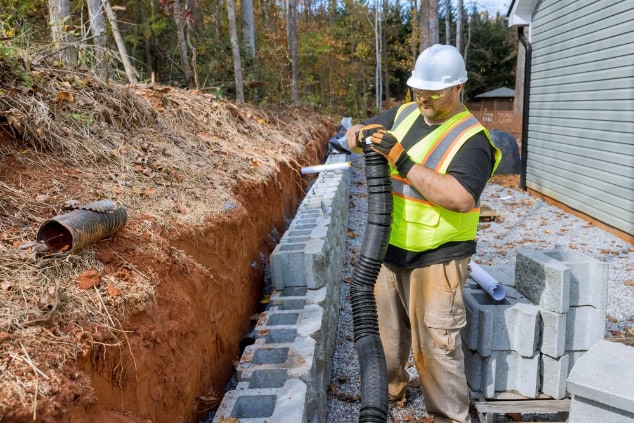
A French drain is a gravel-filled trench with a perforated pipe at the bottom that collects subsurface water and routes it to a safe outlet usually a daylight point at the edge of the property, a dry well, or a municipal drainage connection. It’s one of the most effective solutions for yards that stay wet after rain because the soil beneath the surface is saturated and won’t drain on its own.
Whether you actually need one depends on what’s causing the problem. Some Clifton Heights properties just need the grade corrected and the downspouts rerouted that’s a simpler fix and a lower cost. Others have chronic subsurface saturation from clay soil and decades of compaction that only a French drain will resolve. The only way to know is a real site assessment that looks at how the water is behaving, not a phone quote based on square footage. French drain installation in Delaware County typically runs in the range of $5,000 to $9,000 depending on the length of the system and the complexity of the outlet but a proper diagnosis first ensures you’re spending money on the right solution.
It’s one of the more underappreciated factors in how drainage systems perform long-term. Delaware County goes through significant freeze-thaw cycling from late fall through early spring temperatures drop below freezing, moisture in the soil and in drainage pipe freezes and expands, then thaws and contracts. Over time, this cycling can shift gravel beds, displace pipe, and crack drainage infrastructure that wasn’t installed with the right materials or at the right depth.
The practical result is a drainage system that worked fine the first year or two but starts failing by year three or four usually right when you’ve stopped thinking about it. Installing drainage with materials rated for Pennsylvania’s climate, at depths that account for frost penetration, is what separates a system that lasts from one that needs to be redone. We use materials and installation methods appropriate for this region specifically not products designed for milder climates that happen to be available at a lower cost.
Clifton Heights Borough has FEMA-designated Special Flood Hazard Areas (SFHAs) tied primarily to Darby Creek, which runs along the borough’s northern and northeastern border. If your property is within or near one of those designated zones, there are specific restrictions on what can be built or modified under the borough’s Floodplain Management Ordinance (Ord. No. 846). In floodway areas specifically, no new construction or development is permitted without a permit from the Pennsylvania DEP Regional Office.
For most residential properties in Clifton Heights, this doesn’t prevent drainage work it means the work needs to be designed with those requirements in mind. A contractor who understands the borough’s MS4 permit requirements and floodplain ordinance will design drainage that functions within that framework. If you’re unsure whether your property falls within a designated flood zone, the borough’s floodplain map or FEMA’s online Flood Map Service Center can give you a starting point before you schedule a site visit.
A properly installed French drain or yard drainage system in Delaware County should last 20 to 30 years or more when it’s built with the right materials, installed at the correct depth, and maintained periodically. The biggest factors that shorten that lifespan are using undersized or low-grade pipe, inadequate gravel filtration that allows clay soil to migrate into the drain over time, and improper outlet placement that allows the system to back up during heavy rain events.
In Clifton Heights specifically, clay soil migration into the drain is a real long-term concern the fine particles in heavy clay can gradually clog a drainage system that wasn’t wrapped in the appropriate filter fabric during installation. Periodic inspection every few years, and occasional flushing of the pipe, keeps the system performing the way it should. A contractor who tells you the system is maintenance-free forever is overpromising. One who installs it correctly and explains what to watch for is giving you something that will actually last.
Yes and in Clifton Heights, this is one of the more common situations we see. Row homes and attached properties share walls, and when the grade on one side of that wall sheds water toward the other, both properties end up with a drainage problem that neither owner caused on their own. The fix usually involves regrading the affected side of the yard to redirect surface flow away from the shared wall, combined with a drainage solution a French drain, catch basin, or improved downspout routing that moves the water to a proper outlet before it reaches the foundation or the property line.
The key in this situation is a site assessment that looks at both sides of the drainage pattern, not just the yard of the person calling. If your neighbor’s grade is contributing to your problem, that needs to be part of the conversation. A drainage system installed without accounting for where the water is coming from upstream will manage the symptom but not the cause. Getting the full picture first is what leads to a fix that actually holds.
Useful Links
Other Services we provide in Clifton Heights