
Hear from Our Customers
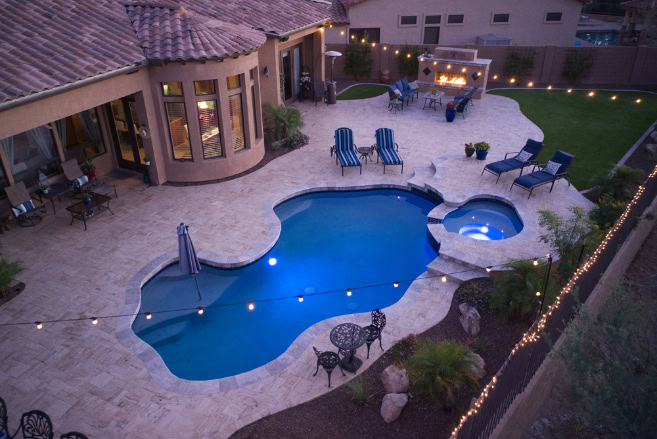
Here’s what most homeowners in Clifton Heights already know: the backyard behind a row home or semi-detached house on Davis Avenue or Oak Avenue isn’t large. But that doesn’t mean it can’t work hard. A well-designed outdoor kitchen even a compact grill station with a counter, storage, and a refrigerator turns a narrow rear yard into a functional outdoor room. You’re not just adding a cooking surface. You’re creating a space where evenings actually happen outside.
The other thing worth knowing upfront is that anything built outdoors in Clifton Heights has to survive real winters. The borough sits in the Darby Creek watershed, and the freeze-thaw cycles here are relentless temperatures swing above and below freezing repeatedly through a single winter. Materials that aren’t frost-rated crack. Bases that aren’t properly prepared heave. If you’ve watched your existing rear patio surface degrade over the years, you already understand why this matters. An outdoor kitchen built with the right materials and the right base preparation doesn’t just look good on day one it holds up through year ten and beyond.
The return is real too. Outdoor kitchens deliver between 55% and 100% ROI at resale according to the National Association of Realtors, and in a Clifton Heights market where median sale prices have risen nearly 23% year-over-year, a well-built outdoor kitchen is a genuine differentiator. More importantly, it changes how you use your home every single week not just when you sell it.
We’re based in Aston, PA right here in Delaware County, not a regional operation that added your zip code to a service map. That distinction matters when you’re navigating a borough like Clifton Heights, where the Code Enforcement and Community Development office has specific permit requirements and setback rules that affect how and where an outdoor kitchen can be built on your lot.
Every project runs with a single crew. That means one point of contact, one team accountable for the work from the first shovel to the final walk-through, and no subcontractor handoffs that leave things unresolved. In a tight-knit borough like Clifton Heights where neighbors talk and contractor reputations travel fast, that kind of accountability isn’t a selling point it’s just how the work gets done. When your project is finished and you have a question three months later, you’re calling the same people who built it.
It starts with a conversation about your actual space not a showroom template. In Clifton Heights, that means accounting for compact lot dimensions, rear yard setbacks under the borough’s zoning code, and any drainage considerations relevant to your specific property. Clifton Heights is part of the Darby Creek watershed, so stormwater and grading aren’t afterthoughts here. They’re built into the design from day one.
Once the design is confirmed, we handle the building permit through the borough’s Code Enforcement and Community Development office including the PA state HIC license documentation and certificate of insurance the borough requires from all contractors. You don’t need to navigate that process yourself. Any licensed trade work required for your kitchen, whether that’s a gas line connection or electrical circuits for outdoor lighting and appliances, gets coordinated through the same team.
From there, installation follows a clear sequence: base preparation and drainage grading first, then structural framing, then countertop and finish work, then appliance installation and final connections. The practical build window in Clifton Heights runs April through October masonry and hardscaping work can’t be done safely below 40°F. If you want your kitchen ready before Memorial Day, the planning conversation needs to happen in late winter. That’s not a sales push it’s just how the calendar works.
Ready to get started?
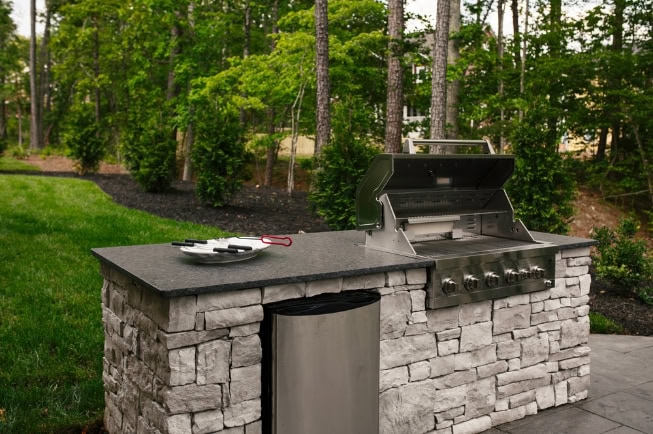
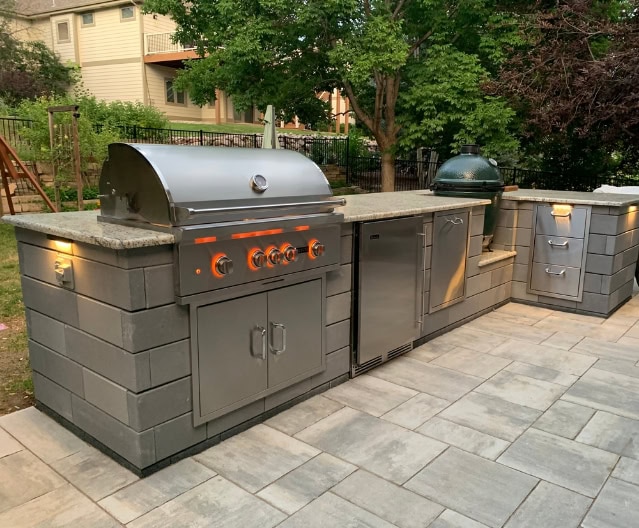
Every outdoor kitchen we build in Clifton Heights is designed around the actual constraints of the property not a one-size-fits-all layout. For the row homes and semi-detached houses that make up the majority of the borough’s housing stock, that typically means a compact, highly functional configuration: a built-in grill, a durable countertop that doubles as a bar surface, integrated storage, and a small refrigerator. The goal is a space that genuinely works within your yard’s dimensions, not one that technically fits but feels crowded.
Material selection is non-negotiable in this climate. Every build we complete uses frost-rated stone veneer or masonry, marine-grade stainless steel appliances, sealed countertop surfaces granite, quartz, or treated concrete and properly graded drainage slopes beneath the structure. These aren’t premium upgrades. They’re the baseline for anything that’s going to hold up through Delaware County winters without cracking, heaving, or staining. The homes in Clifton Heights were largely built between the 1920s and 1950s if you’ve owned yours long enough, you’ve seen what happens to outdoor surfaces that weren’t built to last.
We also handle the full permit process with Clifton Heights borough, manage all licensed trade coordination, and deliver on a defined timeline. The outdoor entertaining season here is short enough that a delayed project isn’t a minor inconvenience it’s a missed summer.

Yes and it’s worth understanding what that process actually involves before you hire anyone. Clifton Heights has its own Code Enforcement and Community Development department that oversees all construction activity in the borough. Any outdoor kitchen that involves structural work, gas connections, or electrical circuits requires a building permit, and the borough requires all contractors to submit a PA state HIC license number and a current certificate of insurance when applying. Fees are calculated based on the total cost of the job.
This matters for a few reasons. First, if a contractor can’t provide those credentials, the permit process stalls and that delay can push your project well past the start of the outdoor entertaining season. Second, unpermitted work creates real problems at resale. Buyers’ inspectors find it, title companies flag it, and you end up either retroactively permitting or removing the structure. We handle the entire permit process on your behalf, including all documentation Clifton Heights requires. You don’t have to figure out the Code Enforcement office’s hours or submission requirements that’s already handled.
This is one of the most important questions you can ask, and most homeowners don’t think to ask it until something fails. Delaware County winters involve repeated freeze-thaw cycles temperatures that swing above and below freezing multiple times through a single season. Any material that absorbs water and isn’t frost-rated will crack. That includes certain natural stones, improperly sealed concrete, and non-marine-grade cabinetry. The cost of reconstructing a failed outdoor kitchen structure runs $3,000 to $8,000 or more, which makes material selection a financial decision, not just an aesthetic one.
For a Clifton Heights build, the right material list looks like this: frost-rated stone veneer or masonry for the structure, marine-grade stainless steel appliances, sealed countertop surfaces granite, quartz, or treated concrete all perform well and a properly prepared compacted base that prevents frost heave from underneath. Drainage slopes built into the base are especially relevant in Clifton Heights, which sits in the Darby Creek watershed where stormwater management is an ongoing community concern. A base that doesn’t drain properly doesn’t just create standing water it accelerates freeze-thaw damage from below.
Yes and honestly, smaller yards often produce more functional outdoor kitchens than larger ones, because the design has to be intentional rather than sprawling. The row homes and semi-detached houses that make up the majority of Clifton Heights’s housing stock typically have rear yards in the range of 15 to 25 feet deep. That’s enough space for a well-designed outdoor kitchen that includes a built-in grill, a counter surface, storage, and a compact refrigerator everything you need to cook and entertain outside without running back into the house.
The key is starting with your actual yard dimensions, not a standard template. Setback requirements under Clifton Heights’s zoning code affect where the structure can be positioned relative to your property lines, and in a compact lot, those setbacks matter. A contractor who designs outdoor kitchens for large suburban lots and then tries to scale down for your property will run into problems. The design process should start with a site visit, accurate measurements, and a layout that works within your specific rear yard not the other way around.
The honest answer is that it depends on size, materials, and what appliances and features you’re including but here are real numbers to work with. A compact, well-built grill station with a counter and storage typically starts in the $8,000 to $13,000 range. A mid-range outdoor kitchen with a built-in grill, refrigerator, countertop seating, and integrated storage runs roughly $15,000 to $25,000. Larger or more complex builds with premium countertops, multiple appliances, and custom features can reach $35,000 to $50,000 or more.
For most Clifton Heights homeowners, the mid-range is the most practical fit both for the typical rear yard dimensions and for the value equation. In a market where median home values have risen nearly 23% year-over-year, a $15,000 to $25,000 outdoor kitchen is a meaningful but reasonable investment relative to the equity most long-term owners have built. The more important cost consideration is build quality. A cheaper outdoor kitchen built with the wrong materials in this climate will need partial or full reconstruction within five to seven years. The upfront cost difference between a properly built kitchen and a shortcut build is almost always less than the cost of fixing the shortcut.
The practical build window in Clifton Heights runs from approximately April through October. Masonry and hardscaping work can’t be performed safely below 40°F or in wet conditions attempting it produces weak joints, improper curing, and structures that fail faster. That’s not a preference; it’s a material science reality that applies to every outdoor kitchen built in Delaware County.
If you want your kitchen ready before Memorial Day weekend, the planning and permitting process needs to start in January or February at the latest. The Clifton Heights permit process takes time, and scheduling fills up quickly once the spring build season opens. Homeowners who reach out in late winter are in the best position to get on the calendar for a May or early June installation. If you’re reading this in the fall or early winter, that’s actually the ideal time to start the conversation you’ll have the full planning period ahead of you and won’t be competing with every other homeowner who waited until April to call.
This is a fair concern, and it comes up constantly not just in Clifton Heights but across Delaware County. BBB complaint data consistently shows that one of the most common contractor complaints involves unresponsiveness after a project starts or after completion, leaving homeowners with unresolved issues and no way to get a callback. In a dense borough like Clifton Heights, where neighbors talk and a bad contractor experience spreads quickly, that kind of outcome is both financially and socially costly.
The clearest indicator of contractor reliability is accountability structure. A company that uses a single crew the same people on your job from day one to the final walk-through has no one to blame but themselves if something goes wrong. There are no subcontractors to point fingers at, no handoffs where things fall through the cracks. Our model is built around exactly that: one team, one point of contact, and the same people who built your kitchen are the ones you call if you have a question afterward. We’re a Delaware County company operating out of Aston not a regional operation that moves on to the next market. When the job is done, we’re still your neighbors.
Useful Links
Other Services we provide in Clifton Heights