
Hear from Our Customers
A lot of Radnor properties especially in Wayne, North Wayne, and Saint Davids sit on grades that make the backyard more of a liability than an asset. You lose usable space, deal with erosion every time it rains hard, and watch mulch and topsoil migrate down the hill season after season. A properly built retaining wall stops all of that and turns what was a drainage headache into actual outdoor living space.
What most homeowners don’t realize until they start researching is that the wall itself is only part of the equation. Radnor’s clay-heavy Piedmont soils hold water differently than sandy or loam-based soils, and when that moisture freezes behind a wall with no drainage relief, the pressure builds until something gives. That’s why so many walls in this area fail within five to ten years not because the materials were cheap, but because the drainage was an afterthought.
When the drainage is engineered right from the start, the wall performs the way it should. You get a structure that handles Radnor’s wet springs and hard winters without cracking, bowing, or shifting. And on the Main Line, where buyers are paying close attention to what a property looks like inside and out, a well-built retaining wall isn’t just a landscaping improvement it’s a real asset to the property’s long-term value.
We’re a Delaware County-based landscaping and hardscaping company serving residential homeowners across the county including Radnor Township and the surrounding Main Line communities. We hold an active Pennsylvania contractor license (PA057623) and carry a BuildZoom score of 102, placing us in the top 11% of licensed contractors statewide.
What sets us apart isn’t a long list of services it’s the way the work gets done. One experienced crew handles your project from the first site visit through the final cleanup. No subcontractors handed a job they didn’t quote. No communication gaps once the check clears. Our name is on the license and on the work, which means there’s a real person accountable for the outcome.
Radnor Township has specific grading permit requirements, mandatory contractor township licensing, and a housing stock that ranges from 1880s Main Line estates to mid-century colonials on larger lots. That variety demands a contractor who actually shows up to assess the property before putting a number on paper and that’s exactly how every project we take on starts.
It starts with an on-site visit not a phone estimate, not an online form that generates a ballpark. Radnor properties vary too much for that to mean anything. The grade on a North Wayne lot with a 1920s stone colonial is a completely different project than a newer build near the Lancaster Avenue corridor, and the drainage requirements, material fit, and permit path are all different too. The site visit is how an accurate scope gets built.
From there, you get a clear proposal that covers materials, drainage specifications, timeline, and any permit requirements that apply to your project. In Radnor Township, walls four feet or taller require a building permit and engineered plans. Projects involving grading or fill require a separate grading permit through the township’s Engineering Department a process that includes a site plan submission and a Professional Services Account deposit. If your project triggers those steps, you’ll know upfront, not mid-construction.
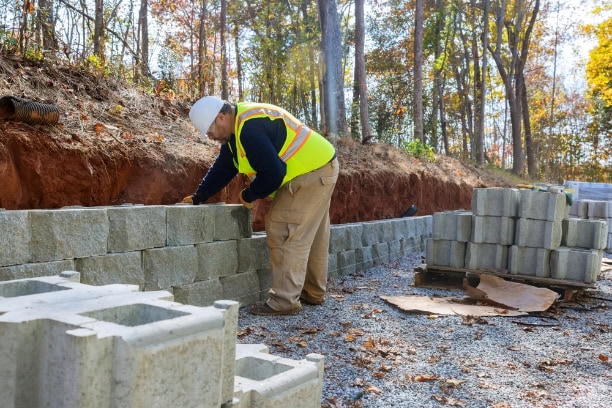
Once work begins, the process follows a consistent sequence: excavation and base preparation, drainage installation drain tile, gravel backfill, and weep holes sized for the wall height and soil type then block or stone placement, compaction, and backfill in lifts. The site gets cleaned up before the crew leaves, not after you follow up twice. When the job is done, it’s actually done.
Ready to get started?
Every retaining wall project we handle is scoped around what the property actually needs not a default material or a one-size approach. For Radnor homeowners, that usually means one of a few directions depending on the property’s character and structural requirements.
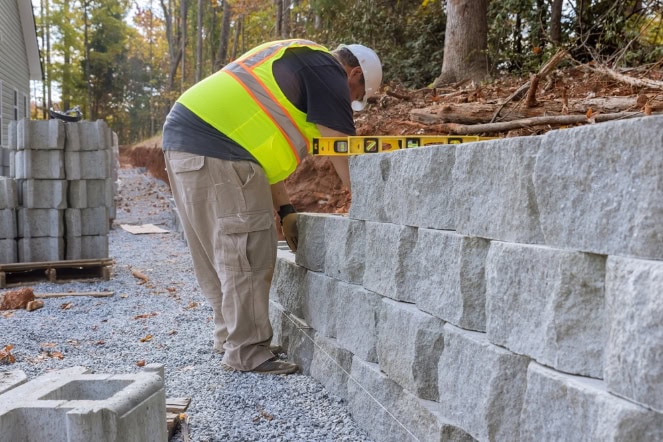
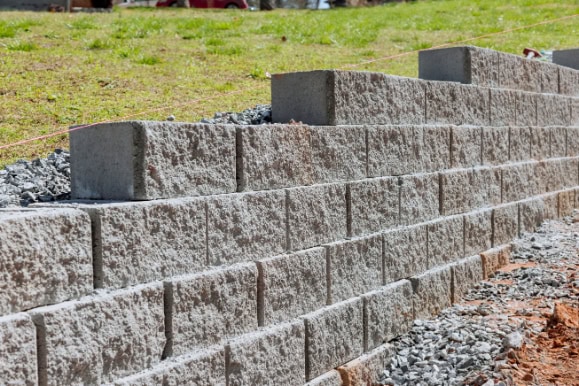
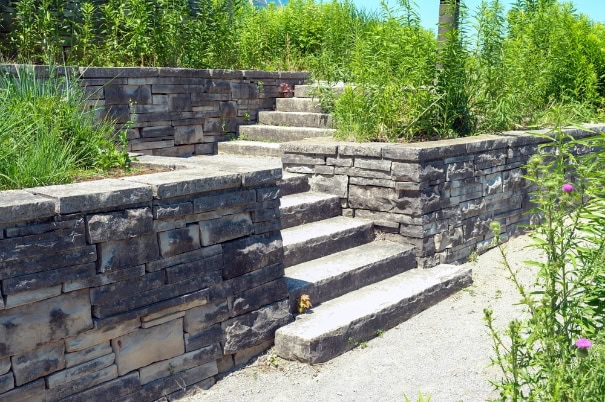
VERSA-LOK engineered block is a strong fit for most residential retaining wall projects in this area. The system doesn’t require frost footings, which matters in a climate where freeze-thaw cycles put constant stress on conventional wall foundations through winter. VERSA-LOK walls can be built with curves, corners, steps, and columns, and the geogrid reinforcement option allows for taller walls where the grade demands it. For historic properties in Villanova or the older Wayne neighborhoods, natural stone is often the right call it fits the existing aesthetic in a way that concrete block simply doesn’t. Boulder walls work well for naturalistic settings on larger lots.
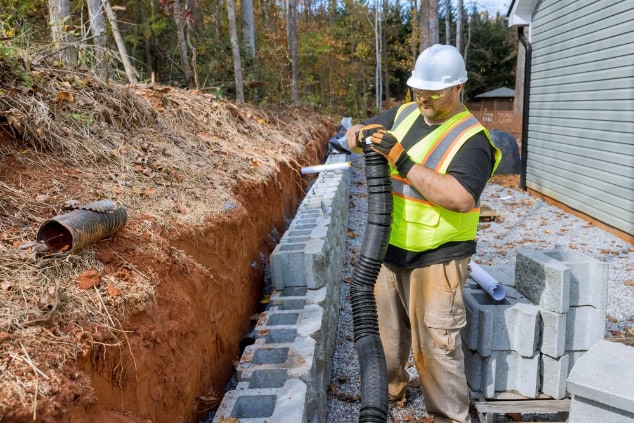
Every installation we complete includes proper drainage engineering: drain tile behind the wall, clean gravel backfill, and weep holes that give hydrostatic pressure somewhere to go before it becomes a structural problem. Radnor Township’s stormwater management ordinance specifically addresses soil permeability, slope, and drainage design compliance isn’t optional, and it’s built into how we do this work. The result is a wall that performs through Radnor’s wet springs, hard winters, and everything in between.
It depends on the height of the wall and whether your project involves any grading or fill. In Radnor Township, retaining walls under four feet tall are generally exempt from a building permit as long as the wall isn’t supporting a surcharge or impounding liquids. That’s consistent with Pennsylvania’s Uniform Construction Code statewide standard.
Once you hit four feet or taller, a building permit is required, and you’ll need engineered plans sealed by a registered architect or professional engineer to submit with the application. That’s a step a lot of homeowners don’t anticipate when they’re budgeting a project.
Separately, if your project involves any grading or fill which most retaining wall projects do Radnor Township requires a grading permit through the Engineering Department. That process involves a $1,500 permit fee, a $3,000 Professional Services Account deposit, and submission of five copies of a site plan showing existing and proposed impervious coverage. The PSA deposit is refunded after project completion, but it’s a real upfront cost that should be factored into your budget from the start. Radnor also requires all contractors performing work in the township to be licensed with the township before work begins.
The honest answer is that it varies significantly depending on wall height, length, material selection, drainage complexity, and site access. Nationally, retaining walls run roughly $40 to $345 per linear foot installed, with most residential projects landing somewhere between $3,500 and $10,000. In Radnor, where properties often involve more complex grades, larger lot sizes, and premium material preferences, projects at the higher end of that range are common.
Material choice is one of the biggest variables. VERSA-LOK engineered block is typically more affordable than natural stone but performs extremely well structurally. Natural stone costs more but is often the right aesthetic fit for historic properties in Wayne or Villanova where a concrete block wall would look out of place. Both are legitimate choices the right one depends on your property.
What tends to inflate costs unexpectedly is drainage. If a contractor quotes you a wall without specifying the drainage plan, that’s a red flag. Drain tile, gravel backfill, and proper weep holes add to the upfront cost, but they’re what separates a wall that lasts 30 years from one that needs to be rebuilt in ten. And if your project triggers Radnor’s grading permit process, factor in that $3,000 PSA deposit as well. A complete, honest quote should cover all of it before work starts.
The most common reason retaining walls fail especially in Radnor and across Delaware County is poor drainage. Radnor’s soils have significant clay content, which means water doesn’t drain through quickly. When moisture builds up behind a wall with no relief, the hydrostatic pressure increases until the wall bows, cracks, or topples outward. This is especially pronounced through the freeze-thaw cycles that hit Radnor every winter: water saturates the soil, freezes, expands, and pushes against the wall repeatedly from November through March.
The fix isn’t complicated, but it has to be done right from the start. Drain tile installed at the base of the wall, clean gravel backfill instead of native soil, and weep holes at regular intervals give that water somewhere to go before it becomes a problem. Skipping or undersizing any of those components is where walls get into trouble.
Beyond drainage, base preparation matters a lot. A wall that isn’t set on a properly compacted base will shift over time, especially on Radnor’s rolling terrain where the grade creates lateral pressure. And for walls four feet or taller, geogrid reinforcement layers of grid material embedded in the backfill at intervals is what keeps the retained soil from pushing the wall forward as the years go on. These aren’t optional upgrades. They’re what the wall needs to actually perform.
For most residential retaining wall projects, you’re looking at two to five days of active construction once work begins. A straightforward single-tier wall on a manageable grade might wrap up in two days. A larger project multiple tiers, steps, significant drainage work, or a wall over four feet requiring engineered block placement with geogrid can run closer to four or five days.
What extends the overall timeline more than the construction itself is the permit process, when it applies. If your project requires a grading permit from Radnor Township’s Engineering Department, that submission and review process adds time before any work can legally begin. Permit timelines vary, but it’s not uncommon for the permitting phase to take two to four weeks depending on the department’s current workload and whether any revisions to the site plan are requested.
The right time to start planning is late winter or early spring, when you can get through permitting and have construction scheduled for the driest, most workable part of the season. Trying to rush a project in late fall when ground conditions are unpredictable and frost can interfere with compaction and base work is where timelines and quality both suffer. Getting the site assessment done early gives you the most flexibility.
VERSA-LOK is an engineered concrete block system designed specifically for retaining wall construction. The blocks interlock using a pinning system that doesn’t require a frost footing which is a meaningful advantage in Radnor’s climate, where frost depth can cause conventional footings to heave over time. VERSA-LOK walls can handle significant height using geogrid reinforcement, they’re highly customizable in terms of curves, corners, and steps, and they’re built to consistent engineering specifications. For most functional retaining walls on residential properties especially where the primary goal is slope management and adding usable yard space VERSA-LOK is a strong, cost-effective choice.
Natural stone walls are a different conversation. They cost more, they require more skilled labor to place well, and they don’t have the same standardized structural specs as an engineered block system. But for a historic property in Villanova, a 1920s colonial in North Wayne, or any home where the existing landscape character involves fieldstone, slate, or other natural materials, a VERSA-LOK wall can look jarringly out of place. Natural stone fits the aesthetic in a way that concrete block doesn’t, and on Main Line properties where curb appeal is tied directly to property value, that matters.
The honest answer is that the right choice depends on what the wall needs to do, how tall it needs to be, and what the property looks like. That’s exactly what the on-site assessment is for.
There are a few clear signs that a wall has moved past the point where repair makes sense. If the wall is visibly leaning or bowing outward even slightly that’s a sign that hydrostatic pressure has already compromised the structure. Patching the face or adding material to the front doesn’t fix the underlying problem; it just delays the failure. The same goes for walls that have separated at the joints, shifted laterally, or developed significant cracks that run through the block or stone rather than just along the surface.
Older timber walls are almost always better replaced than repaired. Treated timber has a functional lifespan of roughly 20 years under good conditions, and many of the timber walls on Radnor properties especially on homes that haven’t changed hands recently are well past that. Once the wood begins to rot or the deadmen anchors lose their hold, the wall loses its structural integrity and no amount of surface treatment reverses that.
It’s also worth knowing that Radnor Township’s municipal code places legal maintenance responsibility on property owners you’re required to keep retaining walls on your property in good condition and repair. A wall that’s visibly failing isn’t just an aesthetic problem; it’s a liability, and it’s the kind of thing that surfaces in a home inspection when you go to sell. Getting an honest assessment of whether repair or replacement is the right call is exactly what the initial site visit covers.
Useful Links