
Hear from Our Customers
If you’ve watched soil wash across your driveway after every heavy rain, or you’ve got a slope that’s been slowly losing ground for years, you already know the problem isn’t going away on its own. Lansdowne sits in the Darby Creek watershed a region the Delaware County Conservation District has specifically flagged for stormwater runoff problems tied to decades of dense development and inadequate drainage controls. That’s not abstract. It shows up in your yard, on your foundation, and along your property line every time the sky opens up.
A properly built retaining wall changes that. It holds the grade, redirects water before it can build up pressure behind the structure, and turns a sloped section of yard you’ve been ignoring into usable outdoor space. That might mean a flat area for a patio, a garden bed that actually stays put, or simply a yard you can maintain without worrying about what’s happening underneath.
Lansdowne’s housing stock is also one of the oldest in Delaware County many homes date to the 1880s and 1890s, and the median build year sits around 1939. Original grading and drainage from that era was never built to modern standards, and it’s had generations to shift. A wall that addresses what’s actually happening beneath the surface not just what’s visible is what makes the difference between a fix that lasts and one you’re revisiting in five years.
We’re based in Aston and serve Delaware County exclusively which means Lansdowne isn’t a stretch of our service map. It’s home territory. I run a single experienced crew, and that crew handles your project from the first site visit to final cleanup. There’s no rotating cast of subcontractors, no project manager who disappears after the deposit clears.
That matters more than it might sound. The most common complaint homeowners have after a landscaping job isn’t the price it’s that nobody picks up the phone when something comes up afterward. With one crew and a named owner on every job, there’s no ambiguity about who’s responsible if a question or issue comes up six months down the road.
We hold an active Pennsylvania contractor license (PA057623) and carry a BuildZoom score of 102 placing us in the top 11% of over 125,000 licensed contractors statewide. Reviews from Delaware County homeowners consistently point to the same things: honest communication, clean sites, and work that holds up. That’s the standard on every job, including yours.
It starts with a site visit, not a sales pitch. I walk the property, look at the slope, and assess what’s actually driving the problem because in Lansdowne, that’s rarely just the grade. It’s the soil composition, the drainage pattern, where the water is coming from, and how your property sits relative to neighboring lots. On a block of Victorian-era homes with tight setbacks and shared property lines, that context matters before a single block gets placed.
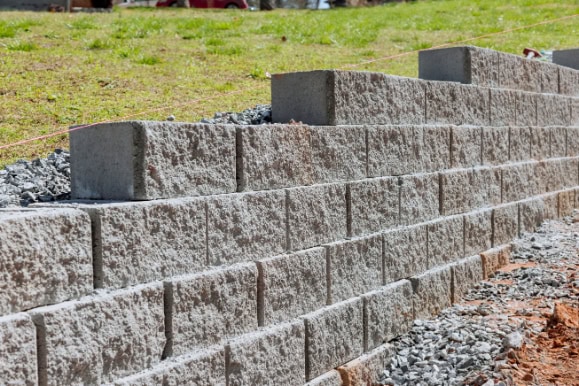
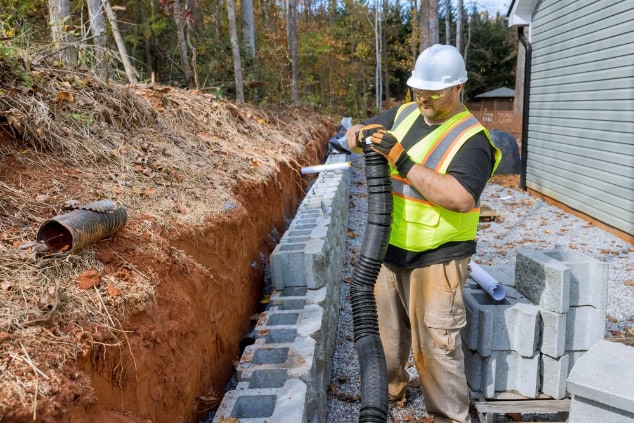
From there, you get a clear recommendation on materials and design whether that’s a VERSA-LOK segmental system, natural stone that fits the character of an older home, or concrete block suited to the structural load. Drainage is planned at this stage, not added as an afterthought. Gravel backfill, perforated drain pipe, and properly placed weep holes are part of the design, not optional upgrades.
One thing worth knowing before any work starts in Lansdowne: the borough requires a building permit for any retaining wall over 24 inches in height that’s half the standard Pennsylvania state threshold of 48 inches. A zoning permit is also required for any wall, regardless of height. If your property falls within the Lansdowne Park Historic District or the Henry Albertson Subdivision Historic District, a Certificate of Appropriateness from the Historic Architectural Review Board may be required before permits are issued. We navigate all of this upfront, so you’re not discovering a compliance issue mid-project.
Ready to get started?
The material you choose matters especially in southeastern Pennsylvania, where freeze-thaw cycles put real stress on anything built into the ground. Water infiltrates the soil behind a wall, freezes, expands, and pushes. If the drainage isn’t right and the material isn’t rated for that kind of cycling, you’ll see it bow, crack, or lean within a few winters. Treated timber can last 10 to 30 years. Concrete block runs 30 to 50. Natural stone, when it’s built correctly, can last a century which fits well on a street in the Lansdowne Park Historic District where the homes themselves are already 130 years old.
VERSA-LOK segmental retaining wall systems are a strong option for many Lansdowne properties. They require no frost footings, handle significant height with geogrid reinforcement, and can be shaped for curves, corners, and stairs which is useful on the irregular lot configurations common in older Delaware County boroughs. They’re also a practical choice when site access is tight, which it often is in a 1.2-square-mile borough where homes sit close together and driveways are narrow.
Every wall we build includes drainage as a core component not an add-on. Hydrostatic pressure from water trapped behind a wall is the leading cause of retaining wall failure, and it’s entirely preventable when drainage is addressed at the design stage. Most retaining wall projects in the Lansdowne area run between $3,500 and $10,000 depending on wall height, length, material, and site conditions. We provide clear, itemized estimates so you know exactly what you’re paying for before work begins.
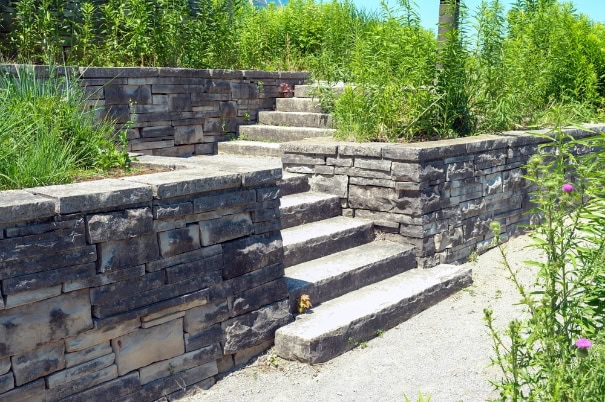
Yes and Lansdowne’s rules are stricter than most people expect. Pennsylvania’s standard building code exempts retaining walls under 48 inches from requiring a permit. Lansdowne Borough has modified that threshold: any retaining wall over 24 inches in height requires a building permit under Chapter 146 of the borough’s local code. That’s a significant difference, and it catches a lot of homeowners and contractors off guard.
On top of the building permit, a zoning permit is required for any wall in Lansdowne regardless of height. If your property is located within the Lansdowne Park Historic District or the Henry Albertson Subdivision Historic District both nationally registered historic areas you may also need a Certificate of Appropriateness from the Historic Architectural Review Board before any permits are issued. This applies to exterior changes visible from public ways, which can include front and side yard walls. Skipping this step doesn’t make the requirement disappear; it creates a compliance problem that can surface at resale or during a neighbor dispute. We handle the permit process as part of the project so you’re covered from day one.
Most residential retaining wall projects in the Lansdowne area fall between $3,500 and $10,000, though the range is wide because several factors shift the number significantly. Wall height, total length, material choice, and site conditions all play a role and in Lansdowne specifically, site access can be a real variable. Many properties in the borough have narrow driveways, close setbacks, and mature trees near the work area, which affects how materials get moved and how the crew works.
Material selection is one of the bigger cost drivers. Natural stone tends to run higher but lasts the longest which matters on a property that’s already 100 years old and where you’re not looking to revisit this in a decade. VERSA-LOK segmental systems sit in the middle range and offer good structural performance for the price. Treated timber is typically the lowest upfront cost but has the shortest lifespan in Pennsylvania’s climate. Beyond the wall itself, proper drainage gravel backfill, drain pipe, weep holes adds to the cost but is what keeps the wall standing. A wall without drainage is just a wall with an expiration date. We provide detailed estimates so you can see exactly where the money goes before committing.
The most common cause of retaining wall failure is water specifically, water that has no way to escape from behind the wall. When soil absorbs moisture and has nowhere to drain, it builds up hydrostatic pressure against the wall face. In Pennsylvania’s climate, that pressure gets compounded every winter when the water in the soil freezes, expands, and pushes laterally. Over time, even a well-built wall will bow, lean, or crack if drainage wasn’t part of the original design.
In Lansdowne, this risk is higher than average for a few reasons. The borough sits in the Darby Creek watershed, which is documented as stormwater-stressed due to dense development and high impervious surface coverage. A significant portion of Lansdowne’s housing stock dates to the late 1800s and early 1900s, meaning many existing walls were built in an era before modern drainage engineering and some have been patched rather than properly rebuilt over the decades. Signs that your wall may be at risk include visible leaning or bowing, cracks running horizontally along the face, soil pulling away from the top of the wall, or water pooling at the base after rain. Any of those warrants a professional assessment before the next hard winter.
Lifespan depends almost entirely on two things: the material and the drainage. In Pennsylvania’s climate with its freeze-thaw cycles, clay-heavy soils, and significant seasonal rainfall materials behave very differently over time. Treated timber typically lasts 10 to 30 years before it begins to rot, warp, or lose structural integrity. Concrete block and segmental systems like VERSA-LOK are rated for 30 to 50 years under normal conditions. Natural stone, when it’s properly built with good drainage behind it, can last a century or more which is why you’ll find stone walls on Lansdowne properties that are still standing after 80 or 100 years, even if they’ve settled or shifted.
The drainage piece is what most people underestimate. A wall built from premium materials but without proper drainage will fail faster than a modestly priced wall that was engineered correctly. Water is patient. It will find every weakness in a wall that wasn’t designed to handle it, and southeastern Pennsylvania gives it plenty of chances between spring rains, summer storms, and the freeze-thaw cycles that run from November through March. When you’re investing in a retaining wall on a property that’s already been standing for generations, it’s worth building it to last at least that long.
It can and in Lansdowne’s current market, the case for it is straightforward. Median home sale prices in the borough have risen roughly 12.9% year-over-year, which means your property is likely worth meaningfully more than it was 12 to 18 months ago. A retaining wall that stops active erosion, corrects drainage problems, and creates usable outdoor space protects that value. Property appraisers generally estimate that well-executed hardscaping returns between 100% and 200% of its cost at resale.
The flip side is also true. A visibly failing wall one that’s leaning, cracking, or showing signs of water damage signals deferred maintenance to buyers and can undermine an otherwise strong listing. In a market where buyers are comparing properties carefully, a wall that looks like a problem is a problem. Beyond resale, there’s the functional value: a properly graded and walled yard gives you outdoor space you can actually use. Many Lansdowne homeowners have slopes they’ve written off entirely too steep to mow, too eroded to plant, too close to the neighbor’s property to leave alone. A retaining wall solves that, often turning the most neglected part of a yard into its most useful.
Start with licensing. Pennsylvania requires contractors to register with the state, and you can verify any contractor’s license number through the PA Attorney General’s office. We hold active license PA057623 and carry a BuildZoom score of 102 placing us in the top 11% of over 125,000 licensed Pennsylvania contractors. That’s a verifiable number, not a marketing claim.
Beyond licensing, the questions that matter most are about process and accountability. Does the contractor know Lansdowne’s specific permit requirements including the 24-inch building permit threshold and the HARB overlay for historic district properties? Can they explain their drainage plan in plain language before a single block is placed? And critically who do you call if something comes up after the job is done? In a borough where homes are old, drainage is complicated, and post-project issues are a real possibility, a contractor who becomes unreachable after the final invoice is a real risk. Our one-crew model means the same team that built your wall is the team that answers the phone. There’s no subcontractor to point fingers at and no rotating staff to explain the situation to. That kind of accountability is worth factoring into your decision alongside the price.
Useful Links