
Hear from Our Customers

Standing water in a Lansdowne yard isn’t just a nuisance. It’s a slow threat to your foundation, your lawn, and the equity you’ve built in a home you’ve invested in. Once the drainage is right, that threat is gone and the yard you’ve been avoiding becomes one you can actually use again.
Lansdowne’s clay-heavy soil is a big part of why water sits where it does. Clay doesn’t absorb it holds. When rain hits a yard with compacted, clay-dense soil and grading that’s settled over eighty or a hundred years, the water has nowhere to go. A properly designed drainage system gives it a path, and the difference shows up fast: no more puddles three days after a storm, no more soggy corners eating away at your foundation’s base.
For homeowners near Scottdale Road or the southern sections of Lansdowne close to Darby Creek, there’s an added layer the creek’s influence on the local water table means subsurface drainage needs to be planned with that in mind, not ignored. Getting it right the first time means not dealing with it again next spring.
We’ve been doing drainage and grading work across Delaware County for over fifteen years. That’s not a number we throw out to sound impressive it means we’ve worked in the soil conditions, the tight lots, and the older housing stock that defines boroughs like Lansdowne. We know what pre-war construction looks like from the outside and what it means for drainage underneath.
We’re based in Aston, PA, which puts us squarely in the same county, same regulatory environment, and same climate as every property we work on in Lansdowne. Renato leads the crew personally, which means the person who walks your property and assesses the problem is connected to the team that actually does the work. No handoffs, no miscommunication, no surprises when the crew shows up.
Lansdowne is a borough people are genuinely investing in. Values are up, the revitalization is real, and homeowners here aren’t looking for a temporary patch they want something that holds. That’s how we approach every job.
It starts with a site assessment, not a sales pitch. Before anything is recommended, we walk the property and look at how water is actually moving or not moving. We evaluate the slope, the soil, the existing drainage features (or lack of them), and where the problem is originating. In Lansdowne, that often means looking at original grading that’s shifted over decades, clay soil that’s blocking absorption, and downspout systems that are sending water straight toward a foundation instead of away from it.
Once we understand what’s happening, we build a plan around the actual problem. That might mean a French drain, a catch basin, a dry well, surface regrading, or some combination of all of them. The solution depends on your specific yard not a template. Because Lansdowne Borough operates under a state-mandated stormwater management program, we design drainage systems with an eye toward how water is discharged and where it goes, keeping everything aligned with the borough’s requirements.
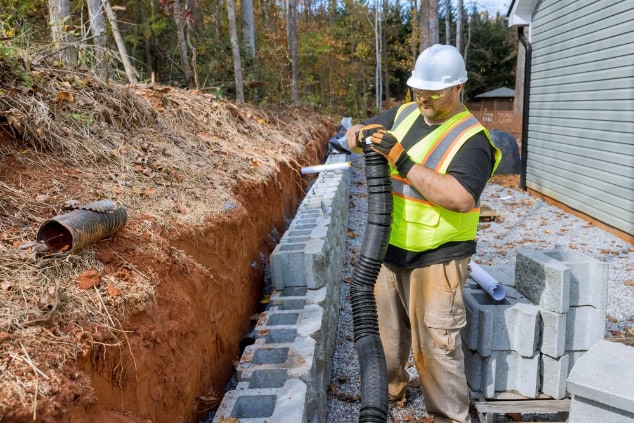
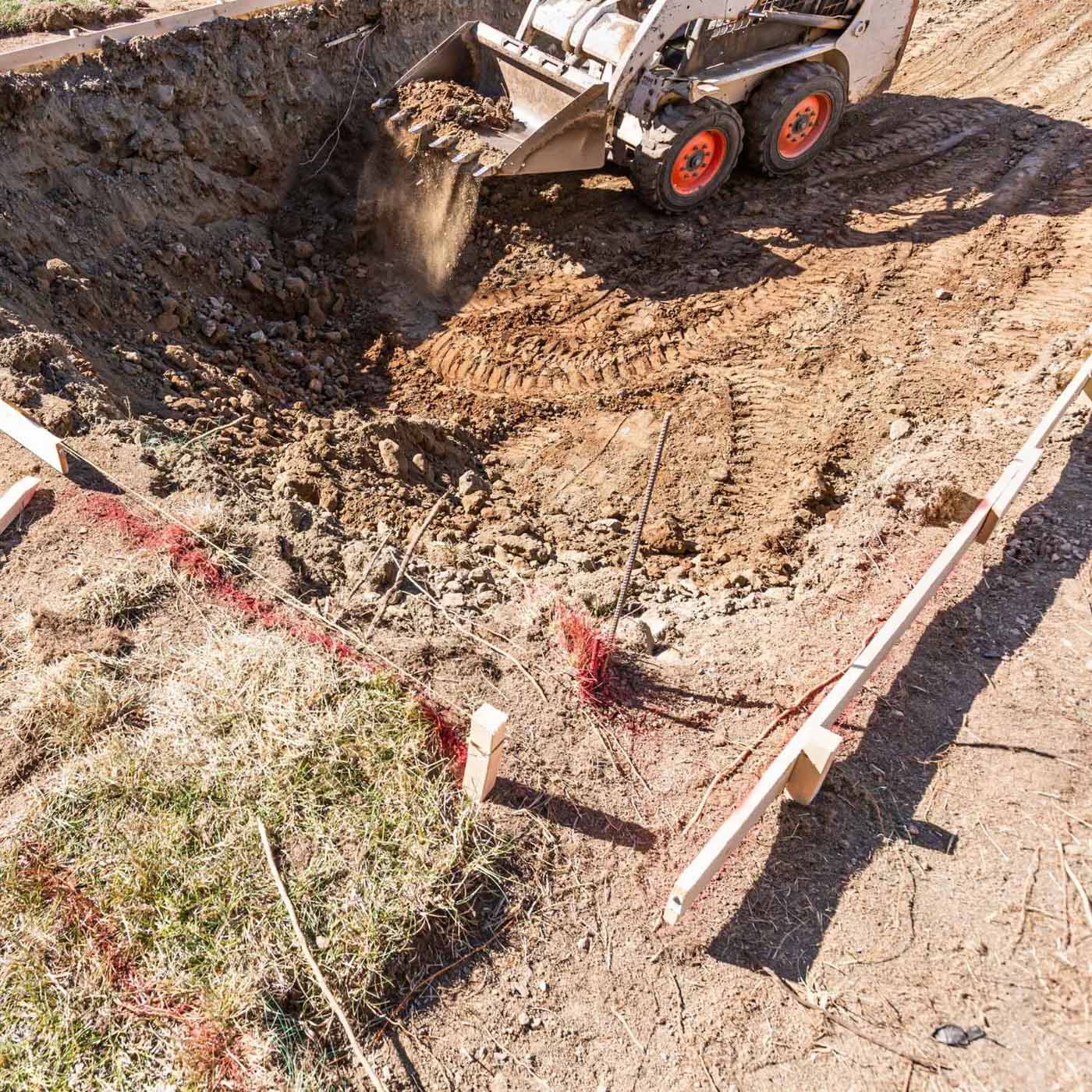
Installation is handled by one crew, start to finish. We handle the excavation, the pipe work, the gravel, and the cleanup. When we leave, your yard looks like work was done right not like a trench ran through it.

Ready to get started?
Lansdowne properties aren’t one-size-fits-all. A Victorian twin on a flat block has completely different drainage needs than a single-family home on a sloped lot near Hoffman Park or a property backing up to the Darby Creek corridor. That’s why every drainage system we install starts with a real assessment not a standard package dropped into whatever yard we’re standing in.
French drain installation is one of the most common solutions we use in Lansdowne because it directly addresses the clay-soil problem: a perforated pipe buried in gravel gives water a path through soil that would otherwise hold it indefinitely. For yards with low spots that collect water after every rain, catch basins provide a surface-level collection point that ties into an underground outlet. Dry wells work well where there’s room for water to disperse slowly into the soil below the clay layer. And in many cases, the most important fix is the simplest regrading the surface so water moves away from the structure instead of toward it.
Because so many Lansdowne homes were built before modern drainage standards existed, we also frequently find that original clay tile drain lines have collapsed or root-intruded over time. When that’s part of the problem, we address it directly rather than installing new drainage on top of a broken system.

The most common reason is a combination of two things: clay-heavy soil and grading that’s no longer doing its job. Lansdowne’s soil has a high clay and shale content, which means it doesn’t absorb water the way sandy or loamy soil does. When rain hits, it sits at the surface until it either evaporates or finds a low point to pool in and that low point is usually the worst possible place, like next to your foundation or in the middle of your yard.
The grading issue compounds it. Homes built before 1939 which describes nearly half of Lansdowne’s housing stock were graded at the time of construction, but that grading has had eighty to a hundred years to settle and shift. Slopes that once moved water away from a foundation can reverse over time. What you’re seeing after every rain isn’t bad luck. It’s the result of conditions that have been building for decades, and a proper drainage assessment will tell you exactly what’s driving it on your specific property.
A French drain is a trench filled with gravel and a perforated pipe that collects water underground and redirects it to a discharge point away from your home. It works by giving water a path of least resistance through soil that would otherwise hold it which is exactly why it’s one of the most effective solutions in Lansdowne, where clay soil is a consistent factor in yard drainage problems.
Whether you actually need one depends on what’s causing your specific drainage issue. If water is pooling because of surface grading problems, regrading may be the right fix on its own. If the issue is subsurface water moving toward your foundation, a French drain is likely part of the solution. If you have a low spot collecting runoff from multiple directions, a catch basin might be more appropriate. The only way to know for sure is a site assessment and that’s where every job we do starts. We don’t recommend a French drain unless it’s the right tool for what your yard is actually doing.
French drain installation in Delaware County typically ranges from around $2,000 to $9,000 or more depending on the length of the drain, the depth required, the soil conditions, and how accessible the yard is for equipment. In Lansdowne specifically, the compact lot sizes and clay-heavy soil can affect both the complexity and the cost clay soil is harder to excavate than sandy soil, and tight lots sometimes limit equipment access, which affects labor time.
The wide range in pricing reflects how different properties can be. A straightforward fifty-foot French drain in an accessible backyard is a very different project than a system that needs to work around a foundation, navigate mature tree roots, or tie into an existing catch basin. The best way to get an accurate number is to have the property assessed first. A quote built around your actual yard will be far more useful than a ballpark pulled from a general range, and it ensures you’re paying for what you need not a standard package that may or may not fit your situation.
It depends on the scope of the work. Lansdowne Borough operates under a Pennsylvania DEP MS4 stormwater permit, which means the borough has formal obligations around how stormwater is managed within its boundaries. Drainage installations that significantly alter how water flows on a property or that involve new connections to the municipal storm sewer system may require review or permitting through the borough’s Public Works department.
For most residential French drain installations and yard drainage work, the permit requirements are straightforward, and a contractor familiar with Lansdowne’s regulatory environment will know what applies to your specific project. Pennsylvania also requires that any excavation work be preceded by a PA 811 call the “call before you dig” requirement that ensures underground utilities are marked before any digging begins. This is a standard part of every job we do. If your project does require a permit, we’ll walk you through what’s needed so there are no surprises before work starts.
Darby Creek forms the southwestern and southern border of Lansdowne Borough, and its presence has a real effect on drainage conditions for properties in that part of the borough particularly those near Scottdale Road, Hoffman Park, and the areas closest to the creek corridor. The main impact is on the local water table. During heavy rain events or spring runoff, the water table in those areas rises, which means subsurface drainage systems face backpressure from below, not just from surface rainfall above.
For homeowners in those sections of Lansdowne, this matters when designing a drainage solution. A French drain that works perfectly on a property with a stable water table may underperform if the discharge point or pipe depth isn’t calibrated for a high water table environment. It’s not a reason to avoid drainage work it’s a reason to make sure whoever is designing the system understands the local hydrology. We factor Darby Creek’s influence into drainage plans for properties in the southern sections of Lansdowne as a standard part of the assessment process.
It starts as annoying and becomes dangerous over time that’s the honest answer. Water that consistently pools near a foundation is applying hydrostatic pressure against the foundation wall every time it accumulates. Over months and years, that pressure works its way into small cracks, expands them during Delaware County’s freeze-thaw cycles, and creates pathways for moisture intrusion into the basement or crawl space. What starts as a soggy corner of the yard can eventually show up as efflorescence on basement walls, musty odors, or actual water in the basement.
In Lansdowne, where so many homes are over eighty years old and were built without modern waterproofing or drainage engineering, the foundation is often already working with a thinner margin than a newer home would have. The freeze-thaw cycles that Delaware County gets every winter accelerate the damage water gets into a small crack, freezes, expands, and widens it. Addressing the drainage problem on the exterior, before it becomes a foundation repair or mold remediation situation, is almost always significantly less expensive than dealing with the consequences of leaving it alone.
Useful Links