
Hear from Our Customers
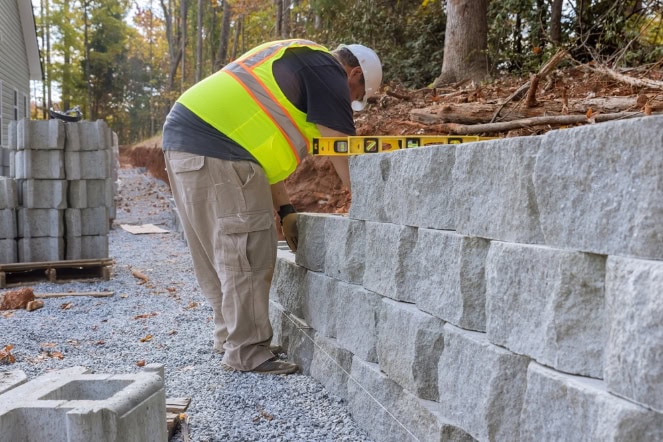
Chester Heights sits on rolling Piedmont-transition terrain with clay-heavy soil that swells when it’s wet and contracts when it dries out. That movement puts constant lateral pressure on anything holding it back. A wall that isn’t engineered for that specific condition with drainage built in from the start doesn’t last. You end up with bowing blocks, shifted timbers, or a slope that’s worse than before you spent the money.
When it’s done right, the difference is immediate. You get usable yard space where there was a problem slope. You get erosion control that actually holds through the kind of spring runoff that follows a Delaware County winter. Older homes throughout Chester Heights frequently have natural grade changes that were never properly addressed or were addressed decades ago with walls that are now well past their lifespan. A new wall, built with proper drainage and the right materials for this soil, stops that cycle for good.
The return on that investment is real. Property appraisers consistently put well-designed retaining walls at 100–200% ROI, and in a market where Garnet Valley School District drives long-term homeownership and buyers notice what’s been maintained, a functional, clean retaining wall signals that this property has been taken care of.
We’re based in Aston the municipality Chester Heights was part of until 1945. That’s not a trivia point. It means we work on the same clay soil, the same grade changes, and the same freeze-thaw conditions that affect your property. We’re not a company dispatching crews from across the county. We’re your neighbor.
Renato Spennato holds active Pennsylvania contractor license PA057623, with a BuildZoom score of 102 placing our company in the top 11% of licensed contractors statewide. More importantly, the same team that builds your wall is the team that answers the phone if something comes up later. No subcontractors. No handoffs. No disappearing act after the final invoice.
Chester Heights homeowners are long-term investors in their properties. You chose this borough for a reason the school district, the character, the community. We build retaining walls that match that investment mindset: engineered for durability, designed for your specific site, and built by people who stand behind the work.
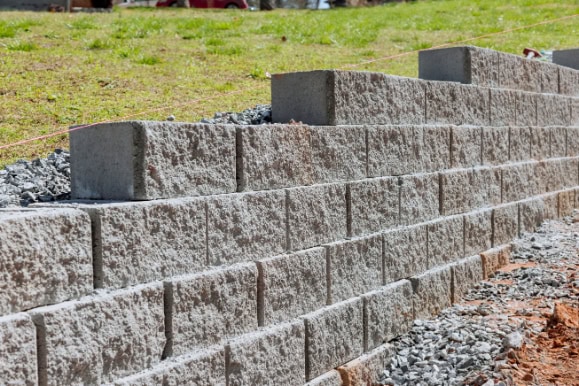
It starts with a site assessment, not a sales pitch. We look at your slope angle, your soil composition, how water moves across your property, and what’s loading the grade above the wall whether that’s a driveway, a structure, or just the natural terrain. In Chester Heights, that assessment almost always turns up drainage considerations that need to be planned before anything else. Clay soil doesn’t forgive poor drainage. We design the drainage system first, then select the material that fits the job.
From there, we walk you through the permit picture. Chester Heights Borough administers both building permits and zoning permits for retaining wall projects. Walls over four feet require a building permit under Pennsylvania’s Uniform Construction Code, but even shorter walls can require a zoning permit depending on placement and load. We handle that process so you’re not guessing, and so you’re protected at resale and with your insurance.
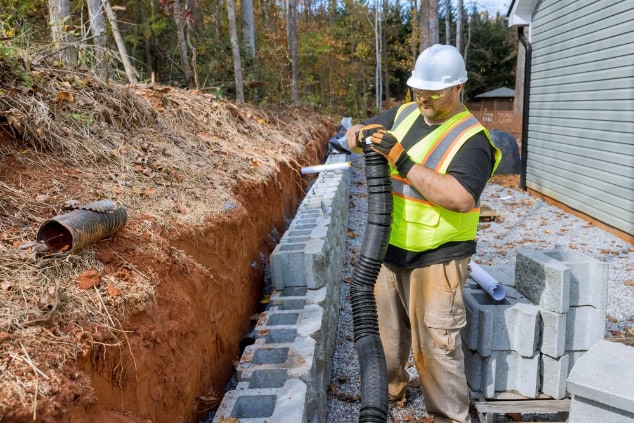
Once permits are in order, installation follows a clear sequence: excavation, compacted gravel base, wall construction with proper batter and drainage aggregate behind it, and backfill in compacted lifts. Taller walls get geogrid reinforcement. The timeline is set before we start, not adjusted week by week. When we leave, the site is clean, the wall is done, and you know exactly what was built and why.
Ready to get started?
Not every retaining wall in Chester Heights needs the same solution. A low decorative wall along a garden bed on a gentle grade has different structural requirements than a wall holding back a significant slope next to a driveway or one that’s managing drainage toward a foundation. The material choice follows the job, not the other way around.
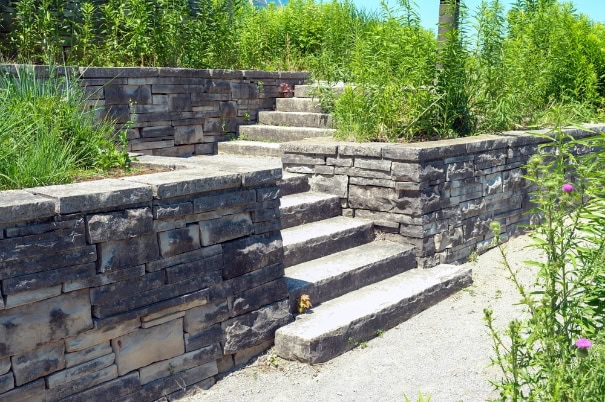
For properties where historical character matters and in a borough with fieldstone homes dating to the 1720s, it often does natural stone is an option that fits the aesthetic without looking like an afterthought. For structural applications that demand engineered performance, VERSA-LOK modular block is a proven system that handles Delaware County’s climate and soil conditions well. Concrete block works for heavy-load applications where function outweighs form. We’ll tell you which one makes sense for your specific site and why.
Every project includes drainage planning, proper base preparation, and backfill compaction not as upsells, but as standard parts of the process. These are the details that determine whether a wall lasts five years or fifty. We also carry full documentation of materials and installation for your records, which matters if you ever sell a property in a market where buyers and their inspectors look closely at what’s been done.
The short answer is: it depends on the height and placement, but you should always check with Chester Heights Borough before assuming you don’t need one. Under Pennsylvania’s Uniform Construction Code, retaining walls under four feet generally don’t require a building permit unless the wall is supporting a surcharge load like a driveway or structure, or impounding certain liquids. Walls four feet and taller do require a building permit from the borough.
What many homeowners don’t realize is that Chester Heights also administers a separate zoning permit process. A wall can be below the building permit threshold and still require zoning approval depending on where it’s located on the property. The borough’s permit office is at 53 W. Baltimore Pike, and they maintain an active fee schedule and a functioning Zoning Hearing Board. We handle the permit navigation on every project so you’re covered at resale, with your neighbors, and with your insurance.
Most residential retaining wall projects in Delaware County fall somewhere between $3,500 and $10,000, with per-linear-foot pricing ranging from around $40 on the low end to $345 or more for taller walls with complex drainage requirements or premium materials. The biggest cost variables are wall height, material selection, site accessibility, and how much drainage engineering the project needs.
In Chester Heights specifically, the clay-heavy soil and rolling terrain mean drainage is rarely a minor consideration. A wall on a property with significant grade change and saturated clay behind it needs more robust drainage infrastructure than a simple decorative wall on a flat lot and that affects cost. The good news is that a properly built wall in this market carries real financial return. Property appraisers consistently estimate 100–200% ROI on well-designed retaining walls, and in a Garnet Valley School District market where buyers look carefully at what’s been maintained, quality hardscaping is noticed. The cost of rebuilding a failed wall typically $3,000–$8,000 or more is almost always higher than the cost of building it right the first time.
The most common cause of retaining wall failure in Pennsylvania is poor drainage specifically, water that builds up behind the wall and creates hydrostatic pressure. When water saturates clay soil, which is common throughout Delaware County including Chester Heights, the lateral force against the back of a wall can reach thousands of pounds. A wall that wasn’t designed to relieve that pressure will bow, crack, or topple.
The second major factor is freeze-thaw cycling. Pennsylvania winters put retaining walls through repeated cycles of soil expansion and contraction as moisture freezes and thaws. Walls without proper drainage hold more moisture behind them, which means more ice formation and more pressure during freeze events. This is why drainage planning has to come before material selection not after. Walls built in Chester Heights without addressing drainage first are essentially on a timer. Properly installed drainage aggregate, outlet pipes, and a compacted gravel base behind the wall are what separate a 50-year wall from one that’s leaning by year three.
The right material depends on what the wall actually needs to do. For structural walls on steeper grades or next to driveways, VERSA-LOK modular concrete block is one of the most reliable options in Delaware County’s climate. It’s engineered for the kind of load and drainage requirements that come with Piedmont-transition terrain, and it holds up well through Pennsylvania’s freeze-thaw cycles. Concrete block is a solid choice for heavy-load applications where structural performance is the priority.
For Chester Heights properties where aesthetics matter alongside function and in a borough with homes dating to the 1720s, that’s a real consideration natural stone can be designed to complement the character of older fieldstone and brick construction without looking out of place. Treated timber is the most affordable option but has the shortest lifespan, typically 10–30 years, and it doesn’t perform as well in consistently wet conditions. Given Delaware County’s 42 inches of annual rainfall and clay-heavy soil, timber walls tend to hit the low end of that range. We’ll give you an honest assessment of which material fits your site, your budget, and your timeline not just the option with the best margin for us.
Lifespan varies significantly by material and, more importantly, by how well the wall was installed. Treated timber walls typically last 10–30 years under normal conditions, and closer to the low end in consistently wet environments like Delaware County. Concrete block and modular systems like VERSA-LOK are rated for 30–50 years. Natural stone, when properly installed, can last 100 years or more which is why some of the original fieldstone structures in Chester Heights are still standing after three centuries.
The bigger factor than material, though, is drainage. A concrete block wall with poor drainage will fail well before its rated lifespan. A natural stone wall with proper drainage and a solid base will outlast almost anything. In Chester Heights, where clay soil and seasonal freeze-thaw cycles put constant stress on retaining structures, the installation quality matters more than the sticker on the block. That’s why we start every project with drainage planning, not material selection. A wall that drains correctly has a fighting chance of reaching its rated lifespan. One that doesn’t is already working against itself on day one.
There are a few signs that point clearly toward replacement rather than repair. If the wall is visibly leaning or bowing especially if it’s moved more than an inch out of plumb the structural integrity is compromised and repair is unlikely to hold long-term. Horizontal cracking in a mortared or concrete wall, large gaps between blocks or stones, and active erosion channels behind or beneath the wall are all indicators that the drainage has failed and the wall is working against soil pressure it was never equipped to handle.
In Chester Heights, a lot of the older retaining walls we assess were installed in the 1970s through 1990s many of them timber or mortared block, which puts them at or past the end of their functional lifespan. A wall that was built before proper drainage standards were common in residential hardscaping is often a wall that was never going to make it to 40 years. If your wall is showing movement, erosion, or visible structural distress, the honest answer is usually that patching it delays the inevitable and costs more in the long run. We’ll give you a straight assessment during the site visit what’s salvageable, what isn’t, and what rebuilding would actually involve.
Useful Links
Other Services we provide in Chester Heights