
Hear from Our Customers
Erosion doesn’t announce itself. It just slowly takes your yard — a few inches of soil here, a crumbling edge there — until one season you look out and realize the slope that used to be flat is now a problem you can’t ignore. A properly built retaining wall stops that cycle and gives you back usable space you didn’t know you were losing.
For homes near Marcus Hook, that problem runs deeper than most. The borough sits right on the Delaware River, and the clay-heavy soil throughout Delaware County doesn’t drain the way sandy soil does — it holds water, expands, and pushes hard against anything in its way. Add Pennsylvania’s freeze-thaw winters to that equation and you’ve got conditions that will expose every flaw in a wall that wasn’t built with drainage in mind from the start.
The difference between a wall that lasts 10 years and one that lasts 50 comes down to what happens behind it — the base, the backfill, the drainage pipe, the compaction. When that’s done right, the wall doesn’t just hold the slope. It protects your foundation, reclaims flat yard space, and adds real value to a home that’s worth protecting.
We’re based in Aston — just a few miles up Route 452 from Marcus Hook — and have been doing hardscaping and retaining wall work across Delaware County for over a decade. This isn’t a company dispatching crews from Philadelphia or across the state line. We know this ground: the clay soil, the drainage challenges, the borough codes, and what it actually takes to build something that holds in this part of Pennsylvania.
Every project is handled by one consistent crew — the same people who walk the site with you at the start are the ones finishing the job. That matters in a community like Marcus Hook, where the work speaks for itself. Renato Spennato is hands-on throughout, not managing from a distance.
Our track record in Delaware County speaks for itself. One well-built wall in a tight-knit neighborhood tends to generate calls from the next street over. That’s the kind of reputation that only comes from doing the work right.
It starts with an on-site assessment. Before anything is quoted or planned, the slope, soil, and drainage conditions of your specific property get evaluated in person. In Marcus Hook, that means paying close attention to how water moves across the lot — especially on properties closer to the waterfront or on the lower end of the borough’s street grid where stormwater runoff tends to concentrate.
From there, we build a material and drainage plan around your site — not a generic package. Wall height, block type, batter angle, base depth, and drain pipe placement are all determined by what your property actually needs. Marcus Hook Borough’s zoning ordinance requires a permit before any wall goes up, regardless of height, and we handle that step before construction begins so you’re not left dealing with compliance issues after the fact.
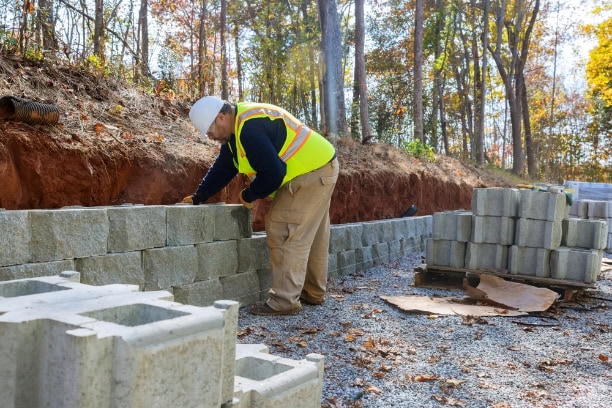
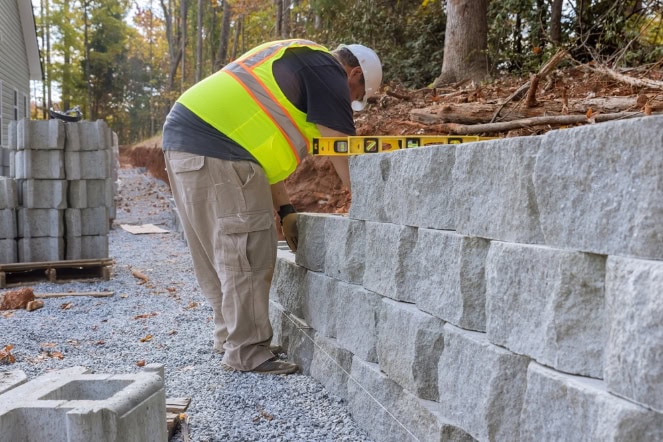
Once the plan is set and permits are in order, installation follows a structured sequence: excavation, compacted gravel base, block placement with proper batter, clean stone backfill, perforated drain pipe, and final grading. No shortcuts in the middle because that’s exactly where most walls fail. When we leave, the job is done — not almost done.
Ready to get started?
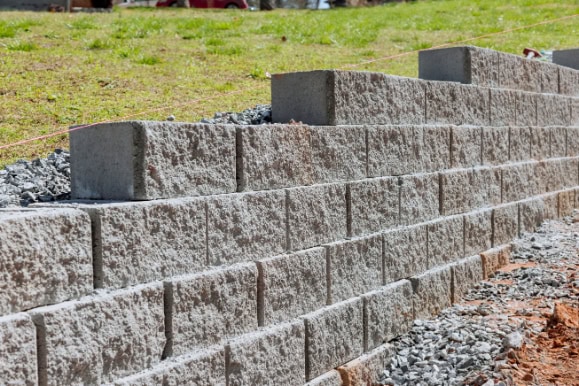
Not every slope calls for the same solution, and we don’t treat them like they do. Material selection — whether that’s Versa-Lok segmental block, natural stone, Pennsylvania fieldstone, or concrete block — is based on the load, the drainage demands, the height of the wall, and what will actually look right on your property. Versa-Lok systems, for example, are a strong fit for many Marcus Hook properties because they don’t require frost footings, which matters in a climate where the ground freezes and thaws repeatedly through winter. Properly installed and drained, they’re rated for 50-plus years.
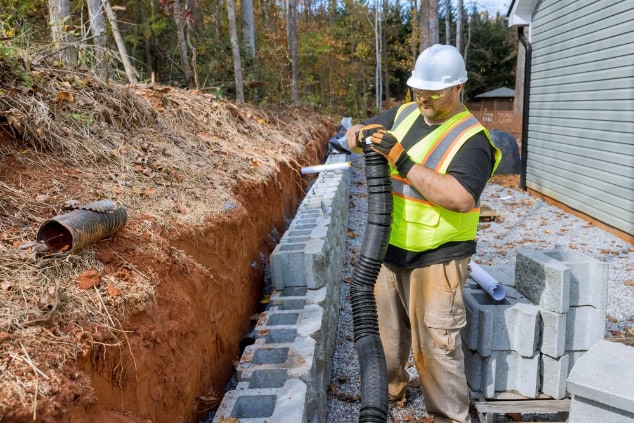
For taller walls — anything approaching or exceeding four feet — geogrid soil reinforcement gets integrated into the build to manage the lateral pressure that Delaware County’s clay-heavy soil generates. That’s not optional in this region; it’s what keeps a wall from leaning five years down the road. Every wall we build also includes a drainage system at the base: perforated pipe, clean stone backfill, and proper outlet routing so water has somewhere to go that isn’t directly behind your wall.
Marcus Hook homeowners also get the benefit of working with a contractor who understands the local zoning requirements. The borough requires a zoning permit before any wall is erected — a step that’s easy to miss and costly to ignore. We handle that as part of the process, not left for you to figure out on your own.
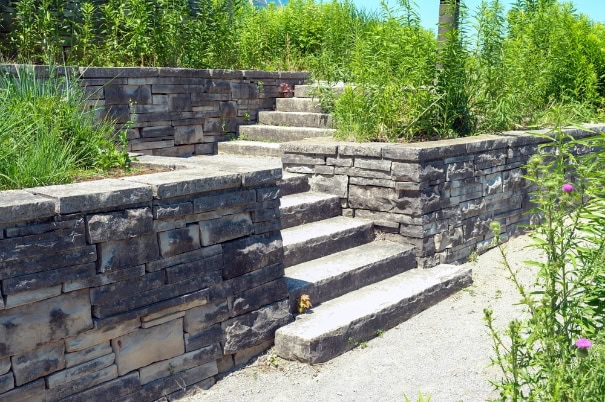
Yes — and this is one of the most common things Marcus Hook homeowners get wrong. Pennsylvania’s statewide building code exempts retaining walls under four feet from building permit requirements, but Marcus Hook Borough’s own zoning ordinance adds a layer on top of that. The borough requires a zoning permit before the erection of any wall, regardless of height. That means even a two-foot garden wall technically needs a permit in Marcus Hook before construction starts.
Skipping that step can result in fines, a stop-work order, or complications when you go to sell the property. It’s not a difficult process, but it does need to happen before the first block goes in the ground. We handle this as part of the project so you’re not left navigating borough code on your own. For walls over four feet — especially those supporting a driveway, patio, or structure above — a full building permit and sometimes engineering review will also be required.
A well-built retaining wall with proper drainage can last 50 years or more in Pennsylvania. The keyword there is proper drainage. Pennsylvania’s freeze-thaw cycle is the single biggest threat to retaining wall longevity in this region — water that collects behind an improperly drained wall expands when it freezes, exerting enormous lateral pressure that causes leaning, cracking, and eventually collapse. That process can happen gradually over several winters before the damage becomes visible.
In Delaware County specifically, the clay-heavy native soil makes this even more critical. Clay holds water longer than sandy or loamy soil, which means more hydrostatic pressure building up behind the wall after every rain event. A wall built with a compacted gravel base, clean stone backfill, and a perforated drain pipe at the footing is designed to relieve that pressure before it accumulates. That’s the difference between a wall you replace in a decade and one your grandkids inherit.
It depends on the specific conditions of your property — height, slope, load, and drainage — but Versa-Lok segmental block is a strong fit for many residential properties in this area. It doesn’t require frost footings, which is a real advantage in a climate where the ground freezes and thaws multiple times each winter. The blocks are dry-stacked and pinned, and for walls over three to four feet, geogrid reinforcement gets integrated into the build to handle the lateral pressure from Delaware County’s clay soil.
Natural stone and Pennsylvania fieldstone are good options when the aesthetic matters as much as the function — they tend to blend well with the older housing stock in Marcus Hook and the surrounding Delaware County neighborhoods. Concrete block is durable and cost-effective for more utilitarian applications. The honest answer is that material selection should follow a site assessment, not a sales pitch. What works on a flat lot in one part of the borough may not be the right call for a sloped property closer to the waterfront.
Retaining wall costs vary based on wall height, length, material, and how much drainage and excavation work the site requires. For a basic segmental block wall, you’re generally looking at somewhere in the range of $25 to $50 per square foot installed — but that number shifts depending on conditions. A taller wall that requires geogrid reinforcement, a property with significant slope, or a site with complex drainage routing will cost more than a straightforward low wall on a relatively flat lot.
What’s worth understanding in Marcus Hook specifically is that the cost of doing it right upfront is almost always less than the cost of fixing a wall that was done wrong. A wall that fails because drainage wasn’t addressed means excavation, disposal, and full reinstallation — plus whatever damage accumulated to the surrounding soil and foundation in the meantime. Getting an accurate quote starts with a site visit, because no reputable contractor can give you a real number without seeing the property first.
Yes — when it’s designed with drainage as part of the plan, not as an afterthought. A retaining wall by itself doesn’t solve a drainage problem. But a retaining wall built with a perforated drain pipe at the base, clean stone backfill, and proper outlet routing actively redirects water away from your foundation and off your property in a controlled way. That’s a meaningful difference for homeowners dealing with soggy yards, basement seepage, or soil that erodes after every heavy rain.
Marcus Hook Borough’s own stormwater management guidance addresses erosion control and drainage as ongoing concerns for residents — and for good reason. The borough’s position near the Delaware River, combined with older housing stock that predates modern drainage engineering, means a lot of properties are managing water the hard way. A properly built retaining wall won’t fix every drainage issue on a property, but it can be a significant part of a real solution, especially on sloped lots where runoff has nowhere controlled to go.
The signs worth paying attention to are leaning or bowing in the wall face, cracks running horizontally across the blocks or stones, soil pushing through gaps, and water pooling directly behind or at the base of the wall after rain. Any of those individually warrants a closer look. More than one showing up at the same time usually means the drainage behind the wall has failed and the structure is already under stress it wasn’t designed to handle.
In Marcus Hook and across Delaware County, a lot of the retaining walls that are showing these symptoms were built without adequate drainage — either because they predate modern standards or because drainage was skipped to cut costs. Sometimes the wall face itself is still structurally sound and targeted repairs can address the problem. Other times, the damage behind the wall has progressed far enough that a full rebuild is the only fix that will actually last. The only way to know for certain is a site assessment that looks at what’s happening behind the wall, not just what’s visible on the surface.
Useful Links
Other Services we provide in Marcus Hook