
Hear from Our Customers
The most common reason retaining walls fail in Broomall has nothing to do with the blocks. It’s the water. Marple Township sits in the Darby Creek watershed, and a lot of the properties here especially the split-levels and raised ranches off Sproul Road sit on natural drainage gradients that push water straight toward whatever is holding your slope in place. When that drainage isn’t engineered into the wall from the start, you get hydrostatic pressure building behind the structure season after season until something gives.
A properly built retaining wall changes how your yard actually functions. Slopes that were too steep to mow or too unstable to plant become level, usable space. Soil that was washing onto your driveway or your neighbor’s property stops moving. And the foundation drainage issues that come with Broomall’s clay-heavy Piedmont soils the kind that hold water instead of releasing it get addressed structurally, not just cosmetically.
There’s also the equity side of this. With median home values in Broomall approaching $700,000, the condition of your outdoor infrastructure matters at resale. A failing wall, an eroding slope, or standing water in the backyard is something buyers negotiate against or walk away from. A well-built wall returns 100 to 200 percent of its cost at appraisal. That’s not a sales pitch; that’s what property appraisers report consistently.
We’re based in Aston, about 12 miles south of Broomall on I-476. That matters because Delaware County isn’t a service area we added to a list it’s the only place we work. The terrain in Marple Township, the drainage patterns near Darby Creek, the clay soils, the rolling Piedmont grades these aren’t new to us. We’ve been building on this ground for years, and we know exactly what Broomall properties need to stay stable.
What also matters is how we’re structured. There are no subcontractors on a Spennato job. The crew that shows up to your property in Lawrence Park or near Paxon Hollow is the same crew that designed the wall, pulled the permit, and will still answer the phone if you have a question two years from now. That’s not a small thing in a category where the most common complaint is that the contractor disappears the moment the final payment clears.
We hold an active Pennsylvania contractor license (PA057623) and carry a BuildZoom score of 102 top 11% of over 125,000 licensed contractors statewide. That’s the baseline. The work is what backs it up.
Every project starts with an on-site assessment not a phone estimate, not a ballpark based on photos. Renato walks the property, reads the slope, evaluates the drainage patterns, and looks at what’s already there. On a 1950s or 1960s Broomall property, that often means assessing an existing wall that’s already at or past its design life. Timber walls from that era have a 10 to 30-year lifespan. If yours is still standing from the original build, it’s been running on borrowed time.
From there, the design gets built around your specific site material selection, drainage system layout, wall height and step configuration, and how everything ties into the existing grade. In Marple Township, every retaining wall permit requires approval from the Township Engineer before it can be issued. That’s not a standard PA requirement it’s specific to Marple Township, and it’s the kind of detail that slows down contractors who aren’t familiar with local municipal process. We handle that from the start so it doesn’t become your problem mid-project.
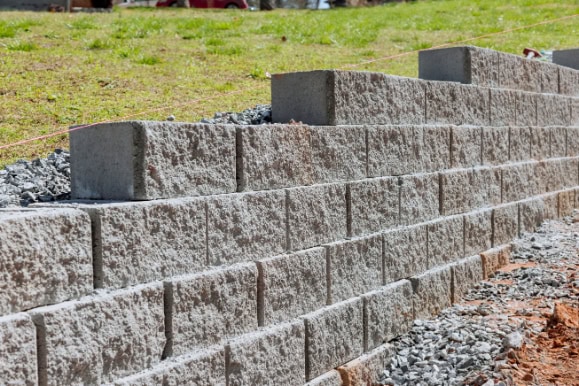
Once permits are approved, installation follows a defined sequence: excavation and base preparation, compacted aggregate drainage layer, block placement with proper batter and pinning, backfill compaction, and drainage outlet placement. When the job is done, you get a walkthrough of what we built and why not just a handshake and an invoice.
Ready to get started?
Broomall averages a January temperature of just under 32 degrees. That means every winter, the soil behind your retaining wall freezes, expands, and then thaws applying and releasing lateral pressure on the wall’s structure over and over across the season. It’s one of the primary reasons walls in Delaware County start bowing or leaning within a few years of installation, even when they looked solid at first. The fix isn’t a stronger wall it’s a wall that was designed with freeze-thaw movement in mind from the beginning.
We install VERSA-LOK retaining wall systems for most residential projects in Broomall. The pinning system handles thermal movement without requiring frost footings, and the design range straight walls, curves, corners, columns, stairs, freestanding walls means the system fits the property rather than the other way around. For homeowners near Paxon Hollow or in areas where natural aesthetics matter more, natural stone is an option that integrates with mature trees and established landscaping and can last well over a century when properly installed.
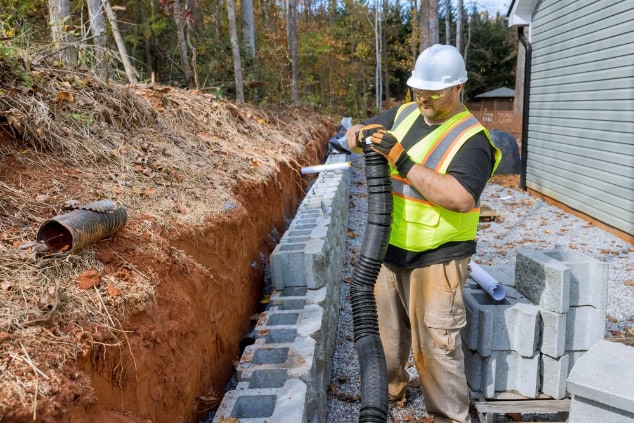
Every wall we build includes engineered drainage drainage aggregate, perforated pipe, and weep holes because in Broomall’s watershed terrain, drainage isn’t an upgrade. It’s the structure. The material you choose affects your upfront cost and your long-term maintenance picture. Treated timber runs 10 to 30 years. Concrete block runs 30 to 50. Natural stone, installed correctly, outlasts the house. We’ll walk you through what makes sense for your specific site, your budget, and how long you plan to be there.
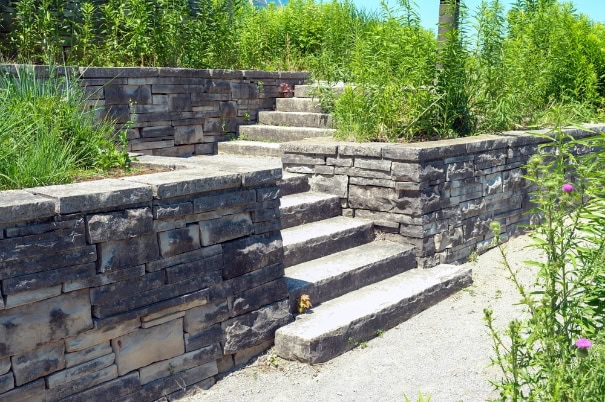
Yes and the process in Marple Township is more involved than most homeowners expect. Under Marple Township’s Uniform Construction Code, retaining walls require a permit regardless of height. There’s no small-wall exemption. But the part that catches a lot of contractors off guard is that Marple Township also requires every retaining wall permit application to be reviewed and approved by the Township Engineer before the permit can be issued. That’s a specific local requirement, not a standard Pennsylvania provision.
What this means practically is that your permit application needs to include a property survey or plot plan showing the proposed wall location, and the design has to be solid enough to pass engineering review. If your contractor isn’t familiar with this process, you could be looking at significant delays or back-and-forth with the township that pushes your project weeks off schedule. We handle the Marple Township permitting process regularly, so it doesn’t become a surprise in the middle of your project. Getting this right from the start also protects you at resale unpermitted walls are a liability that buyers and inspectors will flag in Broomall’s competitive real estate market.
Retaining wall pricing has a wide range roughly $40 to $345 per linear foot depending on material, wall height, site conditions, and drainage requirements. Most residential projects in Broomall land somewhere between $3,500 and $10,000, though more complex installations on sloped lots or properties with significant drainage challenges can run higher. The range exists because a timber garden wall and a VERSA-LOK system engineered for a 4-foot grade change on a clay-heavy slope are genuinely different projects.
The factors that drive cost up in Broomall specifically are the drainage requirements and the permit process. Properties in the Darby Creek watershed often need more robust drainage systems than flat-terrain sites. And because Marple Township requires Township Engineer approval for every retaining wall permit, there’s real engineering involved before a block gets set. Contractors who quote low and skip the drainage work or pull the wrong permit aren’t saving you money they’re moving the cost to a future repair or a compliance problem. When you get a quote from us, we’ll walk through what’s driving each line item so you understand exactly what you’re paying for and why.
Pennsylvania’s freeze-thaw cycle is the main variable you’re designing around. When water gets into the backfill behind a wall and freezes, it expands and that expansion puts lateral pressure on the wall. Do that enough times across enough winters and even a structurally sound wall will start to bow or lean. So the right material isn’t just about aesthetics or budget; it’s about how well the system handles thermal movement and moisture.
VERSA-LOK concrete block is what we use on most Broomall residential projects. The interlocking pin system handles freeze-thaw movement without needing frost footings, which simplifies installation and improves long-term performance. Natural stone is the right call when the property has mature landscaping or a traditional aesthetic and when installed correctly, it can last over a century. Treated timber is the least expensive option upfront, but with a design lifespan of 10 to 30 years, it’s often not the right call for a Broomall property where the original timber walls from the 1950s and 1960s are already failing. Whatever material fits your project, drainage aggregate and perforated pipe go in behind every wall we build because no material performs well when water is trapped behind it.
The most obvious signs are visible the wall is leaning or bowing outward, blocks or stones are shifting out of place, there’s cracking running along the face or through the joints, or soil is visibly washing out from behind or underneath the base. Any of those warrant a professional look before the next winter adds another freeze-thaw cycle to the stress the wall is already under.
The less obvious sign is age. If your home was built in the 1950s or 1960s which covers the majority of Broomall’s housing stock and the retaining wall has never been replaced, it may be original to the property. Timber walls from that era have a design lifespan of 10 to 30 years. Concrete block walls run 30 to 50. A wall that was built when your home was constructed has been in the ground for 60 to 80 years. It doesn’t have to be visibly failing to be structurally compromised. An on-site assessment will tell you whether you’re dealing with a repair, a reinforcement, or a full replacement and what the drainage situation looks like behind the wall, which is usually where the real story is.
For most residential retaining wall projects in Broomall, the physical installation takes anywhere from one to three days once permits are in hand and materials are staged. Larger projects with significant grading, tiered walls, or integrated stairwork can run longer. The installation itself is usually the shortest part of the timeline.
The part that takes the most time is permitting. In Marple Township, the Township Engineer has to review and approve your permit application before work can begin and that review process adds time that isn’t always predictable. We factor this into the project schedule from the start so you’re not waiting on a permit that was submitted late. The other timing factor worth knowing is seasonal demand. In Delaware County, retaining wall inquiries spike in spring when freeze-thaw damage becomes visible after winter. Quality contractors typically book 4 to 8 weeks out during peak season. If you’re seeing a problem now, getting on the schedule sooner rather than later is the practical move not because of any sales pressure, but because the wall isn’t going to hold itself together while you wait.
Broomall sits in the Darby Creek watershed, and a significant portion of the residential properties here particularly those on the rolling terrain east of Sproul Road sit on natural drainage gradients. The soils in Marple Township’s Piedmont terrain are clay-heavy, which means they hold water instead of releasing it. When water accumulates behind a retaining wall and has nowhere to go, it builds hydrostatic pressure against the back of the wall. That pressure is the single most common cause of retaining wall failure, regardless of how well the wall itself was constructed.
Marple Township’s own grading and drainage code reflects this reality it explicitly requires that stormwater management prevent the discharge of excess runoff onto adjacent properties, which means your drainage problem can become a neighbor’s problem and a code violation if it isn’t handled correctly. Every wall we build includes a drainage system designed for the specific site: drainage aggregate directly behind the wall, perforated pipe to move water laterally, and weep holes to release pressure. This isn’t optional on a Broomall property it’s the part of the wall that determines whether it’s still standing in 20 years.
Useful Links