
Hear from Our Customers
If you’ve watched soil wash across your driveway after a hard rain, or noticed an old wall starting to lean after winter, you already know the problem isn’t going away on its own. Brookhaven’s housing stock was built mostly in the 1950s and 1960s and original retaining walls from that era are either already failing or close to it. Timber walls from that period have a 10 to 30 year lifespan. Concrete block walls top out around 50. If your wall is original to the home, the math isn’t in your favor.
What a properly built retaining wall actually gives you is stability not just structural, but practical. That slope you’ve been avoiding becomes usable yard. The erosion eating at your foundation stops. The drainage problem that’s been quietly working against your property gets solved at the source. Property appraisers put 100 to 200 percent ROI on well-designed retaining walls, and for a Brookhaven home valued around $307,000, that’s a real number attached to a real investment.
Brookhaven’s position between two creek watersheds means water moves through and across properties here constantly. About 46 inches of rain falls in this area every year, spread across every season there’s no dry stretch that gives a poorly drained wall a break. Add Delaware County’s freeze-thaw cycles and clay-heavy soils, and the case for getting drainage right the first time becomes pretty hard to argue with.
We operate out of Aston Township one of only three communities in the Penn-Delco School District alongside Brookhaven and Parkside. That’s not a coincidence worth ignoring. When you’re dealing with the specific soil conditions, slope patterns, and drainage dynamics of properties in Brookhaven and the surrounding area, it matters that your contractor already knows the terrain.
I hold an active Pennsylvania contractor license (PA057623) and carry a BuildZoom score of 102, placing me in the top 11 percent of licensed Pennsylvania contractors. More practically, I’m the person you talk to from the first call to the final walkthrough not a project manager, not a scheduler, not someone you’ve never met. One crew builds your wall. The same people who designed your drainage plan are the ones installing it.
There are no subcontractors on our jobs. That’s not a policy statement it’s how the work actually gets done, and it’s why the accountability holds after the project closes.
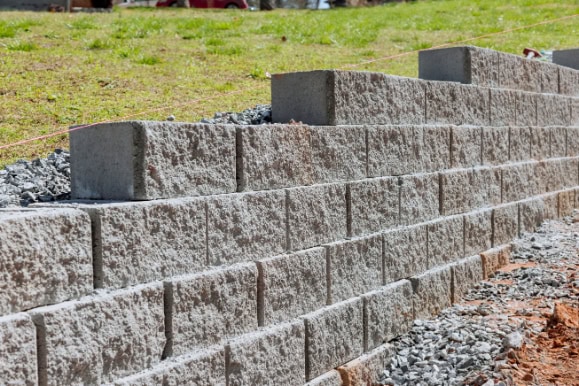
It starts with an on-site visit not a phone estimate, not a number pulled from square footage you described over the phone. I walk the property, read the slope, check how water moves across the lot, and look at what’s already there before anything gets discussed. For Brookhaven properties, where terrain between the Chester Creek and Ridley Creek corridors can vary significantly from one street to the next, that site visit isn’t a formality. It’s where the actual plan gets built.
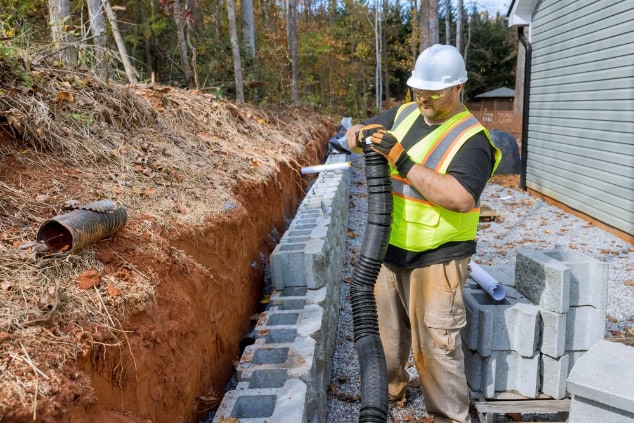
From there, drainage gets designed before materials get selected. This is the step most contractors skip or treat as an afterthought, and it’s the reason walls fail. Hydrostatic pressure water building up behind a wall with nowhere to go is the single most common cause of retaining wall failure. Getting the drainage system right means the wall doesn’t have to fight that pressure every time it rains.
Once the plan is set, Brookhaven Borough’s permit requirements get handled. The borough requires a Zoning Permit before any structure goes up, and walls of significant height require a building permit as well. We carry the required insurance, hold an active Pennsylvania contractor license, and navigate that process so you’re not dealing with it. Installation follows with compacted backfill, proper layering, and the same crew from start to finish. When the job is done, the site is clean and the wall is built to handle what this borough’s weather actually delivers.
Ready to get started?
Not every retaining wall material performs the same way in Delaware County’s climate, and the wrong choice shows up fast. Timber walls are inexpensive upfront, but they absorb moisture, rot, and fail especially on Brookhaven properties near creek corridors where the ground stays wet longer than it does in drier parts of the region. Concrete block and segmental systems like VERSA-LOK are engineered for freeze-thaw resistance and carry 30 to 50 year lifespans. Natural stone, when built correctly, can outlast the house. Each material has a place, but that place depends on your specific wall height, soil type, drainage pattern, and what you’re trying to accomplish with the space.
VERSA-LOK in particular works well on Brookhaven properties because the pinning system allows for curves, corners, columns, and stairs not just straight runs and it requires no frost footings, which matters in a climate where the ground freezes and heaves every winter. For taller walls or walls supporting a significant surcharge, we incorporate geogrid reinforcement into the build.
Every project starts with a free on-site assessment where material recommendations are made based on what your property actually needs not what’s fastest to install or easiest to quote. If you’re in the 19015 ZIP code and dealing with a slope that’s been eroding, a wall that’s starting to lean, or a section of yard that’s never been usable, that conversation is where it starts.
In most cases, yes. Brookhaven Borough administers the Pennsylvania Uniform Construction Code and has its own zoning ordinance adopted in September 2018 that requires a Zoning Permit before any structure is erected or altered. Retaining walls fall under that definition. So even a shorter wall that might be exempt from a full building permit under state code still typically requires a zoning permit from the borough before work begins.
Walls four feet or taller generally require a building permit as well, and in many Delaware County municipalities, walls of that height need to be accompanied by plans from a licensed engineer or architect. The borough also requires that contractors carry General Liability and Workers Compensation insurance naming Brookhaven Borough as the certificate holder. If your contractor isn’t handling that paperwork, you’re the one left exposed at resale, with your insurance company, or if the borough flags unpermitted work during a future inspection. We handle the permit process as part of the job.
Residential retaining wall projects in the Delaware County area generally run between $3,500 and $10,000, with pricing ranging from roughly $40 to $345 per linear foot depending on material, wall height, site conditions, and drainage requirements. That’s a wide range, and it’s one of the reasons getting multiple quotes can feel confusing two contractors can look at the same wall and come back with numbers that are thousands of dollars apart.
The biggest variable most homeowners don’t account for is drainage. A wall that’s properly engineered with drainage behind it costs more upfront than one that isn’t but a wall without drainage will fail, and reconstruction runs $3,000 to $8,000 on top of whatever you paid the first time. For a Brookhaven home valued around $307,000, a well-built retaining wall isn’t just a yard improvement. It’s protection for the property and, in many cases, a real increase in appraised value. The on-site assessment is where you get a number that actually reflects your specific project.
The short answer is water specifically, water that gets trapped behind the wall and has nowhere to go. When temperatures drop, that water freezes and expands, pushing against the wall from behind. When it thaws, the soil loosens and becomes more vulnerable to washing away in the next rain. Repeat that cycle every winter for a few years, and even a structurally sound-looking wall can start to lean, crack, or separate at the joints.
Delaware County’s clay-heavy soils make this worse. Clay expands when it absorbs moisture and contracts when it dries out, which puts ongoing stress on retaining structures that weren’t built with drainage in mind. For Brookhaven properties which sit between Chester Creek and Ridley Creek and receive about 46 inches of rain annually there’s no dry season that gives a poorly drained wall a rest. The fix isn’t a stronger wall. It’s a wall with the right drainage system built behind it from the start, using materials rated for Pennsylvania’s climate zone.
VERSA-LOK is a segmental retaining wall system interlocking concrete units pinned together to create a wall that handles curves, corners, columns, and stairs, not just straight runs. It’s one of the more versatile systems available for residential use, and it performs well in freeze-thaw climates because it doesn’t require frost footings the way poured concrete walls do. That’s a meaningful advantage in Brookhaven, where the ground freezes and heaves every winter.
For taller walls or walls that need to hold back a significant amount of soil which is common on the sloped lots near Brookhaven’s creek corridors VERSA-LOK can be reinforced with geogrid layers embedded during installation. This extends the structural capacity of the wall without dramatically changing the appearance. It’s a good fit for properties where the slope is significant, the drainage demands are high, or the homeowner wants flexibility in the design a terraced garden, a built-in staircase, or a wall with columns. Whether it’s the right choice for your specific property depends on what the on-site assessment turns up.
A few things to look for: visible leaning or bowing in the wall face, horizontal cracking along the middle of the wall, gaps opening between blocks or stones, soil washing out from behind or beneath the wall, and water pooling at the base rather than draining away. Any one of these is worth having looked at. More than one showing up at the same time usually means the drainage system if there ever was one has failed, and the wall is working against hydrostatic pressure it wasn’t built to handle.
For Brookhaven homes built in the 1950s and 1960s, the more important question is often how old the wall is. Timber walls have a 10 to 30 year lifespan. Concrete block walls from that era top out around 50 years. If the wall is original to the home, it’s at or past the end of its expected service life regardless of how it looks on the surface. A repair on a wall that’s already structurally compromised is usually money spent twice. The on-site assessment will tell you which situation you’re actually in.
For most residential retaining wall projects, the installation itself runs one to three days once work begins. The longer part of the timeline is usually what happens before installation starts the on-site assessment, material selection, drainage planning, and permit approval from Brookhaven Borough. The borough’s zoning permit process adds time upfront, but it’s not something to work around. Unpermitted walls create real problems at resale and with homeowner’s insurance, and the borough’s building department is active.
Seasonal timing matters too. Spring is the busiest period for retaining wall work in Delaware County freeze-thaw damage becomes visible in March and April, and homeowners in Brookhaven who’ve watched soil wash across their yards all winter start moving on solutions. Scheduling earlier in the season means less waiting. That said, retaining wall installation can happen across most of the year in this region as long as the ground isn’t frozen solid. If you’re in Brookhaven and want to get ahead of next spring’s erosion season, the best time to start the conversation is before everyone else does.
Useful Links
Other Services we provide in Brookhaven