

Hear from Our Customers

Aston’s housing stock is mostly mid-century homes built in the 1960s and 70s when lots were carved out of wooded land fast and developed faster. Fifty years later, those same lots have mature trees pushing into fence lines, invasive species creeping in from the creek corridor, and rear yards that have quietly been taken back by the woods. It’s not dramatic. It just gets worse every season you wait.
When we clear land the right way in Aston, what you’re left with isn’t just less brush. You’ve got usable ground properly graded, drainage-considered, and ready for whatever comes next, whether that’s a pool, a patio, an addition, or simply a yard you can walk through again. That matters especially on Aston’s rolling terrain, where elevation changes from one side of a property to the other are common, and clearing without attention to drainage creates runoff problems that cost far more to fix later.
The other thing worth knowing: Aston’s proximity to Marcus Hook Creek means some properties sit in or near drainage corridors where stormwater management requirements apply. A crew that clears without thinking about what happens to the water after isn’t doing you any favors. The outcome you want isn’t just cleared it’s cleared and done correctly the first time.
We’re based in Aston. Not a regional chain dispatching crews from across the county a contractor whose address is in the same township as yours. That means familiarity with the terrain around Village Green, the soil conditions near Five Points, and the permit requirements that Aston Township’s Building Code Department actually enforces before work begins.
Over 15 years of serving Aston homeowners, our work has stayed consistent: one experienced team, clear timelines, and no contractor chaos. Renato is personally involved in every project not a sales rep handing you off to a crew you’ve never met. When you call for a land clearing estimate in Aston, you’re talking to someone who has worked on properties in this community for over a decade and understands what we’re dealing with before we ever set foot on your lot.
The full-service model matters here too. Clearing is rarely the whole job. If grading, drainage, excavation, or hardscaping comes next, it’s all handled under the same contract no second contractor to find, no gap between phases.
It starts with a complimentary consultation a walkthrough of your Aston property where the full scope gets assessed before any numbers are discussed. Lot size, vegetation density, slope, drainage patterns, proximity to Marcus Hook Creek if relevant, and what you plan to do with the space after clearing all factor into an honest written estimate. What you’re quoted is what you pay. No additions mid-project, no surprises at invoice.
Once the scope is confirmed, we address permit requirements before any equipment touches the ground. Aston Township requires permits for land disturbance work, and the township’s Stormwater Management ordinance adds requirements for projects that affect drainage particularly on sloped lots or properties near the creek corridor. We handle that process on your behalf, so you’re not navigating township paperwork on your own.
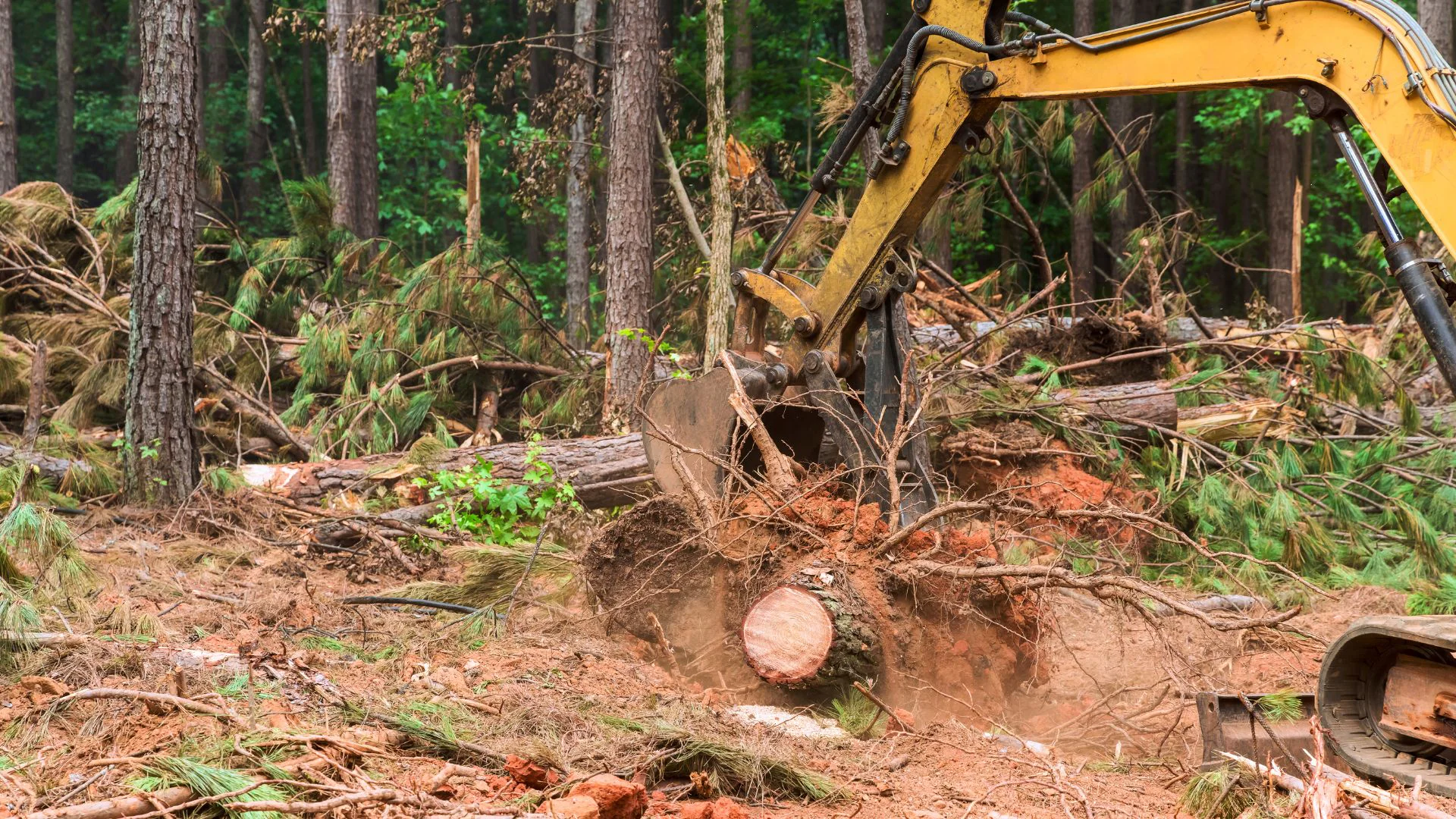
The clearing work itself goes beyond what most people picture. Trees come down, stumps are managed, brush and debris are removed, and the site is finish-graded to leave you with usable ground not a cleared mess. If grading, drainage correction, excavation, or construction follows, the same team transitions directly into the next phase. No handoff. No gap. The site stays moving.

Ready to get started?
Land clearing in Aston typically means one of a few things: a backyard that’s been reclaimed by decades of unchecked growth, a wooded lot being prepped for a pool or addition, a slope that needs clearing and regrading before construction can begin, or an inherited property where overgrowth is the first obstacle. Each of those scenarios requires a different scope, and the estimate reflects that not a flat rate that doesn’t account for what’s actually on your property.
What’s included goes further than tree removal. We handle brush clearing, overgrowth removal, stump management, root clearing, debris hauling, and finish grading as part of how the work gets done. Southeastern Pennsylvania’s invasive species problem Japanese knotweed, multiflora rose, English ivy is real in Aston, especially on properties near the Marcus Hook Creek corridor. If those species are present, they’re part of the conversation, because leaving them behind after clearing means the problem comes back faster than the grass does.
For homeowners in Green Ridge, Village Green, or anywhere along the Pennell Road corridor planning a larger project, the clearing phase connects directly to what follows. Grading, excavation, drainage, masonry, hardscaping all of it is available through the same team. You’re not managing multiple contractors across multiple timelines. One crew, one schedule, one point of contact from cleared ground to finished project.

Yes, in most cases. Aston Township’s Building Code Department requires permits before construction or land disturbance work begins, and the township is explicit that permits must be posted prior to the start of work not applied for after the fact. Only emergency repairs are exempt, and even those require an application within three business days.
Beyond the standard building permit, Aston Township has a dedicated Stormwater Management ordinance Chapter 1043 of the township’s Code of Ordinances that governs how land-disturbing activities must address runoff and drainage. If your clearing project involves significant grade changes, proximity to Marcus Hook Creek, or any work that affects how water moves across your lot, that ordinance applies. Navigating what triggers review, what the township engineer needs to see, and what a stormwater management plan requires is not something most homeowners should handle alone. We manage that process on your behalf before any equipment arrives.
It depends on the scope, and the honest answer is that scope varies significantly from one Aston property to the next. A quarter-acre backyard with moderate overgrowth and no significant grade change is a different job than a half-acre wooded slope with invasive species, stump removal, and drainage work required after clearing. Generally speaking, residential clearing in Aston runs anywhere from $1,500 to $8,000 for a typical homeowner project, with site preparation for a pool or addition on an existing lot ranging from $5,000 to $15,000 depending on what’s involved.
What drives cost is vegetation density, stump count, debris volume, slope and drainage complexity, and whether grading or excavation follows the clearing phase. Aston’s rolling terrain with elevation changes that can be significant even within a single lot means slope and drainage are factors on more properties here than in flatter suburban communities. The complimentary consultation exists specifically to give you a written number based on your actual property, not a ballpark that shifts once work begins.
These terms get used interchangeably, but they describe different scopes of work. Brush clearing typically refers to removing overgrown vegetation shrubs, vines, invasive species, and dense undergrowth without necessarily taking down trees or altering the grade of the land. It’s the right scope for a fence line that’s been overtaken or a yard where the problem is overgrowth rather than trees.
Lot clearing and land clearing generally imply a more complete scope: trees removed, stumps managed, brush cleared, debris hauled, and the site graded and prepared for use or construction. For most Aston homeowners, the relevant question is what the property needs to be ready for the next phase whether that’s a pool excavation, a patio installation, or simply a usable yard. The consultation is where that scope gets defined clearly, so you’re not paying for work you don’t need or getting a partial job when you needed the full one.
Significantly, and it’s a more common issue in Aston than a lot of homeowners realize until they’re in the middle of a clearing project. Southeastern Pennsylvania has a well-documented invasive species problem Japanese knotweed, multiflora rose, English ivy, and Oriental bittersweet are all common in Delaware County, and they colonize disturbed ground aggressively. Properties near Marcus Hook Creek or adjacent to wooded lots in Aston are especially prone to establishment.
The challenge with invasive species during clearing is that cutting them back without addressing the root system doesn’t solve the problem it often accelerates regrowth. Japanese knotweed in particular has a root system that can extend 10 feet deep and 65 feet laterally, and standard clearing equipment that doesn’t account for that will leave you with a cleared site that looks different in six months. When invasive species are identified during the consultation, we account for them in the clearing plan not as an afterthought, but as part of the scope from the start.
Spring and fall are the two strongest windows for clearing work in Aston, and each has a different advantage. Spring roughly March through May is peak demand for a reason: the ground has thawed, construction season is open, and homeowners who spent winter planning a pool, addition, or backyard project need the site cleared before anything else can begin. If you’re planning a summer construction project, spring is when you want the clearing done.
Fall September through November is the second strong window. Deciduous trees have dropped their leaves, which makes it easier to assess exactly what needs to come down and what can stay. Ground conditions are typically firm, equipment works efficiently, and the cleared site has time to settle before spring construction begins. Late winter can also work well for larger jobs frozen ground reduces soil disturbance and gives heavy equipment a firmer working surface. The one consistent recommendation: don’t wait until you’re ready to build to call about clearing. Lead times exist, permits take time, and the best scheduling window for your specific project is worth a conversation early.
That’s actually one of the more important questions to ask before you hire anyone for clearing work in Aston, because most clearing contractors stop at the clearing. They cut what’s visible, haul the debris, and leave and then you’re back to finding a grading contractor, an excavation contractor, a drainage contractor, and eventually whoever is building the thing you cleared the lot for in the first place. Managing that sequence across multiple crews and multiple timelines is where projects in Aston go sideways.
We handle the full sequence: land clearing, grading, excavation, drainage correction, masonry, hardscaping, and landscaping all under one contract, one crew, and one schedule. For an Aston homeowner planning a pool, a garage addition, a retaining wall, or a full backyard transformation, that means the clearing phase connects directly to everything that follows without a gap, a handoff, or a second round of contractor vetting. The site keeps moving from cleared ground to finished project, and you have one point of contact the entire way through.
Useful Links