Not all outdoor kitchens are built for Pennsylvania winters. Here's what Delaware County homeowners need to know before they build.
Share:

Summary:
If you’ve been thinking about adding an outdoor kitchen to your Delaware County backyard, you’ve probably already spent time on Pinterest or Houzz collecting ideas. And most of what you’ll find looks incredible — sleek countertops, built-in grills, bar seating, the works. What those inspiration boards won’t tell you is how any of it holds up after a Delco winter.
That’s the part that actually matters here. Pennsylvania’s freeze-thaw cycles are relentless, and the wrong materials or a poorly built foundation will show it within a few seasons. This guide covers outdoor kitchen ideas that are genuinely worth pursuing in Delaware County, PA — beautiful, functional, and built to last through whatever January throws at them.
Material selection is where most outdoor kitchen projects either succeed long-term or quietly start failing. In a climate like Delaware County’s — where temperatures can cross the freezing mark 40 to 60 times in a single year — the material choices you make upfront determine whether your kitchen looks great in year five or starts showing cracks and rust by year three.
The core issue is simple physics. Water gets into porous surfaces, freezes, expands about 9 percent, and breaks the material from the inside out. It happens slowly at first, then all at once. Choosing non-porous or properly sealed materials isn’t an aesthetic preference in PA — it’s a structural one.
Porcelain is consistently one of the top performers for cold weather outdoor kitchens in Delaware County, PA. It’s non-porous by nature, which means water has nowhere to go — no absorption, no freeze-thaw damage, no cracking. It’s also extremely hard, UV-stable, and available in a wide range of finishes that can mimic natural stone without any of the maintenance headaches. For a Delco backyard that’s going to sit through multiple winters, porcelain is a reliable starting point.
Sealed granite is another strong option. Granite is dense enough that, when properly sealed, it handles outdoor Pennsylvania conditions well. The key word is “properly” — granite that hasn’t been sealed, or that’s been sealed with a low-quality product, will absorb moisture and eventually fail. When it’s done right, though, granite brings a natural, high-end look that holds up and photographs well for resale.
Soapstone is worth mentioning for homeowners who want something a little different. It’s naturally non-porous, doesn’t require sealing, and develops a patina over time that a lot of people find genuinely beautiful. It’s softer than granite, so it will show wear, but it won’t crack from freeze-thaw cycling.
Concrete countertops can work outdoors in PA, but they require more upfront sealing and more ongoing maintenance than granite or porcelain. A concrete countertop that hasn’t been sealed correctly going into its first winter is a liability. If you love the look of concrete, it’s not off the table — just make sure whoever is building it knows how to seal it for outdoor use in a cold climate.
What doesn’t work: ceramic tile, unsealed natural stone, and any countertop material rated for interior use only. These are the shortcuts that look fine at installation and start failing within two or three winters. Delaware County’s climate is not forgiving of material choices made to save money upfront.
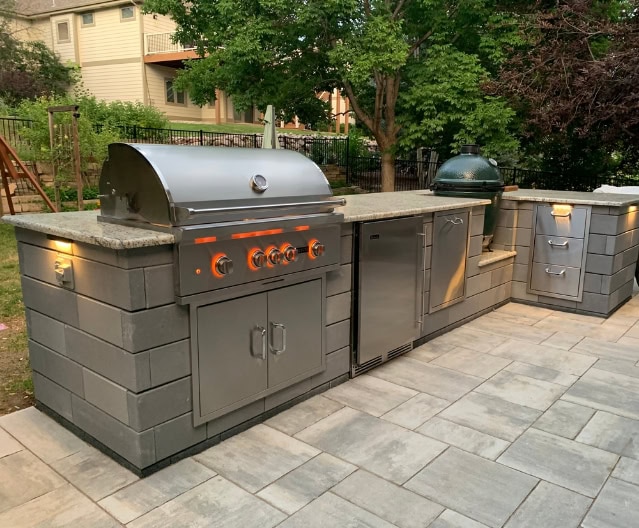
The countertop gets most of the attention, but the frame and appliances matter just as much for a winter-proof outdoor kitchen in PA. A masonry base built with reinforced block — mortar between every course, rebar running through the cores, solid-filled with concrete — is the construction standard that separates a kitchen built to last from one built to look good at the reveal. Stacking block and stuccoing the outside might pass a casual inspection, but it won’t pass a Delaware County winter for long. Cracks show up first in the mortar joints, then the stucco, then the block itself.
For appliances, the material standard for variable-climate environments is 304 or 316 marine-grade stainless steel. This is the same specification used in coastal environments where salt air accelerates corrosion — and it applies equally well to the freeze-thaw and moisture conditions in Delco. Appliances built with lower-grade steel will rust visibly within a few seasons, and rust isn’t just cosmetic; it compromises the appliance’s function and the whole kitchen’s appearance.
Built-in grills, refrigerators, sinks, and beverage centers are all available in marine-grade stainless and are worth the investment. A refrigerator that rusts out after three years isn’t a savings — it’s a replacement cost you didn’t plan for. Specifying the right grade of stainless upfront is one of the clearest ways to protect the long-term value of the whole project.
Drainage is the detail that often gets skipped by contractors who aren’t thinking about the full picture. Every outdoor kitchen base and surrounding surface needs to be graded so water moves away from the structure — not toward it, not underneath it. Standing water that freezes against a masonry base, under a countertop overhang, or in a low spot on the patio surface is a slow but consistent source of structural damage. Getting the drainage right at installation is far cheaper than fixing it after the fact.
Good outdoor kitchen design in Delaware County starts with understanding how you actually use your backyard — not with a catalog of features. How often do you entertain? Are you cooking for four or fourteen? Do you want a bar setup, a full prep area, or both? The answers shape everything from the footprint to the appliance list to whether a covered structure makes sense for your situation.
Delaware County lots vary considerably depending on where you are. A backyard in Aston or Boothwyn is going to work differently than one in Swarthmore or Newtown Square. Layout ideas that work on a larger outer-township property won’t translate directly to a tighter mid-county lot — and pretending otherwise leads to kitchens that feel cramped or awkward in use. The design should fit your yard, not the other way around.
One of the most common hesitations we hear from Delaware County homeowners is some version of: “We only use the backyard a few months a year — is an outdoor kitchen really worth it in Pennsylvania?” It’s a fair question, and the honest answer is that the use season is longer than most people assume — if the space is designed for it.
A covered structure changes the equation significantly. A pergola, a solid roof, or even a retractable awning over the kitchen area extends comfortable use well into October and November in Delco. Fall evenings in this part of PA are genuinely beautiful, and a covered outdoor kitchen with the right setup makes them usable in a way that an uncovered patio simply doesn’t. You’re not fighting the weather — you’re just managing it.
Adding outdoor heating takes it further. Ceiling-mounted infrared heaters are efficient, effective, and unobtrusive when integrated into a covered structure. They warm people, not air, which means they work even when there’s a breeze. A wall-mounted heater or a built-in fire feature can add ambiance and warmth simultaneously. With a covered structure and a heating element, a well-designed outdoor kitchen in Delaware County, PA can realistically be used from April through November — that’s eight months of the year.
Built-in storage is worth thinking about early in the design process, not as an afterthought. Covered cabinetry keeps propane, tools, and accessories dry and accessible. It also reduces the amount of gear you’re hauling in and out of the house every time you use the space. For homeowners in Ridley Park, Springfield, or Glen Mills who want the backyard to function like a real extension of the house, storage is part of what makes that possible.
Lighting is the detail that often determines whether a space actually gets used on weekday evenings or just on weekends. Under-counter lighting, pendant lights over a bar area, and pathway lighting back to the house make the space feel finished and functional after dark — which is when most weeknight entertaining actually happens.
A few questions come up consistently when Delaware County homeowners are seriously considering an outdoor kitchen, and they’re worth answering directly.
The first is about cost. Outdoor kitchen cost in PA varies widely depending on size, materials, and features, but a realistic range for a custom masonry build is $15,000 to $50,000 or more. Mid-range builds with quality materials and a solid appliance package typically fall between $20,000 and $35,000. Modular or prefabricated setups start lower, but they’re not built for Delaware County winters the way a custom masonry outdoor kitchen in PA is — and the difference shows over time. In a market like Delco where outdoor kitchens consistently rank as a top feature buyers want, that investment makes sense.
The second question is about permits. In most Delaware County municipalities, a permanent outdoor kitchen requires a building permit — sometimes a zoning permit as well, depending on the township. This isn’t something to skip. Unpermitted work creates real problems at resale and may not meet the safety standards required for gas and electrical connections. We coordinate permits as a standard part of every project, so you’re not left navigating township offices on your own.
The third question we hear often is simpler but important: “How do I know the contractor I hire actually knows what they’re doing?” In a market with a lot of landscaping and masonry companies, it’s a reasonable thing to wonder. The clearest signals are verifiable ones — an active Pennsylvania contractor license, documented reviews from real clients in the area, and a track record of showing up, communicating, and finishing what we start. Those aren’t things every contractor in Delaware County can point to, but they’re the minimum you should expect before signing anything.
A fourth question that comes up specifically for backyard kitchen ideas in Pennsylvania is about layout for smaller lots. Not every Delco backyard has room for a sprawling outdoor kitchen complex. For tighter lots — common in Norwood, Darby, or the inner townships — an L-shaped or galley configuration gives you real functionality without eating the whole yard. Two walls of counter space, a built-in grill, a small refrigerator, and a prep sink can all fit in a footprint that leaves room for a dining table and still feels open. The key is designing for your actual space, not a template.
We’ve been building outdoor kitchens and hardscape projects across Delaware County for over a decade, and the work we’re proudest of is the kind that still looks right five or ten years later. That means reinforced masonry construction, climate-appropriate materials, proper drainage, and permits pulled before a single block is laid. It also means one consistent crew from start to finish — not a rotating cast of subcontractors — and a process that keeps you informed rather than wondering what’s happening in your backyard.
Delaware County homeowners deserve an outdoor kitchen that actually works in this climate, fits your lot, and holds up through every PA winter without becoming a maintenance project. That’s what we build.
If you’re ready to start thinking through what your backyard could look like, reach out to us. We’ll walk through the space with you, talk through the options that make sense for your property, and give you a clear picture of what the project involves — no pressure, no guesswork.
Article details:
Share:
Continue learning: