
Hear from Our Customers
Slope erosion in Colwyn isn’t just a cosmetic problem. When you’re sitting in the Darby-Cobbs Creek watershed — one of the most flood-documented drainage systems in Delaware County — soil movement and water pressure behind an aging or undersized wall can do real structural damage. The kind that spreads to your foundation, your neighbor’s property, or both.
A properly built retaining wall changes that. You get level, usable ground where there used to be a sliding, eroding slope. You get water that moves through and away from the wall instead of building pressure behind it. And in a community where most homes were built before modern drainage standards existed, you get a structure that’s actually designed for what your yard is dealing with — not just what looks good in a brochure.
Colwyn’s housing stock is dense and older. Lots are small. Every square foot of flat, stable ground matters more here than it does in a sprawling suburban township. A well-built retaining wall doesn’t just solve a drainage problem — it gives you functional outdoor space you didn’t have before.
We’re based in Aston, PA — Delaware County — and have been building retaining walls throughout the county’s borough corridor for over a decade. That includes Colwyn and the communities immediately surrounding it: Darby to the north, Sharon Hill to the west, and the Cobbs Creek corridor to the east. This isn’t a company driving in from Chester County with no feel for the terrain. The drainage conditions, the clay-heavy soils, and the tight lot sizes in this part of the county are familiar ground.
What makes our work different here is straightforward: Renato Spennato is hands-on in a way that most contractors aren’t. Reviews consistently mention him by name — not as a distant owner, but as the person who showed up, assessed the slope, and brought real ideas to the table. One project in a Colwyn neighborhood led to multiple neighbors calling on their own. That’s not a marketing claim. That’s just what happens when the work is done right.
It starts with a site visit — not a phone estimate, not a ballpark figure based on square footage. Renato walks the property, looks at the slope, asks about what’s been happening with water and soil movement, and gets a clear picture of what the wall actually needs to do. In Colwyn, that conversation almost always includes drainage, because the Darby Creek watershed makes it unavoidable.
From there, material selection happens based on your specific site — not on what’s easiest to install. Versa-Lok segmental block, natural stone, boulder, and concrete block each perform differently depending on wall height, soil load, and what the ground is doing. For walls over four feet, Pennsylvania state code requires a building permit, and in some cases engineer-stamped plans. Colwyn Borough has its own grading and erosion control ordinance under Chapter 80 of the municipal code that governs this work — and navigating that process is part of what you’re getting when you hire a contractor who actually knows the area.
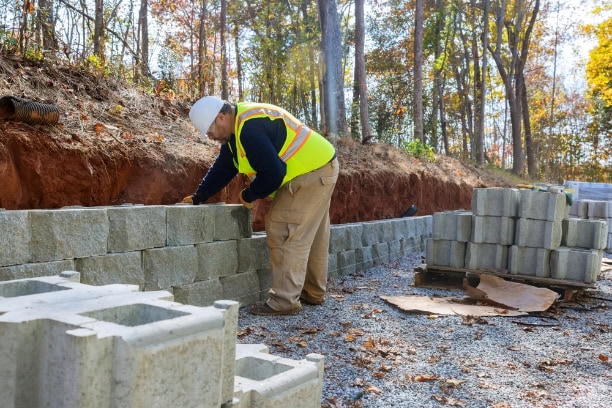
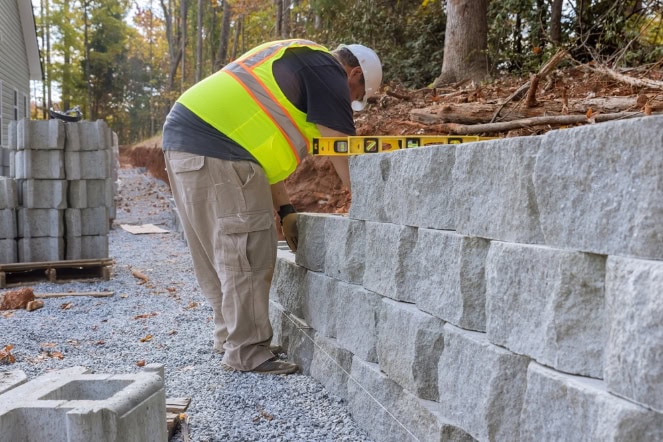
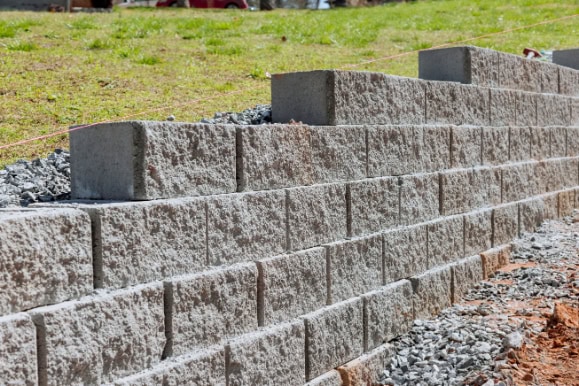
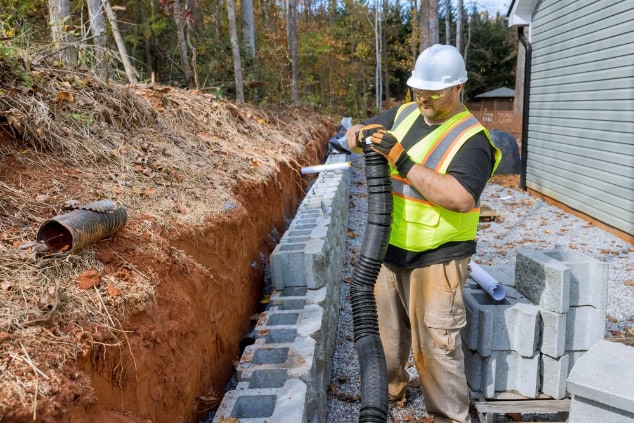
Installation follows a structured sequence: base excavation, compacted gravel foundation, stepped block placement, clean stone backfill, and perforated drain pipe routed to a proper outlet. The drainage isn’t an add-on — it’s built into the wall from the first layer. The same crew that assessed your property is the crew that finishes the job. No handoffs, no subcontractors showing up mid-project, no guesswork.
Ready to get started?
Delaware County’s clay-heavy soil is one of the most demanding environments for retaining wall construction in the region. Clay holds water. It expands when it freezes and contracts when it thaws — and that cycle repeats dozens of times every Pennsylvania winter. A wall that wasn’t designed for that kind of lateral pressure and freeze-thaw stress will show it within a few years. Leaning, cracking, bowing — these aren’t random failures. They’re what happens when drainage and material selection are treated as afterthoughts.
Every retaining wall we build near Colwyn includes a dedicated drainage phase: perforated drain pipe, clean stone backfill behind the wall face, and a planned outlet so water has somewhere to go. This is standard on every project — not an upgrade. The material options include Versa-Lok segmental concrete block systems, which are engineered for Pennsylvania’s climate and carry 50-plus year lifespans when drainage is done correctly; natural stone and boulder walls for larger slopes or properties where the visual weight fits the landscape; and concrete block for clean, modern applications at practical price points.
Because Colwyn Borough falls within the Darby-Cobbs Creek Act 167 Stormwater Management watershed, drainage design isn’t just good practice here — it’s the baseline expectation for any wall that’s going to hold up over time. The borough’s own municipal code requires ongoing maintenance of retaining walls and drainage structures, which means the wall you build today has a long-term relationship with your property. Getting it right from the start is the only version of this that makes sense.
Under Pennsylvania state code, retaining walls under four feet in height — measured from the lowest adjacent grade to the top of the wall — generally do not require a building permit, as long as the wall isn’t supporting a surcharge load like a driveway, deck, or structure above it. Once you cross that four-foot threshold, a permit is required, and taller or load-bearing walls typically need plans reviewed and stamped by a licensed structural engineer.
What makes Colwyn specifically worth paying attention to is Chapter 80 of the borough municipal code — the Grading and Erosion Control ordinance. It requires that property owners maintain retaining walls and drainage structures on their property, and it governs any grading or land disturbance work that touches the surface. Colwyn is one of 49 individual municipalities in Delaware County, each with its own code enforcement, so what applies in neighboring Darby or Sharon Hill doesn’t automatically apply here. Before any work starts, it’s worth knowing exactly what the borough requires — and working with a contractor who already does.
Retaining wall cost varies based on wall height, length, material choice, and how much drainage work the site requires. In the Colwyn area, a typical residential retaining wall project — addressing a single slope or erosion problem — generally falls somewhere in the range of $3,000 to $10,000. Larger walls, taller walls, or projects that require engineer-stamped plans will run higher.
Material choice has a real impact on cost. Versa-Lok segmental block systems tend to be mid-range in price but carry excellent long-term performance in Pennsylvania’s freeze-thaw climate. Natural stone and boulder walls can cost more upfront but offer durability and visual weight that suits certain properties well. Concrete block is often the most accessible price point. What matters more than the material itself is whether the drainage is designed correctly — because a cheaper wall with poor drainage will cost far more to repair or replace in five years than a properly built one costs today. Given Colwyn’s median home values and dense lot sizes, the most compelling case for a well-built wall isn’t curb appeal — it’s avoiding the much larger cost of foundation damage, erosion, or code violations down the road.
The most common cause of retaining wall failure in Delaware County — and in Colwyn specifically — is inadequate drainage. When water can’t escape from behind a wall, it builds hydrostatic pressure that eventually forces the wall to lean, bow, or collapse outright. This problem is made worse by the region’s clay-heavy soils, which hold water longer than sandy or loamy soils and exert significantly more lateral pressure on wall structures.
Pennsylvania’s freeze-thaw cycle compounds this further. Clay soil expands when it freezes and contracts when it thaws, and that movement happens repeatedly throughout every winter. A wall without proper drainage and a solid compacted base absorbs that stress year after year until something gives. In Colwyn’s older housing stock — where most homes and their associated walls predate modern drainage standards — this is a recurring reality, not an edge case. Walls that were built without perforated drain pipe, clean stone backfill, or a proper outlet are already under pressure. Catching the problem before it becomes a structural failure is almost always cheaper than dealing with it after.
Pennsylvania state code sets the general threshold at four feet. Walls under four feet — measured from the lowest point of the adjacent grade to the top of the wall — typically don’t require a building permit, provided they aren’t supporting a surcharge load. A surcharge means anything above the wall that adds weight or pressure: a driveway, a deck, a structure, or even a heavily trafficked pathway. If any of those conditions apply, the permit requirement can kick in regardless of wall height.
Above four feet, a building permit is required. For taller or more complex walls, most municipalities in Delaware County — including Colwyn — will require plans reviewed by a licensed structural engineer before the permit is issued. It’s also worth knowing that Colwyn Borough’s own grading and erosion control ordinance adds a local layer to this: any grading or land disturbance work in the borough is subject to borough oversight, not just state code. The safest approach is to have a contractor who understands both the state requirements and the borough’s specific rules handle the permit process before any excavation begins.
For Pennsylvania’s climate — specifically the freeze-thaw cycling that happens throughout the winter — Versa-Lok segmental concrete block systems are one of the strongest performers. They’re dry-stacked and pinned rather than mortared, which means they can flex slightly with ground movement without cracking. When installed with proper drainage and a compacted granular base, these systems are engineered to last 50 years or more. They can also be reinforced with geogrid for taller walls without requiring a poured concrete footing that’s susceptible to frost heave.
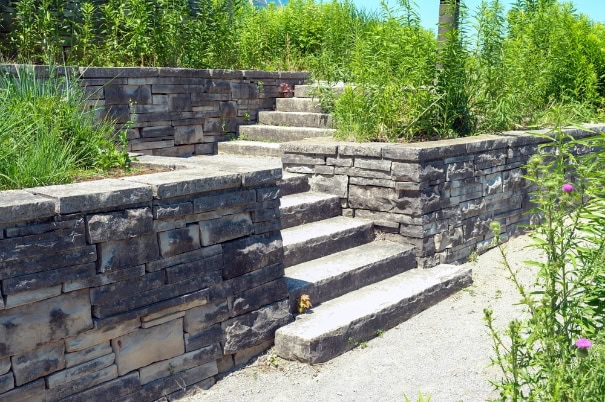
Natural stone and boulder walls are another strong option for the Delaware County climate, particularly for larger slopes or properties where a more organic visual fits the landscape. They’re heavy, they drain well when installed correctly, and they don’t corrode or degrade the way some manufactured materials can over decades. Concrete block is a practical choice for smaller walls or budget-conscious projects. What matters most — regardless of material — is that the drainage is engineered into the wall from the first layer. In Colwyn’s watershed environment, where Darby Creek flooding and clay soil saturation are documented realities, drainage isn’t optional on any material.
There are a few signs that a retaining wall is past the point of simple repair. Leaning or bowing — even a slight forward tilt — means the wall is already under more pressure than it was designed to handle. Horizontal cracks running across the face of the wall, especially near the base, indicate structural stress. Gaps between blocks or stones, soil visible pushing through the wall face, and water pooling directly at the base after rain are all signs that drainage has failed and pressure is building behind the structure.
In Colwyn specifically, older walls are common — the borough hasn’t seen new construction since 2007, and most of the housing stock dates to the early-to-mid 20th century. Walls built in that era were rarely designed with modern drainage standards in mind, and decades of Pennsylvania freeze-thaw cycling have added cumulative stress. In a dense community where twin homes and rowhouses sit close together, a failing wall doesn’t just affect your property — it can affect your neighbor’s as well, which creates both a practical and a liability concern under Colwyn’s grading and erosion control ordinance. If you’re seeing any of these warning signs, a site assessment before the next heavy rain season is worth doing sooner rather than later.
Useful Links