
Hear from Our Customers
In Collingdale, where nearly half the land is occupied by cemeteries and residential lots are some of the smallest in Delaware County, you don’t have square footage to waste. A slope that’s been eroding for years isn’t just an eyesore it’s usable space you’re not using. A properly built retaining wall converts that problem into flat, functional ground: a patio, a garden bed, a clean edge along your driveway that actually stays put.
But the bigger issue in Collingdale isn’t aesthetics. It’s water. The borough adopted its own Stormwater Management Ordinance because unmanaged runoff overtaxes storm sewers, accelerates erosion, and sends water toward foundations yours and your neighbor’s. In a neighborhood where homes sit close together and lots share drainage patterns, a wall built without a real drainage plan is a wall that will fail. Every retaining wall we build starts with understanding where the water comes from and where it needs to go.
Delaware County’s clay-heavy soil and annual freeze-thaw cycle add another layer. Water gets into the ground, freezes, expands, and pushes. Without proper drainage behind the wall, that pressure builds season after season until something gives. Getting this right the first time means you’re not rebuilding in ten years.
We’re based in Aston, PA right here in Delaware County and have been building retaining walls throughout Collingdale and across the county for years, including along the MacDade Boulevard corridor. This isn’t a franchise sending out whoever’s available. Renato Spennato is the owner, and the same experienced team that walks your property is the team that builds your wall, start to finish.
That matters more than it might sound. In a close-knit borough like Collingdale, where neighbors talk and word travels fast, the quality of the work crew showing up on your property is visible to everyone on your street. No rotating subcontractors. No handoffs. No calling a main number and getting a different person every time. If something comes up six months after the job is done, you reach the same people who built it.
We hold active Pennsylvania contractor license PA057623 and carry a BuildZoom score of 102 placing us in the top 11% of all licensed contractors in the state. That’s a number you can verify, not a claim you have to take on faith.
It starts with a free on-site assessment not a phone estimate, not an online form. Collingdale’s residential lots aren’t cookie-cutter. The grade on your property, the condition of any existing wall, what the soil looks like underneath, how water moves across your yard during a heavy rain on MacDade these things determine what your project actually costs and how it should be built. You get a quote that reflects your real conditions, not a number that changes when the crew shows up.
Before any work begins, we handle permits. Collingdale Borough requires a grading permit for any change of grade or excavation which applies to virtually every retaining wall installation. Walls over four feet also require a state-level building permit under Pennsylvania code, and projects with significant earth disturbance may trigger the Borough’s Stormwater Management Ordinance. Most homeowners don’t know this going in, and most contractors don’t bring it up. We pull the required permits and coordinate with the Borough Building Inspector so you’re not left to figure that out on your own.
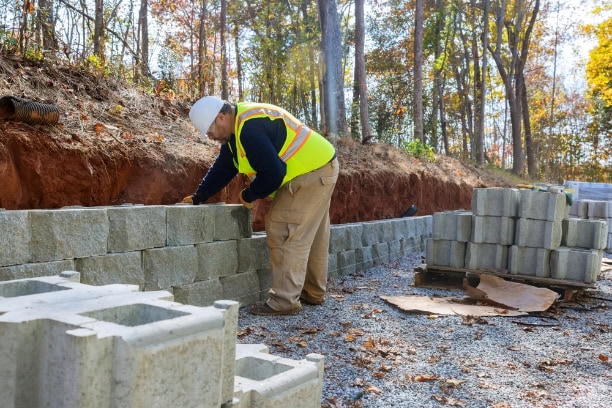
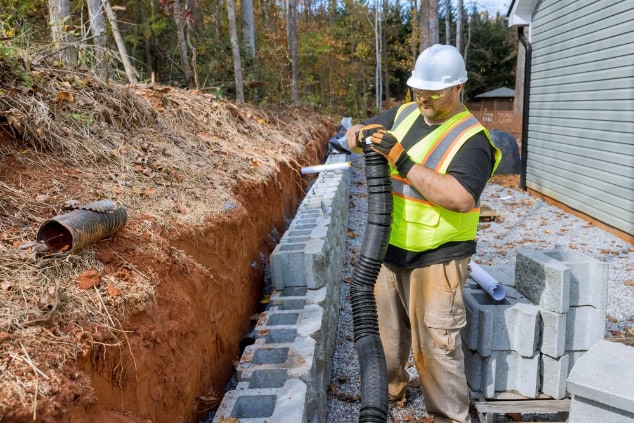
Once permits are in place, the build follows a clear sequence: excavation, drainage system installation behind the wall, material placement, and final grading. The drainage step isn’t optional it’s what separates a wall that lasts from one that leans. Cleanup is included. When the crew leaves, the job is done.
Ready to get started?
Not every wall material makes sense for every property. In Collingdale, where lots are tight, soil is clay-heavy, and winter freeze-thaw cycles put real stress on structures, material selection matters. We work with natural stone, VERSA-LOK modular block, and poured concrete and the recommendation depends on your specific site, not a default preference.
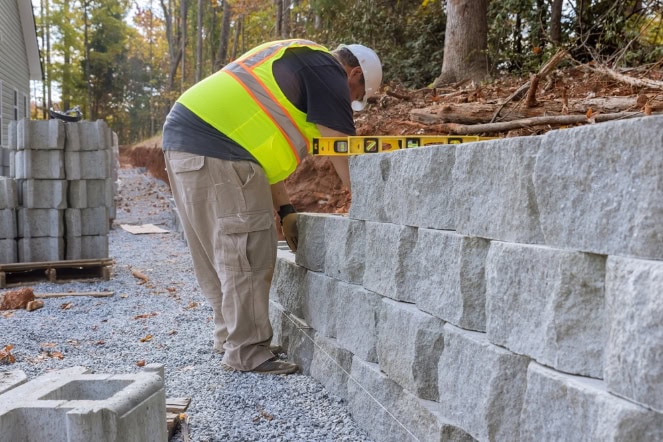
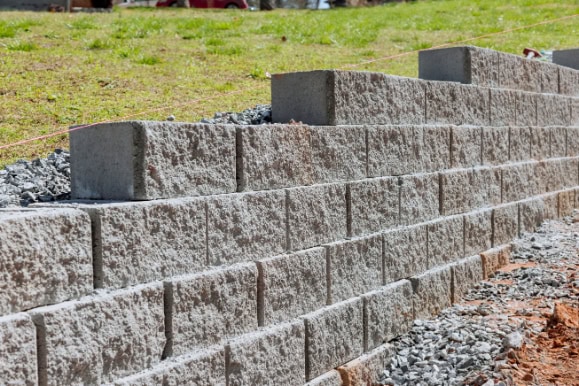
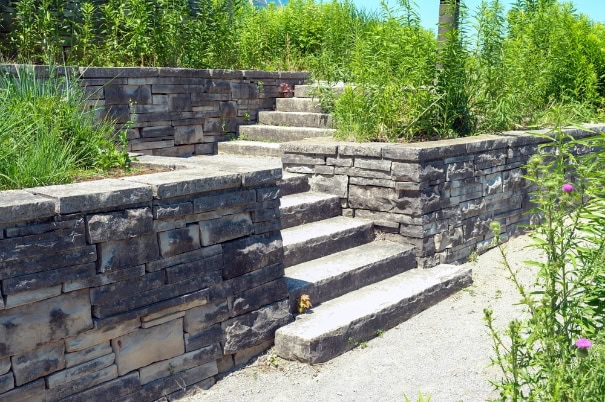
VERSA-LOK is a strong fit for many Collingdale properties. It doesn’t require frost footings, which is a genuine advantage in Pennsylvania’s climate. Its pinning system allows for curves, corners, integrated steps, and columns useful on the irregular lot shapes and corner properties common in Collingdale’s residential grid. For homeowners dealing with larger slopes, VERSA-LOK can be reinforced with geogrid to handle serious height and lateral load. Natural stone works well where longevity and street-facing appearance both matter it’s the longest-lasting option available and holds up well against the borough’s drainage demands. For structural situations where load capacity is the primary concern, poured concrete is the answer.
Retaining walls also return real value at resale. Property appraisers consistently estimate 100 to 200 percent ROI on well-built walls. In a market where the median home value in Collingdale sits around $166,600, a wall that adds usable space and solves a drainage problem is one of the higher-return improvements you can make to the property.
Yes and there’s more than one permit that may apply. Collingdale Borough requires a grading permit under Chapter 268 of its municipal code for any change of grade or excavation. Since retaining wall installation always involves grading and excavation, that permit applies to virtually every project in the borough. You need it before work starts, and it comes from the Borough Building Inspector directly.
On top of that, Pennsylvania state code requires a building permit for any retaining wall four feet or taller measured from the lowest grade to the top of the wall. If the wall is over four feet and supporting a surcharge (like a driveway or structure above it), you’ll also need engineering plans sealed by a licensed Pennsylvania design professional. Projects with significant earth disturbance may additionally trigger Collingdale’s Stormwater Management Ordinance, which can require a drainage plan certified by a design engineer. We handle the permit process for you so you’re not navigating Borough Hall on your own.
Most residential retaining wall projects in Collingdale fall somewhere between $3,500 and $10,000, with cost per linear foot ranging from roughly $40 on the low end to $345 or more depending on material, wall height, and site conditions. That’s a wide range, and the reason quotes vary so much is that no two properties are the same especially in a borough with Collingdale’s lot diversity.
What drives cost up most is height, drainage complexity, and material choice. A four-foot VERSA-LOK wall on a straightforward slope costs significantly less than a six-foot natural stone wall on a tight lot with tricky water management. The permit fees and any required engineering plans add to the total as well. The best way to get an accurate number is an on-site assessment not a phone quote, which almost always changes when someone actually sees the property. We provide free on-site estimates so the number you get reflects what the job actually requires.
Delaware County’s freeze-thaw cycle is the biggest factor to plan around. When water gets into clay-heavy soil which is common throughout the county it freezes, expands, and generates lateral pressure against whatever is holding the slope back. A wall that wasn’t designed for that pressure will show it within a few winters.
VERSA-LOK modular block handles freeze-thaw conditions well because it doesn’t require frost footings and its interlocking pin system maintains structural integrity through ground movement. Natural stone is the longest-lasting option and performs well in Pennsylvania’s climate when installed with proper drainage behind it. Timber walls, which are common in older Collingdale properties, have a lifespan of 10 to 30 years many are at or past that point now. If you have a timber wall that’s starting to lean or show gaps, it’s worth getting it assessed before another winter cycle accelerates the damage. The material recommendation depends on your specific site, but drainage planning behind the wall matters more than material alone.
A few signs are hard to miss: the wall is visibly leaning or bowing outward, you’re seeing cracks running horizontally across the face, the base is shifting, or sections have already started to separate. Any of these mean the wall has lost structural integrity and needs attention before the next freeze cycle makes it worse.
Subtler signs matter too. If you’re noticing soil washing out from behind or underneath the wall after rain, that’s a drainage failure the wall may still look okay from the front but is losing its foundation from behind. Collingdale’s older housing stock means a lot of walls in the borough were built in the 1980s and 1990s using timber, which has a finite lifespan. If your wall is timber and it’s been there for 20-plus years, it’s worth having it looked at even if it doesn’t look obviously damaged. Catching a failing wall before it fully lets go is almost always less expensive than dealing with it after.
For most residential projects in Collingdale, the physical installation takes anywhere from one to three days once permits are in place and materials are on site. Larger walls, more complex drainage systems, or tight access conditions which are common in Collingdale’s dense residential grid can extend that timeline.
The permit process is usually the longer part of the timeline. Pulling a grading permit from Collingdale Borough and, if needed, a state building permit takes time, and that process starts before any ground is broken. During peak season typically late spring through early fall quality contractors in Delaware County book four to eight weeks out. If you’re seeing a problem with a slope or an existing wall right now, the best time to get an assessment scheduled is before everyone else calls in April. We communicate clearly about timelines before the project starts and stick to them.
The wall will fail faster than it should sometimes within just a few years. Hydrostatic pressure is the primary cause of retaining wall failure, and it builds when water has nowhere to go behind the wall. In Collingdale specifically, this isn’t a hypothetical. The borough adopted its Stormwater Management Ordinance because inadequate drainage is a documented problem that contributes to flooding, erosion, and overtaxed storm sewers throughout the borough. On a small residential lot where your property sits close to your neighbors’, water that isn’t managed properly on your side doesn’t stay on your side.
A proper drainage system gravel backfill, perforated pipe, and outlet points that move water away from the wall removes that pressure before it can build. It’s not an add-on or an upgrade. It’s part of what makes a retaining wall a retaining wall. Any contractor who doesn’t bring up drainage before quoting your project is skipping the most important part of the conversation.
Useful Links
Other Services we provide in Collingdale