
Hear from Our Customers
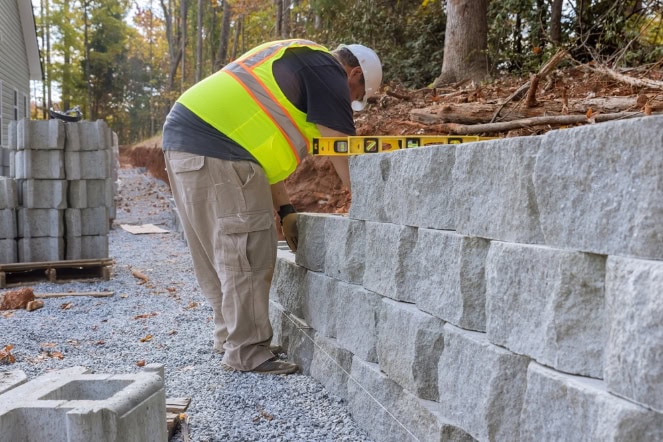
A lot of Middletown’s housing stock was built in the 1950s and 60s. The grading that came with those homes wasn’t designed for decades of freeze-thaw cycles, heavy clay soil, or the kind of storm runoff that Delaware County sees today. What starts as a soft spot in the lawn becomes a washing slope. What starts as a slope becomes a real drainage problem. A properly built retaining wall doesn’t just hold dirt in place it manages where water goes, protects your foundation, and turns an unusable hillside into actual outdoor space.
For homeowners near the creek corridors in Middletown, that drainage piece matters more than most people realize. Hydrostatic pressure the force water builds up behind a wall is the number one reason retaining walls fail. When that’s handled correctly from the start, with the right backfill, drain pipe, and wall system, you get a structure that performs through every wet season without bowing, shifting, or cracking.
The functional upside is real too. That slope you’ve been working around for years could be a patio, a garden terrace, a flat lawn your kids or grandkids can actually use. Property appraisers consistently put retaining walls among the highest-return exterior improvements and in a community like Middletown, where homes in the Rose Tree Media School District hold strong value, that return matters.
We’re based in Aston which shares a direct border with Middletown Township to the south. This isn’t a company dispatching crews from across the county into unfamiliar terrain. The drive from our base to Lima or Glen Riddle is a few minutes. We know what the soil does here, how the slopes drain, and what Middletown Township’s permitting process looks like from start to finish.
Renato Spennato runs one crew. The same team that shows up for your estimate is the team that builds your wall. There are no subcontractors, no rotating faces, and no one to blame if something needs attention after the job is done. Our customers on Yelp, Angi, and BuildZoom specifically call out the honesty and quality of work not just the finished product, but how the whole process felt. That’s what a one-team model actually looks like in practice.
Our Pennsylvania contractor license PA057623 is active and verified. We hold a BuildZoom score of 102, placing us in the top 11% of licensed contractors in the state.
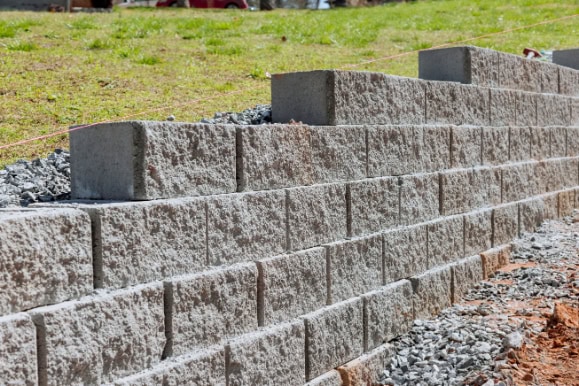
It starts with a site visit. Before anything else, our goal is to understand your property where the water is moving, what the slope is doing, what the soil looks like, and what you’re actually trying to accomplish. In Middletown, that often means looking at how runoff is tracking toward the creek corridors, whether the existing grade is contributing to the problem, and whether any portion of the project falls near a floodplain area along Ridley Creek or Chester Creek that would trigger additional township requirements.
From there, you get a clear plan: materials, drainage approach, wall dimensions, and a straight answer on permits. Middletown Township’s Planning and Development Department administers both zoning and building permits for hardscaping projects. Walls under four feet generally require a zoning permit; walls at four feet or taller require a building permit and, in most cases, engineered plans. We handle the permit coordination so you’re not navigating that process on your own or finding out mid-project that something wasn’t filed correctly.
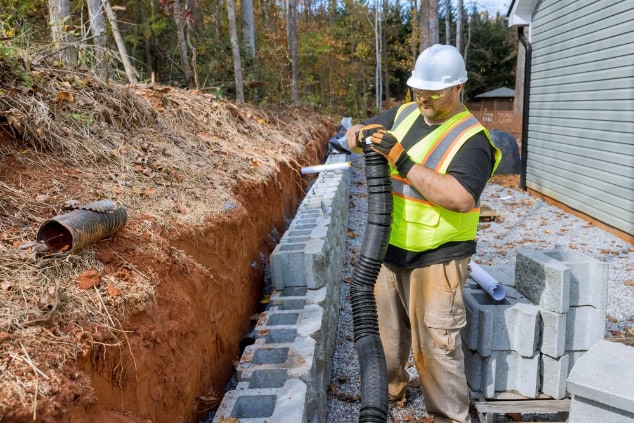
Once the plan is set and permits are in order, our crew gets to work. Drainage infrastructure goes in first perforated pipe, compacted gravel backfill before a single block is placed. That sequence matters. The wall is built on top of a drainage system that’s already doing its job, not added as an afterthought. When the project is done, the site is cleaned up and you have a direct line back to us if anything ever comes up.
Ready to get started?
Not every retaining wall material holds up the same way in Pennsylvania. Treated timber walls can last 10 to 30 years, but in Middletown’s wet, creek-adjacent terrain, they tend to land on the shorter end of that range. Concrete block walls typically last 30 to 50 years. Natural stone, when it’s built right, can last a century. The material recommendation on your project will be based on your site conditions, your wall’s structural demands, and what will actually perform here long-term not what’s easiest to install.
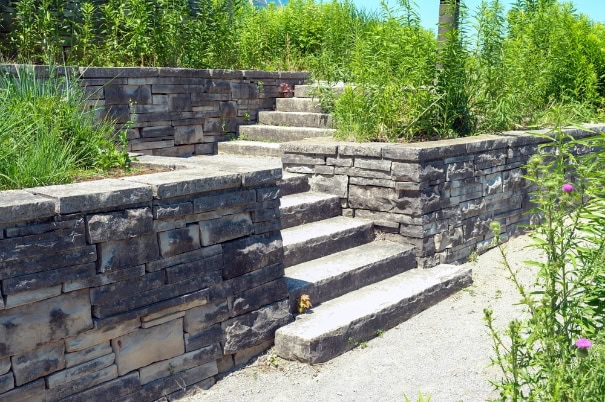
For many properties in Middletown Township, VERSA-LOK segmental retaining wall systems are a strong fit. VERSA-LOK doesn’t require frost footings, which matters in a climate where the ground freezes and thaws every winter. The pinning system allows for curves, corners, columns, and stairs, and geogrid reinforcement can be added for taller walls. It’s a system designed for the kind of conditions Delaware County homeowners actually deal with.
Every project includes a drainage plan specific to your property. That means perforated drain pipe behind the wall, compacted gravel backfill to relieve hydrostatic pressure, and a clear path for water to exit without pooling or saturating the soil. For properties near the Ridley Creek corridor or in areas of Middletown with heavier clay soil, that drainage detail isn’t optional it’s what separates a wall that holds for decades from one that starts leaning after two winters.
It depends on the height of the wall and where it’s located on your property. Under Pennsylvania’s Uniform Construction Code, retaining walls under four feet tall measured from the lowest grade to the top of the wall are generally exempt from a building permit. However, a zoning permit may still be required depending on your specific zoning district, how close the wall is to a property line, and whether the project involves regrading or altered drainage.
For walls four feet and taller, a building permit is required, and Middletown Township will typically want plans sealed by a licensed engineer before issuing it. If your property is near Ridley Creek or Chester Creek, there’s also the possibility that floodplain regulations apply, which adds another layer to the process. Middletown Township’s Planning and Development Department is located at 27 N. Pennell Road and can answer jurisdiction-specific questions at 610-565-2700. We handle permit coordination as part of the project so you’re not left figuring that out on your own.
The most common cause of retaining wall failure is drainage specifically, water that has nowhere to go. When soil behind a wall becomes saturated, it creates hydrostatic pressure. That pressure builds laterally against the wall and, over time, causes bowing, cracking, or full collapse. It’s not a material problem or a construction problem in most cases. It’s a drainage problem that was never addressed at the start.
In Middletown Township, this issue is compounded by the clay-heavy soil that’s common throughout Delaware County. Clay retains water longer than sandy or loamy soil, which means pressure behind a wall builds faster and stays longer after a storm. The fix is straightforward but has to be done in the right order: perforated drain pipe installed at the base of the wall, compacted gravel backfill to allow water to move freely, and a clear outlet so water exits the system rather than pooling. When that foundation is in place before the wall goes up, the structure has a real chance of performing for 30 to 50 years without intervention.
Retaining wall costs vary significantly depending on materials, wall height, linear footage, drainage complexity, and site access. Broadly, residential retaining walls in the Delaware County area run anywhere from $40 to $345 per linear foot. Most straightforward residential projects land somewhere between $3,500 and $10,000. Larger walls, walls requiring engineered plans, or projects on challenging terrain like a steep slope near one of Middletown’s creek corridors will run higher.
The material choice has a meaningful impact on cost and long-term value. A treated timber wall is typically the least expensive upfront but has the shortest lifespan, especially in wet conditions. VERSA-LOK concrete block and natural stone cost more initially but last significantly longer and require less maintenance. When you factor in the cost of replacing a failed wall in 10 years versus a wall that holds for 40, the math usually favors the more durable option. A site visit is the only reliable way to get an accurate number too many variables affect the final cost to quote meaningfully without seeing the property.
VERSA-LOK is a segmental retaining wall system that uses a unique pinning mechanism to lock blocks together without mortar. It’s engineered for residential and commercial applications, and it’s particularly well-suited for Pennsylvania’s climate because it doesn’t require frost footings. In a state where the ground freezes and thaws every winter, that’s a meaningful advantage walls that rely on below-frost footings can still shift if the footing depth isn’t right, but VERSA-LOK’s design accommodates ground movement without compromising structural integrity.
For Middletown Township homeowners, VERSA-LOK works well on sloped lots, properties with irregular terrain, and situations where the wall needs to incorporate curves, corners, stairs, or columns. Geogrid reinforcement can be added for taller walls up to 50 feet in engineered applications, though most residential walls are well under that. It’s not the right material for every project, but for many of the slope and drainage situations common to Middletown’s older residential neighborhoods, it performs reliably and looks clean once it’s done.
For most residential retaining wall projects, installation takes anywhere from two to five days once materials are on-site and permits are in order. Larger or more complex projects walls over four feet, walls requiring geogrid reinforcement, or projects that include stairs, multiple tiers, or significant regrading can take longer. The permit process in Middletown Township adds time before installation begins, which is worth factoring into your planning if you’re working toward a specific date.
Timing also matters seasonally. Spring is the busiest period for retaining wall work in Delaware County freeze-thaw damage becomes visible as snow melts, and homeowners who’ve been watching a slope erode or a wall lean all winter are ready to move. Quality contractors in this area typically book four to eight weeks out during peak spring season. If you’re seeing the problem now, the earlier you get on the schedule, the better positioned you’ll be to have the work done before the next heavy rain season.
Yes, and the return tends to be stronger than most homeowners expect. Property appraisers generally estimate 100 to 200 percent ROI on well-designed retaining walls meaning a $6,000 wall can add $6,000 to $12,000 in appraised value when the project is done right. The functional improvement is a big part of that: a sloped, unusable yard becomes livable outdoor space, which buyers and appraisers both respond to.
In Middletown Township specifically, that value case is reinforced by the local market. Homes in the Rose Tree Media School District hold strong resale value, and buyers in this area expect well-maintained, functional outdoor spaces. A property with an eroding hillside, standing water, or a visibly failing landscape wall reads as deferred maintenance during a showing even if the interior is immaculate. Fixing it before you list, or simply investing in the property you plan to stay in, pays off in both directions. The wall also protects what’s already there: your foundation, your grading, and the structural integrity of the surrounding landscape.
Useful Links
Other Services we provide in Middletown