
Hear from Our Customers
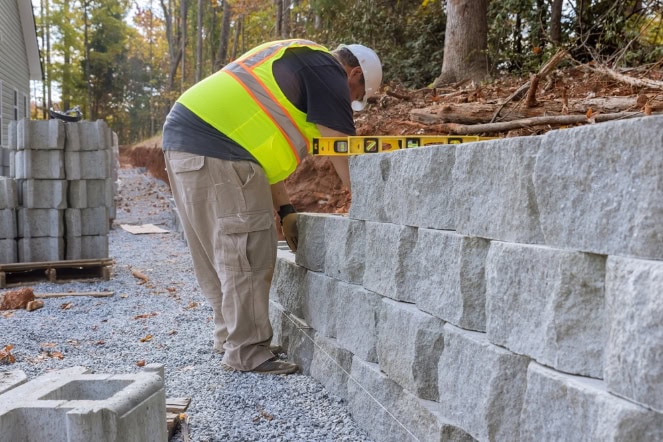
When a retaining wall is built right, you stop watching your yard wash downhill every time it rains. In Concord Township, that matters more than most places. The West Branch of Chester Creek starts right here near Route 202 and the rolling Piedmont terrain means most residential lots in communities like Fox Hill Farm and Darlington Woods have real grade changes that don’t just look messy. They erode, they shift, and over time they eat into the usable space around your home.
The soil here is clay-heavy, which means it holds water, expands when wet, and contracts when it dries out. That cycle puts constant pressure on anything built into the ground including walls that weren’t designed with drainage in mind. A wall built for these conditions doesn’t just hold the slope. It manages the water behind it so that pressure never builds up in the first place.
What you end up with is a yard that’s actually usable. A level patio where there used to be a drop-off. A tiered garden that turns a problem slope into something your neighbors notice for the right reasons. And with median home values in Concord Township sitting near $584,000, a wall that’s built to last isn’t just a landscaping decision it protects real equity.
We’re based in Aston right here in Delaware County and have been building retaining walls and hardscaping for homeowners throughout the county, including Concord Township and the Glen Mills area. This isn’t a company that sends a salesperson to your door and a different crew to your yard. Renato Spennato is the person you meet at the site visit, and our team is the same team that builds the wall start to finish.
That matters in a neighborhood like Fox Hill Farm or along the wooded lots off Smithbridge Road, where the work is visible and the community standard is high. There are no subcontractors. No crew rotations. No wondering who to call if something shifts two years from now. You have one point of contact, and that person is the owner.
We hold an active Pennsylvania contractor license and carry a BuildZoom score that ranks our business in the top 11% of licensed contractors statewide. The reviews back it up homeowners in Concord consistently mention honesty, quality, and the fact that Renato shows up and stays accountable long after the project wraps.
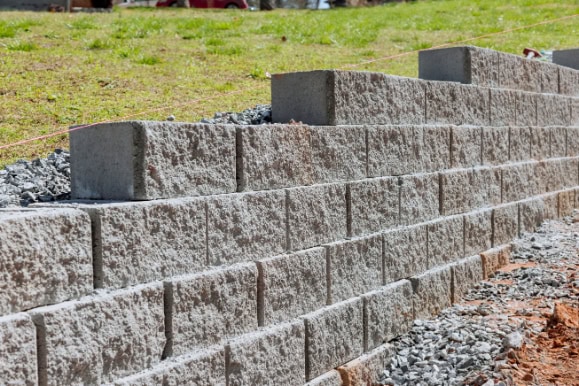
It starts with a site visit not a phone estimate, not a ballpark based on square footage. Every lot in Concord Township is different. The slope behind a home in Darlington Woods behaves differently than one near the Chester Creek headwaters off Route 202, and a quote that doesn’t account for your specific drainage patterns, soil conditions, and access points isn’t worth much. The on-site assessment is where the real work begins.
From there, drainage gets planned before materials get chosen. That’s not how every contractor approaches it, but it’s the right order. The drainage system the aggregate behind the wall, the perforated pipe, the weep holes determines how the wall performs over time. Once that’s dialed in, material selection follows: VERSA-LOK modular block, natural stone, or concrete block, depending on what the site demands and what fits the character of your property.
Concord Township requires permits for retaining wall projects, and the township’s Codes Department runs an appointment-only process walk-ins aren’t accepted. We handle that coordination so you’re not navigating it yourself. Once permits are in order, the build follows a clean timeline with clear communication throughout. When our crew leaves, the site is clean, the wall is done, and you know exactly what was built and why.
Ready to get started?
Every retaining wall we build is engineered for the specific conditions of the site not templated from a catalog. In Concord Township, that means accounting for the Piedmont clay soils that expand and contract with every wet-dry cycle, the freeze-thaw pressure that builds behind walls each winter, and the drainage demands of a township that sits at the headwaters of the West Branch of Chester Creek. These aren’t minor variables. They’re the difference between a wall that holds for decades and one that starts leaning by year three.
Material options include VERSA-LOK modular retaining wall systems, natural stone, and concrete block. VERSA-LOK is a strong choice for many Concord properties it’s engineered for structural performance, handles freeze-thaw cycles well, and offers clean, finished aesthetics that fit the character of planned communities like Fox Hill Farm. Natural stone works well on wooded lots where a more organic look is appropriate. The right material gets chosen based on the wall’s height, the load it needs to support, and what will hold up best in your specific yard.
For walls over four feet or any wall supporting a surcharge like a driveway or structure above it Pennsylvania code requires engineer-reviewed plans. If your project falls into that category, we coordinate that process as part of the job. No surprises, no permit gaps, and no work that creates problems at resale or with your homeowner’s insurance.
In most cases, yes. Concord Township’s zoning code treats retaining walls as structures subject to township review, which typically means a zoning permit is required regardless of wall height. For walls four feet or taller or any wall that supports a surcharge, like a driveway or structure sitting above the wall a building permit is also required, and plans may need to be reviewed by a licensed engineer.
What makes Concord’s process a little different from some other Delaware County municipalities is that the township’s Codes Department runs an appointment-only system. You can’t walk in and submit an application you have to schedule in advance. If your property is near the Concordville Historic District or adjacent to a National Register property, there may be additional design considerations that factor into the approval process as well. We handle permit coordination as part of every project, so you’re not left figuring out the township’s process on your own.
The most common cause of retaining wall failure isn’t the wall itself it’s what’s happening behind it. When water saturates the soil behind a wall and has nowhere to go, it builds up hydrostatic pressure that pushes against the wall face. In Concord Township’s clay-heavy Piedmont soils, that pressure is amplified because clay holds water longer than sandy or loamy soils. Add in the freeze-thaw cycle water behind the wall freezes in January, expands, and thaws in March and you have a mechanical stress that repeats every single winter.
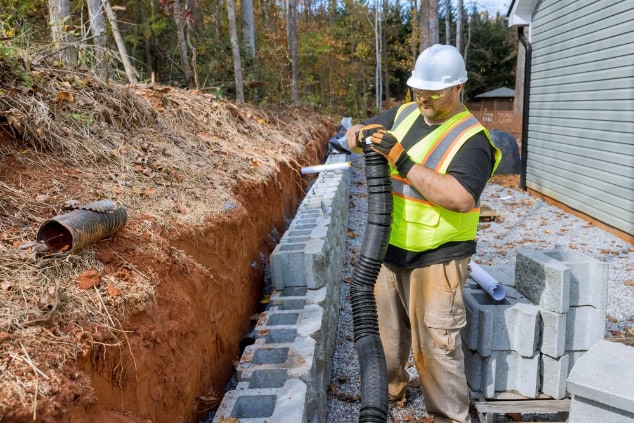
A properly built wall addresses this before the first block goes in. That means installing drainage aggregate directly behind the wall face, running perforated pipe along the base to channel water away, and including weep holes that allow pressure to release. Walls that skip these steps might look fine for a season or two, but they’re working against the physics of the site from day one. Drainage isn’t an add-on it’s the foundation of a wall that actually lasts.
Retaining wall pricing in the Glen Mills and Concord Township area generally runs between $40 and $345 per linear foot, depending on the material, wall height, site access, and drainage requirements. A straightforward VERSA-LOK wall on a moderate slope will sit toward the lower end of that range. A taller natural stone wall with complex drainage engineering and limited equipment access will sit toward the higher end.
For most residential projects in Concord Township, a realistic budget range is somewhere between $5,000 and $15,000, with larger or more technically complex walls going higher. Given that median home values in the township are close to $584,000, a well-built retaining wall typically represents less than two percent of the property’s value and property appraisers generally estimate 100 to 200 percent ROI on structural landscaping improvements like this. The more useful question isn’t just what it costs, but what it costs to keep watching the slope erode and lose usable yard. We provide written, itemized quotes after the site visit so you know exactly what you’re getting before any work begins.
For the freeze-thaw conditions that Concord Township homeowners deal with every winter, material choice matters more than most people realize. Concrete-based systems like VERSA-LOK modular block are specifically engineered for cold-climate performance they’re designed to handle the expansion and contraction that comes with repeated freeze-thaw cycles without cracking or shifting. That makes them a reliable choice for most residential walls in Delaware County.
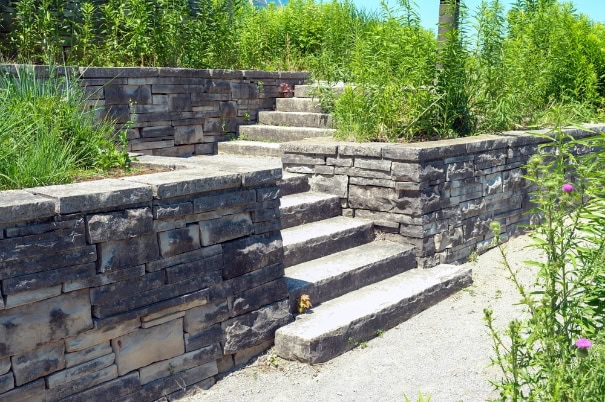
Natural stone is another strong option, particularly for properties with wooded lots or a more naturalistic aesthetic common in the older sections of Concord Township and along the larger lots off Smithbridge Road. Stone walls built with proper drainage behind them can last generations. Poured concrete and concrete block are used where structural demands are highest, such as walls supporting a driveway or a significant grade change. The material that makes the most sense for your project depends on the height of the wall, what it’s retaining, and what will hold up best against the specific conditions on your lot. That’s exactly what the on-site assessment is designed to figure out.
It can and in Concord Township’s market, the case for it is stronger than in most places. When a retaining wall converts an unusable slope into a level patio, a tiered garden, or a functional yard, it adds square footage of livable outdoor space. In a market where buyers are specifically targeting Garnet Valley School District properties and homes are trading at $500,000 to $850,000, usable outdoor space is not a minor selling point.
Property appraisers typically estimate 100 to 200 percent ROI on well-designed retaining wall projects, meaning a $10,000 wall can add $10,000 to $20,000 in appraised value depending on the scope and quality of the work. Beyond the appraisal math, a wall that’s built correctly and permitted properly removes a liability buyers and their inspectors notice unpermitted work, and walls that are visibly shifting or improperly drained can kill a deal or require costly remediation before closing. A wall built right the first time protects your investment on both ends.
A retaining wall that’s properly designed, drained, and built with quality materials should last 40 to 50 years or more. VERSA-LOK modular systems and natural stone walls with good drainage behind them routinely outlast the landscaping around them. The walls that fail early within five to ten years almost always have the same story: drainage was skipped or undersized, the wrong material was used for the climate, or the base wasn’t compacted correctly before the first course went in.
In Concord Township specifically, the combination of clay soils and hard winters puts more stress on retaining walls than you’d see in a warmer or sandier region. That’s not a reason to avoid building one it’s a reason to make sure whoever builds it understands those conditions and engineers accordingly. A wall that accounts for the freeze-thaw cycle, manages hydrostatic pressure from Concord’s wet springs, and uses materials rated for cold climates isn’t just going to look good in year one. It’s going to look the same in year twenty.
Useful Links