
Hear from Our Customers
If you’ve watched the same corner of your yard wash out every spring, or noticed a wall starting to lean after a few hard winters, you already know the problem isn’t going away on its own. Every freeze-thaw cycle that runs through eastern Delaware County loosens more soil. Every heavy rain that feeds into the Darby Creek watershed pushes more water against whatever is holding your grade in place. Left alone, that adds up fast and the repair bill grows with it.
A properly built retaining wall gives you back usable yard space, stops erosion at the source, and redirects water away from your foundation instead of toward it. For Sharon Hill homeowners, that last part matters more than it does in a lot of other places. The borough sits within the Darby Creek drainage basin, and the clay-heavy soil here holds moisture longer than it should, especially on properties with pre-1940 or mid-century foundations that were never graded to modern drainage standards.
When the wall is done right with the correct drainage pipe, gravel backfill, and material selection for Pennsylvania’s climate you stop managing the problem and start ignoring it. That’s the outcome worth paying for.
We’re a Delaware County-based hardscaping and landscaping company, and Sharon Hill falls squarely within the area we work in regularly not occasionally. We know the soil conditions in eastern Delco, we know what the Darby Creek watershed does to properties after a nor’easter, and we know the difference between a wall that looks good in photos and one that’s still standing straight a decade later.
Renato Spennato holds active Pennsylvania contractor license PA057623 verified and ranked in the top 11% of licensed contractors in the state. More importantly, the same crew that builds your wall is the same crew accountable for it afterward. There are no subcontractors, no rotating teams, and no situation where you’re calling a number that nobody answers once the job is done.
If you’re in Sharon Hill whether you’re off Chester Pike, near the Henderson Industrial Park corridor, or tucked into one of the borough’s older rowhouse blocks you’re getting someone who has worked in these conditions before and knows what they require.
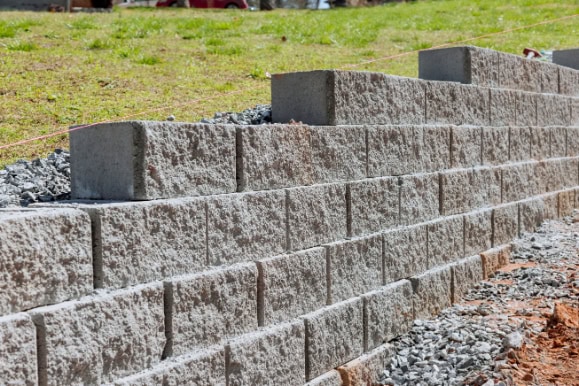
It starts with an on-site visit not a phone estimate, not a ballpark based on square footage. Renato walks the property, reads the slope, checks the soil conditions, and identifies where water is moving and where it needs to go. In Sharon Hill, that assessment almost always includes a close look at drainage, because the combination of clay soil, older yard grades, and proximity to the Darby Creek floodplain means drainage isn’t a detail it’s the whole conversation.
From there, material selection and drainage planning happen before any construction begins. That means choosing the right block system for your specific wall height and load, sizing the drainage pipe correctly, and planning the gravel backfill layer that keeps hydrostatic pressure from building up behind the wall. Sharon Hill Borough requires a permit any time a structure is constructed or altered, and the process takes up to 15 business days from a complete application. We handle that paperwork as part of the project so you’re not navigating borough hall on your own.
Once permits are in place, the build follows a clean sequence: excavation, base preparation, drainage installation, wall construction, and final grading. When the crew leaves, your yard is clean, your wall is documented, and you know exactly what was built and why.
Ready to get started?
Not every retaining wall material performs the same way in eastern Delaware County’s climate. Treated timber walls have a lifespan of 10 to 30 years and in a high-moisture environment like Sharon Hill’s, where soil stays saturated longer due to floodplain proximity, that number trends toward the lower end. Concrete block and VERSA-LOK systems, by contrast, are rated for 30 to 50 years and are specifically engineered to handle Pennsylvania’s freeze-thaw cycle without cracking or shifting. That’s a meaningful difference when you’re deciding whether to spend once or spend twice.
VERSA-LOK is a modular retaining wall system that uses a pinning design to maintain structural integrity through repeated soil movement. For Sharon Hill properties especially the denser rowhouse blocks in Borough Center where lots are tight and walls sometimes sit close to shared property lines the precision of a modular system matters. It installs cleanly in confined spaces, it tolerates the soil conditions here, and it holds its alignment over time in a way that less engineered options don’t.
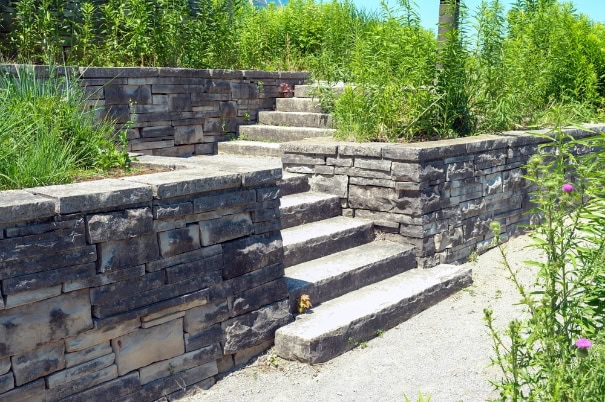
Natural stone is also available for homeowners who want the aesthetic of a traditional wall with a lifespan that can exceed a century when properly built. Whatever material fits your property, the drainage engineering behind it stays the same because that’s what actually determines whether the wall lasts.
Yes, and the borough’s language on this is broader than most people expect. Sharon Hill Borough states that a permit is required any time a structure is constructed or altered which covers retaining walls regardless of height. The application process takes up to 15 business days from the date a complete application is submitted, and it requires drawings and project details along with proof of general liability and workers’ compensation insurance that names Sharon Hill Borough as the certificate holder.
This matters more than it might seem. Homeowners who skip the permit process can face fines, be required to remove the wall at their own expense, or run into complications when they go to sell the property. We handle the permit application as part of the project scope so you’re not left figuring out borough hall on your own, and you’re protected if anyone ever asks for documentation down the road.
Most residential retaining wall projects in the Delaware County area fall somewhere between $3,500 and $10,000, with per-linear-foot costs ranging from roughly $40 to $345 depending on the material, wall height, and how much drainage engineering the site requires. Taller walls, walls with significant surcharge loads, and walls on properties with challenging drainage conditions which describes a lot of Sharon Hill’s older housing stock tend to sit toward the higher end of that range.
The honest framing here is that the cost of building it right the first time is almost always less than the cost of rebuilding a failed wall. A wall that fails due to poor drainage or inadequate materials runs $3,000 to $8,000 or more to reconstruct, on top of whatever damage was done to the surrounding yard or foundation in the meantime. Property appraisers also estimate that well-built retaining walls return 100 to 200 percent of their cost at resale so in a market where Sharon Hill home values are actively moving, it’s an investment that tends to pay for itself.
For Pennsylvania’s climate and specifically for eastern Delaware County’s combination of clay soil, high soil moisture, and repeated freeze-thaw cycles from November through March concrete block and VERSA-LOK modular systems consistently outperform the alternatives. The reason is straightforward: clay soil expands when it gets wet and contracts when it dries. In winter, water trapped in that soil freezes, expands, and physically pushes against whatever is holding the grade. Walls that aren’t engineered to handle that movement will crack, shift, or lean over time.
VERSA-LOK’s pinning system is specifically designed to maintain alignment through soil movement, which makes it a strong choice for Sharon Hill properties where the soil stays saturated longer than it does in higher-elevation western Delco communities. Treated timber is a less expensive upfront option, but in high-moisture environments it tends to reach the lower end of its 10 to 30 year lifespan. If you’re building a wall you don’t want to think about for the next 30 to 50 years, concrete block or VERSA-LOK is the practical choice.
Water is the primary reason retaining walls fail not age, not material quality, and not the weight of the soil itself. When water saturates the soil behind a wall and has nowhere to go, it builds up hydrostatic pressure. That pressure can generate thousands of pounds of lateral force against the wall face. Over time, that force causes the wall to bow, crack, or tip forward. The problem accelerates in freeze-thaw conditions because frozen water expands, physically displacing soil and adding even more pressure.
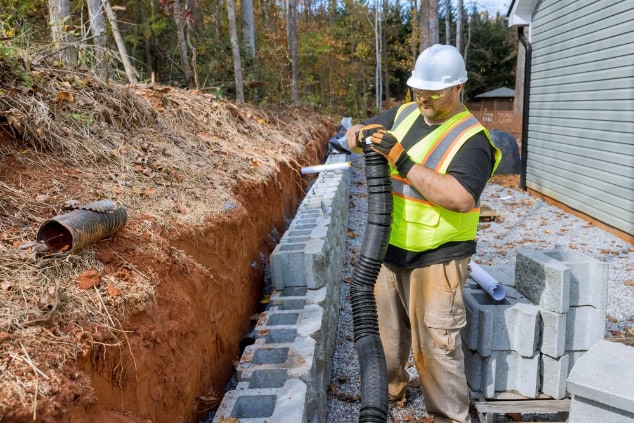
The fix is drainage engineering that happens before the wall goes in not as an afterthought. That means a perforated drainage pipe running behind the base of the wall, a gravel backfill layer that allows water to move freely toward the pipe, and properly placed weep holes that let any remaining pressure escape. For Sharon Hill properties in the Darby Creek watershed, where groundwater levels run higher than in much of the county, skipping any one of these steps creates a wall that’s under constant stress from the day it’s built. We plan drainage before material selection because the drainage system is what makes the material choice matter.
It can, depending on where the water is coming from. Many Sharon Hill homes particularly the pre-1940 and mid-century construction in Borough Center have yard grades that have settled over decades in ways that direct surface water toward the foundation rather than away from it. When that’s the case, a retaining wall that re-establishes proper grade and redirects surface drainage can meaningfully reduce the amount of water reaching the foundation wall.
That said, a retaining wall isn’t a substitute for a proper drainage system if water is entering the basement through the foundation itself. The on-site assessment we conduct before quoting any project includes an evaluation of where water is moving on the property so if the issue is grade-related, a wall can address it. If the source is something else, you’ll know that before you spend money on a solution that won’t solve the actual problem. Sharon Hill’s proximity to the Darby Creek floodplain means drainage assessments here tend to be more detailed than in drier parts of the county, and that’s worth doing right.
The honest answer is that some walls can be repaired and some can’t and the difference usually comes down to what caused the problem in the first place. A wall that has shifted or cracked because the drainage behind it failed is almost always a replacement, not a repair. Patching the face of a wall while the drainage issue remains unresolved just delays the next failure. On the other hand, a wall with isolated surface damage, a single failed section, or minor settling in one area may be a legitimate repair candidate if the underlying drainage and base are still sound.
The signs that typically indicate replacement over repair include bowing or leaning that has progressed past a few degrees, cracking that runs through the full depth of the wall, sections that have separated from the rest of the structure, or any wall where water is visibly coming through the face under pressure. In Sharon Hill’s older housing stock, it’s also common to find walls that were originally built without drainage systems at all and those walls, regardless of how intact they look on the surface, are living on borrowed time. An on-site assessment will tell you which category your wall falls into before any money changes hands.
Useful Links
Other Services we provide in Sharon Hill