
Hear from Our Customers
Most retaining walls don’t fail because of bad materials. They fail because nobody thought seriously about what water does behind that wall once a hard rain hits. In Chadds Ford, that’s not a hypothetical. The Brandywine watershed has a documented history of significant flooding the kind that exposes every drainage shortcut a contractor ever took. When water has nowhere to go, it finds a way. And what it finds is usually your wall, your foundation, or your lawn at the bottom of the hill.
A properly built retaining wall changes that picture entirely. You get a slope that holds, a yard that drains, and outdoor space that actually functions whether that’s a flat area for the kids, a tiered garden that fits the character of your property, or just a hillside that stops eroding every time it rains. On a property in this area, where home values are well into the seven figures, that kind of structural stability isn’t a luxury upgrade. It’s basic property protection.
The Piedmont soils in Chadds Ford a mix of clay, gravel, and sand sitting over schist and gneiss bedrock behave differently than the flatter suburban ground you’d find further east in Delaware County. Grade changes here are real, and they require walls designed around what’s actually underneath your yard, not a standard spec pulled from a catalog. We design every wall we build around the specific soil and drainage conditions on your property.
We’re based in Aston, PA connected to Chadds Ford by Route 1, the same road that runs straight through the heart of the township. I hold an active Pennsylvania contractor license (PA057623) and carry a BuildZoom score of 102, placing me in the top 11% of licensed contractors across the state. That’s not a badge on a wall it’s a verifiable record.
What sets us apart isn’t a tagline. It’s the model. One crew designs your wall, builds your wall, and is still reachable when you have a question two winters later. There are no subcontractors, no crew rotations, no “that was a different team.” My name is on the license, on the truck, and on every project that goes out. In a township of under 4,000 residents where neighbors talk, that kind of accountability isn’t optional it’s the whole point.
We serve Delaware County specifically, which means the western corridor Chadds Ford, the Painters Crossing area, properties near the Brandywine is familiar ground, not an afterthought. We know the township’s permitting process, the soil conditions, and the aesthetic standards that matter to properties in this area.
It starts with a free on-site assessment. Not a phone quote, not a ballpark based on square footage an actual visit to your property. Chadds Ford lots aren’t uniform. A wooded hillside off Pyle Road has a completely different drainage profile than a graded subdivision lot in the Enclave or a property backing up to a tributary near the creek. The only way we can quote accurately and design correctly is to see the land.
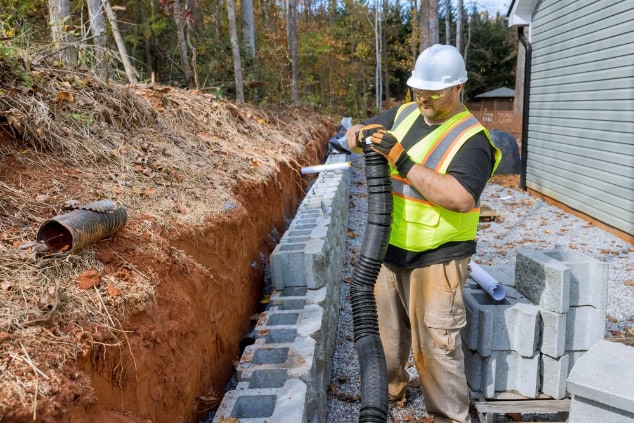
Once we’ve assessed the site, the drainage plan comes first before materials, before layout, before anything else. That means evaluating where water enters the slope, where it needs to exit, and what’s standing in the way. Gravel backfill, perforated pipe, and correctly positioned weep holes aren’t add-ons. They’re the foundation of a wall that holds through Pennsylvania’s freeze-thaw cycles and whatever the Brandywine watershed sends your way next season.
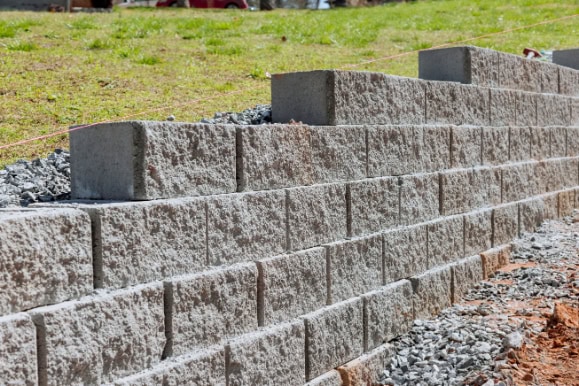
From there, material selection follows the property natural stone for historic or pastoral settings, engineered block like VERSA-LOK for larger structural walls where load and height demand precision. Chadds Ford Township requires a zoning permit for structural additions, and walls over four feet may require a building permit under Pennsylvania’s Uniform Construction Code. Because the Chadds Ford CDP straddles both Delaware and Chester counties, some properties may fall under Chester County’s jurisdiction for permitting something worth knowing before anyone breaks ground. We navigate that process so you don’t have to figure it out mid-project.
Ready to get started?
Every retaining wall we build in the Chadds Ford area is designed around three things: the specific grade and soil conditions on your property, the drainage demands of the Brandywine Valley’s terrain, and the aesthetic standard that this community actually expects. A prefab block wall that looks fine in a flat suburban yard can look completely out of place against a historic stone farmhouse or a wooded hillside property near the Brandywine River Museum. Material selection matters here in a way it doesn’t everywhere else.
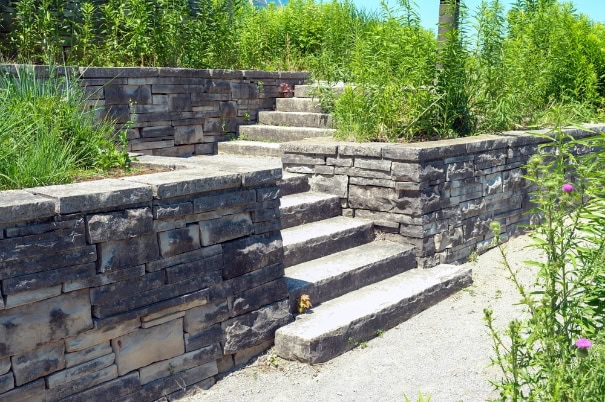
For smaller decorative or garden walls typically under four feet the focus is on material fit and clean integration with the existing landscape. For larger structural walls managing real grade changes, VERSA-LOK engineered block is a common choice: it’s designed for Pennsylvania’s climate, requires no frost footings, and handles the lateral loads that come with significant slope. Natural fieldstone and dry-laid stone walls are available for properties where the historic or pastoral character of the site calls for it. The right choice depends on your land, your property style, and what the wall actually needs to do.
What you won’t find here is a contractor who shows up with one solution and fits your yard to it. The Chadds Ford area has enough variation in topography, soil, and aesthetic character that a one-size approach simply doesn’t hold up literally or visually.
Yes, and it’s a little more involved here than in most Delaware County towns. Chadds Ford Township requires a zoning permit for new construction and structural additions to your property, which includes retaining walls. That’s the baseline regardless of wall height.
Beyond the township zoning permit, Pennsylvania’s Uniform Construction Code sets a threshold at four feet: walls taller than four feet that support a surcharge like a driveway, a structure, or a significant amount of backfill generally require a building permit and, in many cases, a plan prepared by a licensed professional engineer. Given the grade changes on many Chadds Ford properties, walls over four feet aren’t uncommon here.
There’s one more layer specific to this area: the Chadds Ford CDP straddles both Delaware and Chester counties. Depending on exactly where your property sits, your permits may flow through Delaware County or Chester County. If your home is near the village center or within the Chadds Ford Historic District, there may be additional design review considerations for exterior structural work. We handle the permitting process and make sure everything flows through the right jurisdiction before we break ground.
Retaining wall pricing varies significantly based on wall height, length, material, and site conditions and Chadds Ford properties tend to have more site complexity than average. Most residential retaining wall projects in this area fall somewhere between $3,500 and $10,000, with larger estate-scale projects on multi-acre lots running higher depending on scope.
Material is one of the biggest cost drivers. Engineered block like VERSA-LOK typically runs in the mid-range and offers strong structural performance for the price. Natural stone and dry-laid fieldstone cost more but are often the right choice for properties where the aesthetic of the Brandywine Valley matters and in Chadds Ford, it usually does. Treated timber is the most affordable option but carries the shortest lifespan, typically 10 to 30 years, which makes it a harder sell on a property where you’re investing for the long term.
What actually determines your number is an on-site assessment. Soil composition, slope angle, drainage requirements, proximity to structures, and whether the wall needs engineered drawings all affect the final cost. We visit your property, evaluate the conditions, and give you an accurate number and a plan that fits your specific land.
Properties near the Brandywine Creek or its tributaries face a specific combination of challenges: variable soil composition, a high water table in lower areas, and the kind of drainage pressure that comes with a watershed the Brandywine Conservancy spent two years formally studying after the flooding from Hurricane Ida’s remnants in September 2021. Material selection for these properties needs to account for all of it.
For most structural walls in this area, engineered concrete block VERSA-LOK being a common choice performs well because it’s designed for Pennsylvania’s freeze-thaw climate, doesn’t require frost footings, and handles hydrostatic pressure when paired with proper drainage behind the wall. For properties with a historic or pastoral character, natural stone is the stronger aesthetic fit and can last 40 to 100-plus years when properly installed.
What matters most near the creek isn’t just the material it’s the drainage system behind the wall. Gravel backfill, perforated pipe, and correctly placed weep holes are what keep hydrostatic pressure from building up and pushing the wall out over time. A wall without proper drainage will fail eventually regardless of what it’s made of. That’s the piece most contractors skip, and it’s the first thing we plan on every project.
A well-built retaining wall should last decades natural stone can hold for 40 to 100-plus years, engineered block for 30 to 50, treated timber for 10 to 30. What shortens that lifespan almost every time is the same thing: poor drainage.
When water builds up behind a retaining wall and has nowhere to go, it creates hydrostatic pressure lateral force that compounds with every rain event and every freeze-thaw cycle. In Chadds Ford, where January temperatures hover around freezing and the area sees regular freeze-thaw cycling through the winter months, that pressure cycle is real and relentless. Water infiltrates the soil behind the wall, freezes, expands, and pushes. It thaws, contracts, and the soil shifts. Repeat that 15 or 20 times in a winter and a wall without proper drainage starts to bow, lean, or crack.
The other common failure point is improper compaction during installation. Backfill that isn’t properly compacted settles unevenly over time, creating voids behind the wall that allow movement and eventually structural failure. Both problems are entirely preventable with correct installation they’re not bad luck, they’re the result of shortcuts taken during the build.
Yes, and in this market the case for it is straightforward. Chadds Ford home values average close to $928,000. A properly built retaining wall that converts an eroding hillside into usable outdoor space a level lawn, a terraced garden, a defined entertaining area adds functional square footage to a property where outdoor living is part of the value proposition.
Property appraisers generally estimate 100 to 200 percent return on quality retaining wall investments, which means a $7,000 to $10,000 wall can add $14,000 to $20,000 or more in appraised value on the right property. That math works especially well in Chadds Ford, where buyers are paying premium prices and expecting premium outdoor environments to match.
There’s also the cost-avoidance side of the equation. An eroding slope that goes unaddressed doesn’t stay a cosmetic problem. It becomes a drainage problem, then a foundation problem, then a remediation project that costs significantly more than a properly installed wall would have. On a property at this price point, deferring a retaining wall isn’t really saving money it’s just moving the cost forward while the damage compounds.
The most important thing you can verify is licensure. Pennsylvania requires contractor licensing, and you can confirm any contractor’s license status through the state’s public database. We hold active license PA057623 that’s publicly searchable and verifiable before you ever make a call.
Beyond the license, the questions that matter most are about accountability after the job is done. BBB complaint data and consumer forums consistently show that the most common retaining wall problem isn’t the build itself it’s the contractor becoming unreachable once the final check clears. What you want is someone whose name is on the license, who builds the wall themselves, and who you can actually reach two years later when you have a question after a hard winter.
Ask any contractor you’re considering whether they subcontract the work, how they handle drainage planning, whether they pull the required permits, and whether they’ve worked on properties in the Chadds Ford area specifically. The answers will tell you a lot. A contractor who’s genuinely familiar with this end of Delaware County the Piedmont terrain, the township’s permit requirements, the dual-county complexity of the Chadds Ford CDP is going to give you very different answers than one who’s just expanding their radius.
Useful Links
Other Services we provide in Chadds Ford