
Hear from Our Customers
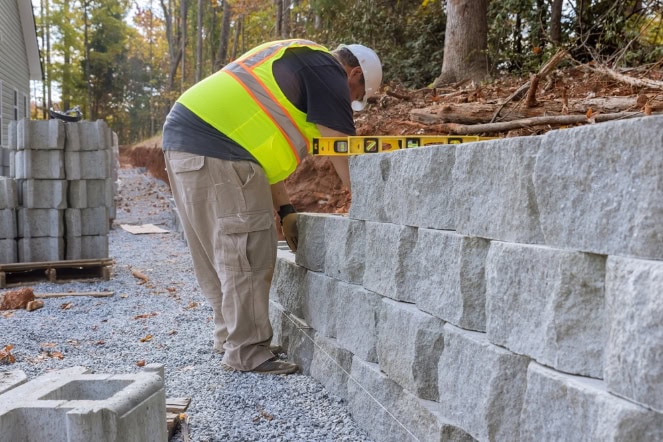
A lot of Boothwyn homeowners have lived with the same slope problem for years. Soil migrating downhill after every rain. A section of yard that’s too steep to mow safely. An old wall that’s started to lean and nobody wants to touch. You put it off because you weren’t sure what it would cost, or you didn’t know who to trust with it. That’s a completely normal place to be and it’s exactly the kind of problem a well-built retaining wall solves.
When the wall is done right, that unusable slope becomes flat, functional outdoor space. The erosion stops. The drainage actually works. And the foundation of your home stops absorbing water it was never meant to handle. For Boothwyn properties many of them built between the 1940s and 1970s with original grading that was never updated this isn’t just a cosmetic upgrade. It’s structural protection that pays for itself over time.
The other thing worth knowing: retaining walls consistently return 100–200% of their cost at resale. On a home in the $300,000–$310,000 range, a $6,000 wall could add $12,000 or more in value. That’s not a sales pitch that’s what property appraisers report. But more immediately, you get a yard you can actually use, starting the season the wall goes in.
We’re based in Aston right on the northern edge of Upper Chichester Township, just minutes from Boothwyn. That’s not a detail we throw in to sound local. It means we and our crew know this area. We know the terrain along Chichester Avenue, the older housing stock near Meetinghouse Road, and the drainage challenges that come with the clay-heavy soils in the southern Delaware County corridor where Boothwyn sits.
I hold an active Pennsylvania contractor license (PA057623) and we carry a BuildZoom score of 102 placing us in the top 11% of over 125,000 licensed PA contractors. More practically, it means you’re working with someone who’s accountable by name, not a regional company that dispatches whoever’s available.
One crew handles your project from the first shovel to the final cleanup. No subcontractors. No handoffs. If something needs attention two years from now, you’re calling the same person who built it not navigating a customer service queue.
It starts with a free on-site visit. Not a phone estimate, not an online form an actual site assessment where I walk your property, look at the slope, evaluate the soil conditions, check the existing drainage patterns, and figure out what your wall actually needs to do. Two houses on the same street in Boothwyn can have completely different wall requirements depending on grade, soil depth, and how water moves across the lot. That visit is the only honest way to give you a quote you can rely on.
From there, you get a clear scope: materials, drainage plan, timeline, and cost. If your project involves grading 750 square feet or more which triggers Upper Chichester Township’s Grading permit requirement or if the wall exceeds four feet in height, the permitting process gets handled as part of the job. You don’t have to figure out what the Township’s License and Inspection office needs. That’s already built into how we operate.
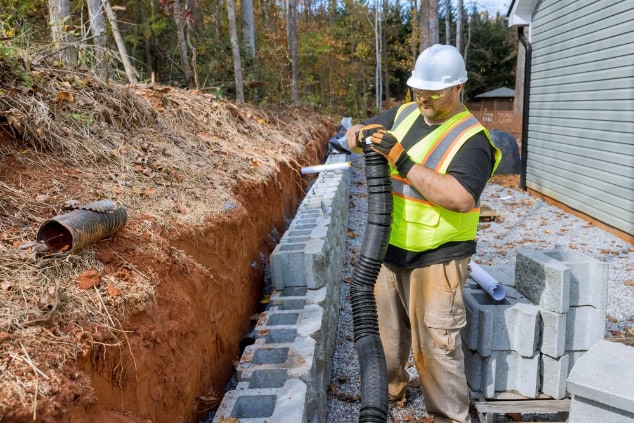
Construction follows a sequenced process: excavation, base preparation, compacted gravel backfill for drainage, wall installation using stepped layering, and final grading and cleanup. The drainage system gravel backfill, perforated drain pipe, and weep holes isn’t optional here. Boothwyn’s clay soil retains water, and without proper drainage behind the wall, hydrostatic pressure will eventually win. The build is done when it’s actually done, and the site is clean when the crew leaves.
Ready to get started?
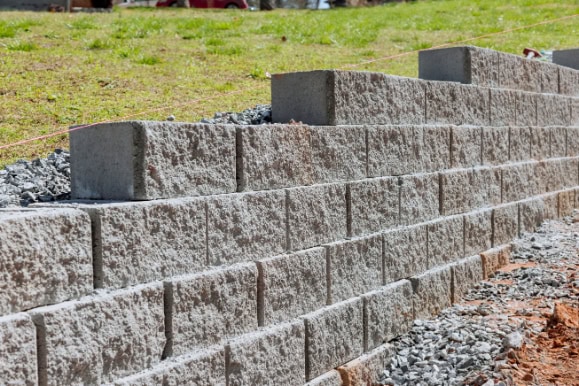
Not every retaining wall needs the same material, and not every contractor takes the time to explain why. A low garden border has different structural demands than a six-foot wall holding back a hillside behind a 1960s Cape Cod. We work with a full range of materials including VERSA-LOK segmental retaining wall units, natural stone, and concrete block and the selection is based on the wall’s actual job, not what’s easiest to install.
VERSA-LOK is worth mentioning specifically because it’s well-suited to Pennsylvania’s freeze-thaw climate. It requires no frost footings, handles curves and corners without special cuts, and the pinning system gives it structural integrity that simpler stacked-block walls don’t have. For Boothwyn properties with irregular lot shapes or walls that need to transition around existing landscaping, that flexibility matters. Natural stone walls, when built correctly, can last a century or more a meaningful consideration for a homeowner who plans to stay in their home long-term.
On the permit side: Upper Chichester Township requires a Grading permit with engineer-sealed plans for projects involving 750 square feet or more of disturbance, and walls over four feet in height require a building permit under the Pennsylvania Uniform Construction Code. Homeowners who skip this or hire contractors who don’t flag it can face fines, forced removal, and complications at resale. We navigate the Township’s permitting requirements on every project that needs it, so your wall is protected from day one.
It depends on the height and scope of the project. Under Pennsylvania’s Uniform Construction Code, retaining walls under four feet in height measured from the lowest grade to the top of the wall generally don’t require a state building permit, as long as the wall isn’t supporting a surcharge or holding back any liquids. But once you cross that four-foot threshold, a building permit is required, and that means submitting documentation to Upper Chichester Township’s License and Inspection office.
There’s a second trigger that a lot of homeowners don’t know about: if your project involves grading 750 square feet or more of land, Upper Chichester Township requires a separate Grading permit and that permit requires plans signed and sealed by a registered professional engineer. This catches people off guard, especially on larger slope stabilization projects in Boothwyn and the surrounding area. The consequence of skipping it isn’t just a fine. It can surface as a title issue when you go to sell the home, or complicate an insurance claim down the road. We handle the permit process as part of every qualifying project so you’re not left figuring that out on your own.
The honest answer is that cost varies significantly based on wall height, length, material, and how much drainage engineering the site requires. As a general range, retaining wall installation runs $40 to $120 per linear foot for mid-range materials like concrete block or VERSA-LOK segmental units and can go higher for natural stone or walls that require more complex drainage systems. A straightforward 20-foot wall might come in around $3,500–$5,000. A longer or taller wall with significant drainage work can reach $8,000–$12,000 or more.
What inflates cost more than anything else is skipping drainage the first time and having to rebuild. In Boothwyn’s clay-heavy soil, a wall installed without proper gravel backfill, perforated drain pipe, and weep holes will fail often within just a few seasons. The repair or replacement cost can easily run $3,000–$8,000 on top of what you already spent. The most accurate quote you can get is one that comes after someone has actually walked your property and assessed the slope, soil, and drainage conditions specific to your lot. That’s why we start every project with a free on-site visit before any number is put on paper.
The primary culprit is water specifically, water that builds up behind the wall and has nowhere to go. In Boothwyn and the broader southern Delaware County area, the soil is clay-heavy. Clay retains moisture instead of draining it. When saturated clay freezes in winter, it expands. When it thaws, it contracts and loosens. Every freeze-thaw cycle applies pressure to the back face of the wall. Without a drainage system designed to remove that water before it builds to damaging levels, even a well-constructed wall will eventually bow, crack, or topple.
The second common failure point is inadequate base preparation. A wall that wasn’t set on a properly compacted base will shift as the ground moves through seasonal cycles. This is especially relevant for Boothwyn’s older homes, where original walls often timber or simple stacked block from the 1960s and 1970s were built without modern drainage engineering and are now at or past the end of their functional life. If you’re seeing a wall that’s starting to lean or has gaps forming between blocks, that’s not cosmetic. It’s a drainage or base failure, and it won’t fix itself.
Material choice plays a big role here. Treated timber walls typically last 10–30 years before the wood deteriorates, especially in a climate like southeastern Pennsylvania’s where the ground stays wet for extended periods. Concrete block and segmental units like VERSA-LOK are rated for 30–50 years when installed with proper drainage and base preparation. Natural stone, when laid correctly with adequate drainage behind it, can last 75–100 years or more which is why you’ll still find functional stone walls on properties in this part of Delaware County that were built generations ago.
The variable that matters most regardless of material is drainage. A concrete block wall with no drainage system behind it will fail in far less time than its rated lifespan. A natural stone wall with proper gravel backfill and weep holes will outlast almost anything else. For Boothwyn homeowners who plan to stay in their homes long-term, the material conversation is worth having in detail during the site visit. The right choice depends on your budget, your aesthetic goals, and what the wall is actually being asked to do structurally.
A retaining wall addresses one specific type of drainage problem: water that’s moving across or through a sloped area and carrying soil with it, or pooling against a foundation because of grade. If your yard is losing soil after every rain, sending runoff toward your house, or has a slope that channels water in a direction that’s causing damage, a properly designed retaining wall with an integrated drainage system can redirect that water and stop the erosion.
What a retaining wall won’t fix on its own is a broader stormwater management issue for example, if your property sits in a low point that collects runoff from neighboring lots, or if the grading around your foundation is directing water toward the house from multiple directions. Upper Chichester Township’s stormwater management program acknowledges that impervious surface coverage roads, driveways, roofs reduces the ground’s ability to absorb water, which puts more stress on residential drainage systems across the area. In those cases, a retaining wall may be one part of a larger drainage solution. The on-site assessment is where that gets sorted out I’ll tell you directly what a wall can and can’t solve for your specific property.
The right material depends on three things: what the wall needs to do structurally, what your budget looks like, and what you want it to look like. Those three factors don’t always point in the same direction, and part of the site visit is working through that honestly.
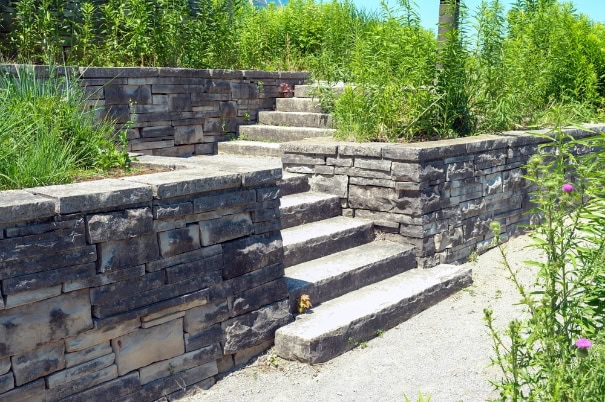
For most Boothwyn homeowners dealing with a mid-height slope say, three to five feet VERSA-LOK segmental block is a strong middle-ground option. It’s engineered for Pennsylvania’s freeze-thaw climate, requires no frost footings, handles irregular lot shapes well, and holds up for decades when installed with proper drainage. It’s also more affordable than natural stone while looking substantially better than basic concrete block. Natural stone is the premium choice for longevity and aesthetics a well-built stone wall on a Boothwyn property can genuinely last a century but it comes at a higher cost per linear foot and requires skilled installation to perform correctly. Timber is the lowest upfront cost but the shortest lifespan, and in the clay-heavy soils common to southern Delaware County, timber walls tend to deteriorate faster than their rated lifespan suggests. If you’re replacing an existing timber wall that’s already failing, it’s worth having a real conversation about whether timber makes sense again or whether a longer-lasting material is the smarter investment this time around.
Useful Links