
Hear from Our Customers

Most Woodlyn homes were built in the postwar boom the 1940s, ’50s, and ’60s. That means the grading, drainage lines, and site prep underneath your yard are anywhere from 60 to 80 years old. Over time, soil settles, slopes shift, and what once directed water away from your foundation quietly starts working against it. If you’ve dealt with water pooling near your house after a heavy rain, a damp basement that gets worse every spring, or erosion that keeps coming back no matter what you plant the problem almost always starts with the grade.
Woodlyn sits in a part of Delaware County where Crum Creek runs along the western edge of the community and the soils trend clay-heavy throughout. Clay holds moisture. It drains slowly. It shifts under freeze-thaw cycles in a way that sandy or loamy soil doesn’t. When excavation and grading are done without accounting for those conditions, the results don’t last. When it’s done right with the right slope, the right depth, and the right compaction for this specific soil the difference is something you actually see and feel: water moving away from your house instead of toward it, a yard that doesn’t turn into a swamp after every storm, and a foundation that isn’t quietly absorbing hydrostatic pressure season after season.
The other thing that changes is what you can build. A patio that doesn’t heave. A retaining wall that holds. A yard renovation that looks the same in year five as it did in year one. That’s what correct site preparation and residential excavation in Woodlyn actually produces not just a hole in the ground, but a stable base for everything that comes after it.
We’re based in Aston, PA a few miles from Woodlyn in the same stretch of Delaware County. Renato Spennato has been doing this work for over 15 years, and the majority of that experience has been on residential properties just like the ones in Woodlyn: postwar lots, tight side yards, clay soils, and drainage situations that require more than a standard approach.
Out of more than 125,000 licensed Pennsylvania contractors, we hold a BuildZoom score of 102 placing our business in the top 11%. That’s not a self-reported number. Any homeowner can verify it independently before making a single call. Renato is named personally in reviews across multiple platforms, which means when something comes up on your project and something always comes up there’s an actual person accountable for it, not an anonymous crew.
What makes our work different is the full-service model. We handle excavation and site preparation as part of a complete project not as a standalone dig that gets handed off to someone else. If you’re in Woodlyn and you want a finished patio, a retaining wall, or a regraded yard that actually solves your drainage problem, you’re working with one team from raw ground to finished surface.
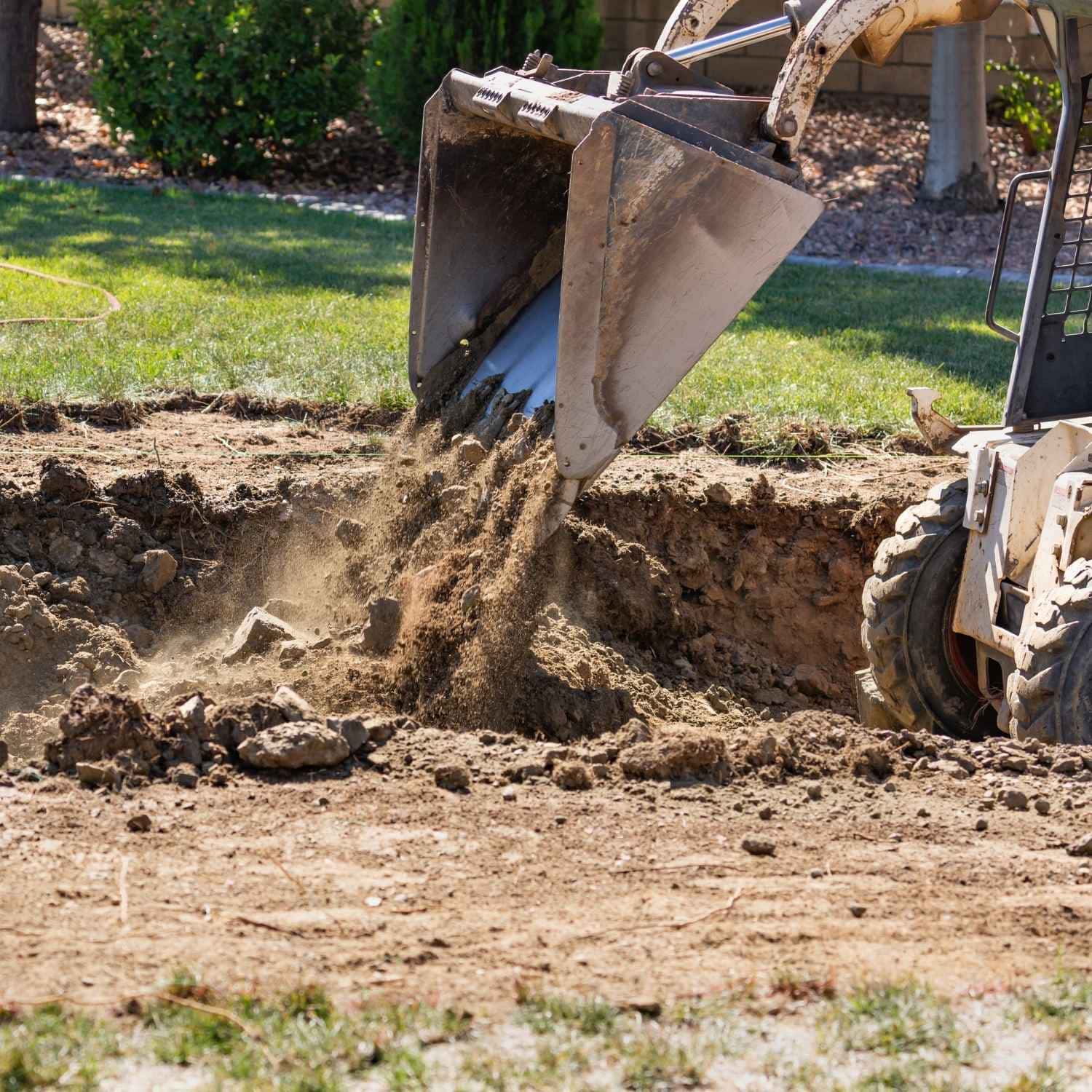
It starts with a site assessment. Before any equipment shows up, we evaluate the existing grade, soil conditions, drainage patterns, and project scope. On Woodlyn properties especially in the Swarthmorewood section where twin homes sit on narrower lots that assessment also determines what equipment makes sense. Not every job needs a full-size excavator. Using the wrong machine on a tight residential lot can cause more damage than the project is worth.
Once the scope is clear, we sort out permit requirements. Woodlyn is governed by Ridley Township, which has a dedicated chapter in its municipal code specifically for excavations and grading, plus separate stormwater management requirements. If your project triggers a permit and many do we handle that process before work begins, not after. Pennsylvania also requires a call to 811 before any digging. That’s not optional, and we take care of it as part of our process.
From there, excavation and grading proceed in stages: rough cut, fine grading, compaction, and drainage integration where needed. If the project continues into hardscaping or outdoor living a patio, a wall, an outdoor kitchen the site prep is done with that finished work in mind, not as a disconnected first step. When we’re done, your yard is ready for what comes next, not just cleared out and left for someone else to figure out.
Ready to get started?
Excavation and site preparation in Woodlyn covers a range of work depending on what your property needs. Regrading to correct drainage slope is one of the most common requests particularly on properties near Crum Creek or in lower-lying sections of the community where soil saturation is a recurring issue. French drain installation, subsurface drainage correction, foundation perimeter grading, and lot clearing for new construction or additions are all part of our scope. We also handle demolition of existing hardscape when a patio or walkway needs to come out before new work goes in.
What sets our work apart for Woodlyn homeowners is that it doesn’t stop at the excavation. Because we handle the full project from dig and grade contractor work through finished masonry, paving, and outdoor living the site preparation is designed with the end result in mind. The depth, the slope, the compaction, the drainage integration: all of it is planned around what’s being built on top of it, not just what needs to be removed. That’s a different approach than hiring a standalone excavation company and hoping the next contractor can work with what they left behind.
For homeowners in Woodlyn dealing with a mix of older and newer construction, or in the twin-home sections where lot access is tight and every inch of side yard matters, that continuity isn’t a small thing. It’s the difference between a project that holds up and one that needs to be redone.

It depends on the scope of the project, but many excavation and grading jobs in Woodlyn do require a permit. Woodlyn is part of Ridley Township, and the Township has a dedicated chapter in its municipal code Chapter 129 that specifically covers excavations and grading. Stormwater management requirements fall under a separate chapter, Chapter 260, and can come into play when a project changes how water moves across or off the property.
The practical answer is: don’t assume your project is exempt. Ridley Township’s code enforcement office advises residents to contact them before starting any new construction or site alteration work. If you’re working with us, we handle permit navigation as part of the project process you don’t have to figure out which chapter applies or what forms to file. Pennsylvania also requires a call to 811 before any digging, regardless of project size. That’s a statewide legal requirement, not something that only applies to large commercial jobs.
Residential excavation in the Delaware County area generally runs between $1,600 and $6,700, with most projects landing around $3,975 depending on scope, depth, and site conditions. Grading and leveling work specifically tends to range from $400 on the low end to $6,500 for more complex regrading jobs. Hourly rates for excavation work in the Philadelphia suburban market run higher than rural Pennsylvania typically 15 to 25 percent above state average which is worth accounting for when comparing quotes.
What affects cost most in Woodlyn specifically is soil behavior and site access. Clay-heavy soils, which are common throughout Delaware County, require more careful compaction work and can affect how long grading takes to complete correctly. Properties with tight access particularly in the twin-home sections of Swarthmorewood or along narrower residential streets may affect equipment selection, which has its own cost implications. The most accurate number comes from a site-specific assessment, not a ballpark estimate over the phone.
Water pooling in a yard is almost always a grading problem. When the slope of the ground no longer directs water away from the house and toward a drainage outlet, it has nowhere to go so it sits. On Woodlyn properties, this is compounded by two factors: the age of the homes and the clay content of the soil. Homes built in the postwar era were graded to standards that made sense at the time, but decades of soil settlement, landscaping changes, and freeze-thaw cycles can completely reverse the original drainage intent.
Clay soil makes it worse because it doesn’t absorb water the way sandy or loamy soil does. When the ground is saturated which happens regularly in this part of Delaware County, especially in areas near Crum Creek water has no path down, so it finds a path sideways, often toward your foundation. Regrading the yard to restore correct slope is the structural fix. In some cases, a French drain or subsurface drainage system is also needed to move water that’s already below grade. The right answer depends on where the water is coming from, and that starts with a proper site assessment.
Site preparation is everything that happens to the ground before a finished structure goes on top of it clearing, excavating to the right depth, grading for drainage, and compacting the base so it doesn’t shift. It’s not glamorous work, but it’s the reason some patios and retaining walls last 30 years and others start cracking and heaving within three.
In Woodlyn, where the soil is clay-heavy and freeze-thaw cycles are a real factor every winter, skipping or shortcutting site prep is one of the most common reasons hardscape projects fail early. Clay soil expands when it’s wet and contracts when it dries. If the base beneath a patio wasn’t excavated to the right depth and compacted with the right material, that movement works its way up through the surface over time. A properly prepared base excavated to the correct depth for the project type, graded for drainage, and compacted in layers is what separates a patio that holds from one that shifts. If someone is quoting you a patio or retaining wall in Woodlyn without discussing site preparation in detail, that’s worth asking about directly.
The honest answer is that you usually can’t tell from the surface alone. Surface grading issues where the yard slopes toward the house or water pools in low spots are sometimes visible and can be corrected with regrading alone. But in Woodlyn, where the municipal sewer system is a combined storm and sanitary system in some areas, and where hydrostatic pressure from saturated clay soils is a documented issue, the problem is sometimes coming from below grade rather than above it.
If you’re seeing water in your basement after heavy rain, that’s a different situation than a yard that takes a few days to dry out. Basement water in Woodlyn can come from surface water running toward the foundation, groundwater pushing through the foundation wall due to hydrostatic pressure, or sewer water backing up through floor drains when the combined system gets overwhelmed. Regrading addresses the surface water component. Subsurface drainage French drains, perimeter drainage systems addresses the groundwater pressure. A proper site assessment is the only way to determine which problem you’re actually dealing with and what the right fix is.
Late spring through fall is generally the most workable window for excavation and grading in Delaware County. The ground is unfrozen, conditions are drier, and compaction work holds better when soil isn’t waterlogged. That said, early spring March and April specifically can be tricky in Woodlyn because the clay soils here hold winter moisture longer than sandy soils do. Excavating in saturated clay before it’s had a chance to drain can affect compaction quality and extend project timelines.
Fall is actually one of the better times to do grading and site preparation work if you’re planning a spring build. Grading done in October or November gives the soil a full winter to settle and compact naturally before anything gets built on top of it. Winter scheduling is possible for planning and scoping, but active excavation in frozen ground significantly increases difficulty and cost it’s generally not worth it unless the project is urgent. If you’re in Woodlyn and thinking about a spring project, booking the assessment in late winter gives you the best chance of getting on the schedule before the busy season fills up.
Useful Links