
Hear from Our Customers
When a retaining wall is built right, you stop watching your yard slowly disappear. No more erosion eating into your property line, no more soil washing toward your foundation after a heavy rain, and no more sections of yard that are too unstable to actually use. That’s the outcome a yard that holds, drains correctly, and stays that way through whatever the season throws at it.
In Tinicum, that “whatever” is more serious than most. The township sits at the meeting point of the Delaware River and Darby Creek, on low-lying coastal plain soil that’s among the most erodible in Delaware County. About 53% of the soil in the Darby Creek watershed which forms Tinicum’s northwestern boundary is classified as easily eroded. That’s not a statistic you can ignore when you’re designing a wall that needs to last.
The freeze-thaw cycles here compound the problem. Water that seeps behind a poorly drained wall freezes, expands, and pushes. It thaws, loosens the soil, and the cycle starts again. In a tidal-adjacent environment with high ambient moisture year-round, that pressure builds faster than it would in a drier inland community. A wall built without proper drainage in Essington or Lester isn’t a long-term fix it’s a deferred repair bill. Getting it right the first time means your wall is still standing and functioning 20, 30, or 40 years from now.
We’re based in Aston right here in Delaware County, about 15 to 20 minutes from Essington and Lester via I-95 or Route 291. This isn’t a regional contractor who added Tinicum to a service area map. We’re a local company that works in this county’s specific soil conditions, understands how Delaware County terrain behaves across seasons, and shows up with that knowledge built into every project.
Owner Renato Spennato holds active Pennsylvania contractor license PA057623, and our BuildZoom score of 102 places us in the top 11% of over 125,000 licensed Pennsylvania contractors. That’s a verifiable credential not a marketing claim.
What sets our work apart isn’t just the credentials. It’s the one-crew model. The same team that walks your property, designs your drainage plan, and selects your materials is the same team that installs the wall and cleans up when it’s done. No subcontractors. No handoffs. No one to blame when something doesn’t go right because we’re still accountable for it.
It starts with an on-site visit not a phone estimate. In a township like Tinicum, where soil conditions vary based on proximity to Darby Creek, where tidal influence affects drainage behavior, and where the township’s 2022 Stormwater Management Ordinance (Ord. No. 2022-916) may apply to your project, there’s no responsible way to quote this work without seeing the property first. That visit covers your slope, your existing drainage patterns, your soil conditions, and any access considerations including the ongoing Route 291 bridge construction that’s affecting traffic through the township right now.
From there, our design phase focuses on drainage before anything else. The drainage system isn’t an afterthought it’s the foundation of the entire wall design. Material selection follows: whether that’s VERSA-LOK modular block, natural stone, or reinforced concrete depends on your specific site conditions, the wall’s height, and what’s going behind it. For walls over four feet, Pennsylvania’s Uniform Construction Code requires a building permit and engineer-sealed plans, and Tinicum’s stormwater ordinance may add a review layer on top of that. We handle all of it before a single block goes in the ground.
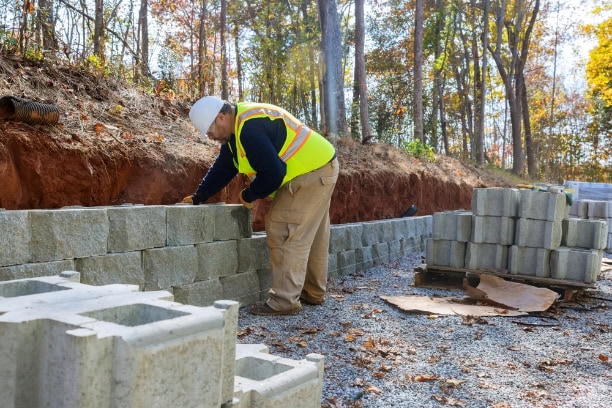
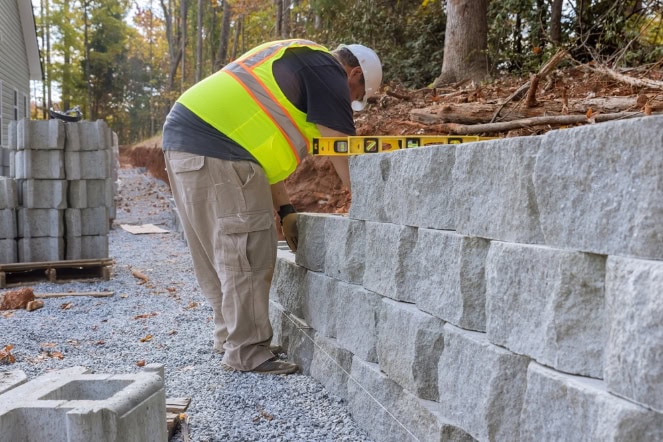
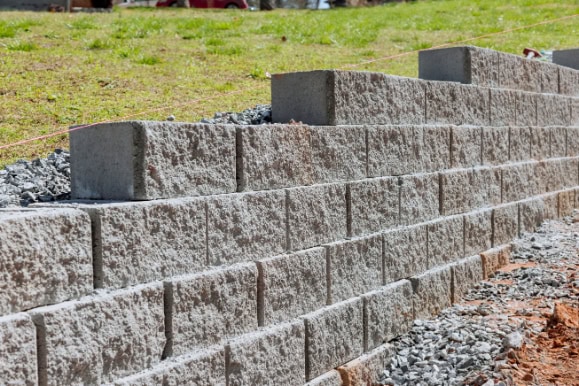
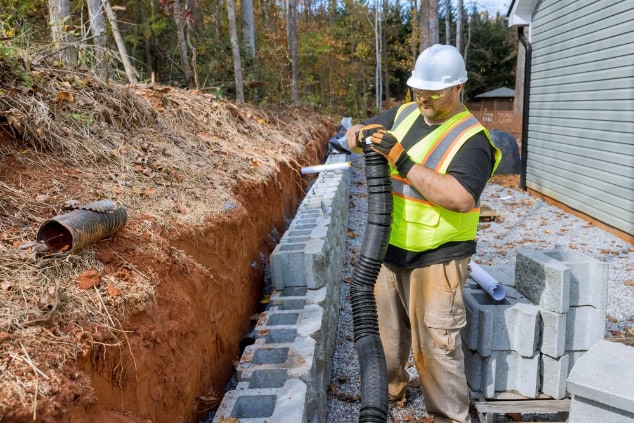
Installation uses stepped layering and compacted backfill to lock the wall in place and distribute load evenly. The drainage layer behind the wall typically crushed stone and a perforated pipe system is installed as the wall goes up, not added at the end. When the job is done, we walk you through it. You know what was built, why it was built that way, and what to expect from it over time.
Ready to get started?
Every retaining wall project in Tinicum starts with a site-specific assessment because the variables here aren’t generic. Tinicum’s coastal plain soils, its tidal proximity, and its position in the lower Darby Creek watershed create drainage and structural conditions that require real engineering consideration, not a standard installation template. That assessment shapes every decision that follows: material selection, foundation depth, drainage design, and whether the project triggers permit requirements under Tinicum Township’s building and stormwater ordinances.
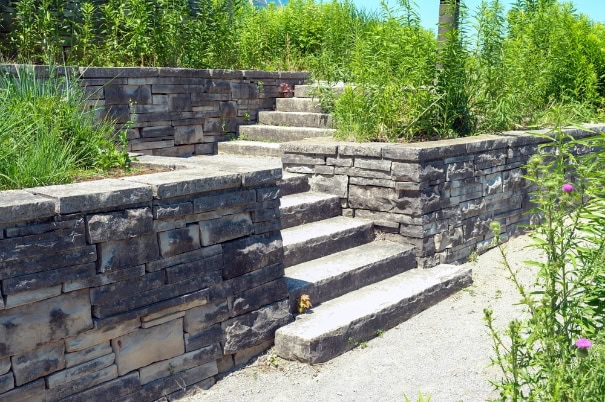
On the materials side, the most common options for residential retaining wall installation in this area are VERSA-LOK modular concrete block, natural stone, and reinforced poured concrete. Each has a place depending on the wall’s height, the soil behind it, the aesthetic of the property, and the load it needs to bear. VERSA-LOK’s interlocking system is particularly well-suited to Tinicum’s variable soil conditions because it allows for flexibility in the wall’s base without compromising structural integrity. Natural stone holds up well in high-moisture environments and fits the older character of homes in Essington and Lester. Reinforced concrete is the right call for taller walls or walls carrying significant surcharge.
Most residential retaining wall projects in Delaware County fall between $3,500 and $10,000 depending on wall length, height, material, and drainage complexity. Tinicum projects often sit toward the middle of that range because the drainage engineering here is more involved than in drier inland communities. That investment reflects what it actually takes to build something that holds not a number pulled from a phone estimate.
In most cases, yes if your wall is over four feet tall. Under Pennsylvania’s Uniform Construction Code, retaining walls that exceed four feet in height (measured from the lowest point of finished grade to the top of the wall) require a building permit and plans sealed by a licensed architect or engineer. Walls adjacent to a driveway, walkway, or any area with additional load may require a permit regardless of height.
What makes Tinicum different from most other Delaware County municipalities is the township’s Stormwater Management Ordinance, adopted in October 2022. If your project alters drainage patterns or affects impervious surface coverage on the property, it may trigger a stormwater management review on top of the standard building permit process. Add to that the PA-1 Call requirement (1-800-242-1776) before any excavation, and the proximity of some properties to Darby Creek and the John Heinz National Wildlife Refuge which can bring additional environmental review into play and the permit process here genuinely has more layers than it does in most surrounding townships. We handle the permit process as part of the project, so you’re not left navigating it on your own.
Most residential retaining wall projects in the Tinicum area fall somewhere between $3,500 and $10,000, with the final number depending on wall length, height, material choice, and how complex the drainage work needs to be. Per linear foot, retaining walls generally range from $40 to $345 with natural stone and reinforced concrete on the higher end, and standard modular block on the lower end.
For properties in Essington and Lester specifically, drainage complexity tends to push projects toward the middle of that range. Tinicum’s low-lying, tidal-adjacent terrain means the drainage system behind the wall requires more engineering than you’d need in a drier, higher-elevation community. Cutting corners on drainage to hit a lower price point is exactly how walls fail within a few winters in this environment. The cost of a properly engineered wall is real but it’s a fraction of what emergency repair or full replacement costs after a failure. Getting an accurate number requires an on-site visit, which is always the first step.
Tinicum’s combination of high ambient moisture, tidal soil influence, and regular freeze-thaw cycles makes material selection more consequential here than in most Delaware County communities. Not every material performs the same way in a high-moisture, low-elevation environment.
VERSA-LOK modular concrete block is one of the strongest options for this area. Its interlocking design allows the wall to handle some soil movement without cracking, which matters in Tinicum’s variable coastal plain soils. It’s also rated for Pennsylvania’s climate zone and holds up well through repeated freeze-thaw cycles. Natural stone is another solid choice it’s been used in this region for centuries, it handles moisture exceptionally well, and it fits the older character of homes throughout Essington and Lester. Timber walls, by contrast, are generally a poor choice for Tinicum specifically: the combination of high moisture, tidal soil, and freeze-thaw stress accelerates rot and structural degradation significantly faster than in drier environments. Whatever material is selected, the drainage system behind it matters just as much as the material itself. A well-drained wall in any material will outlast a poorly drained wall in the best material available.
A properly built retaining wall using materials rated for Pennsylvania’s climate VERSA-LOK block, natural stone, or reinforced concrete can last anywhere from 30 to over 100 years. The walls that fail within a few seasons almost always come down to one of two problems: inadequate drainage or improper installation.
Drainage is the bigger factor, and it’s especially relevant in Tinicum. Hydrostatic pressure the force that builds up when water gets trapped behind a wall is the leading cause of retaining wall failure. In a flood-adjacent, tidal-influenced environment like Tinicum Township, that pressure builds faster and more intensely than it would in an inland community. When freeze-thaw cycles are added to the equation, water that’s already infiltrated behind the wall freezes, expands, and pushes outward then thaws, loosens the soil, and the cycle repeats. Walls that weren’t designed with drainage as the primary consideration don’t survive many winters here. The fix isn’t complicated, but it has to be built in from the start a perforated drain pipe, a crushed stone drainage layer, and proper weep holes or outlet points. Retrofitting drainage into a finished wall is expensive and often incomplete. Getting it right during installation is the only reliable approach.
A retaining wall on its own doesn’t solve a flooding problem but a retaining wall built with an integrated drainage system absolutely can reduce water accumulation, redirect surface runoff, and protect your foundation from water intrusion. The distinction matters.
In Tinicum, where flooding from both the Delaware River and Darby Creek is a documented reality for residents, the drainage component of a retaining wall project takes on added importance. When a wall is built with a proper drainage layer crushed stone backfill, a perforated collection pipe, and outlet points that direct water away from the structure it actively manages the water that would otherwise build up behind it and push against your property. That doesn’t make your yard flood-proof, but it does mean your wall is working with your drainage situation rather than making it worse. For properties in Essington or Lester that sit in lower-lying areas or near Darby Creek, the drainage engineering behind the wall is often the most valuable part of the entire project. It’s worth asking specifically about that component when you’re evaluating any contractor not just what materials they plan to use, but exactly how they’re handling the water.
A few signs are hard to miss: the wall is visibly leaning or bowing outward, blocks have shifted or separated, there’s soil pushing through gaps, or water is pooling at the base after rain instead of draining away. Any of those symptoms means the wall is already under structural stress and the problem will get worse, not better, on its own.
In Tinicum specifically, the older housing stock in Essington and Lester means a lot of existing retaining walls were built decades ago sometimes without drainage systems, sometimes with materials that weren’t rated for sustained moisture exposure, and often without the engineering documentation that current permit requirements would now demand. A wall that’s been in place for 20 or 30 years in Tinicum’s high-moisture, freeze-thaw environment has been through a lot of stress cycles. Whether it needs repair or full replacement depends on what’s happening at the foundation level, not just what’s visible at the surface. That’s exactly what the on-site assessment is for to look at what’s actually going on beneath the wall, not just the face of it, and give you an honest answer about what the right path forward is.
Useful Links