
Hear from Our Customers
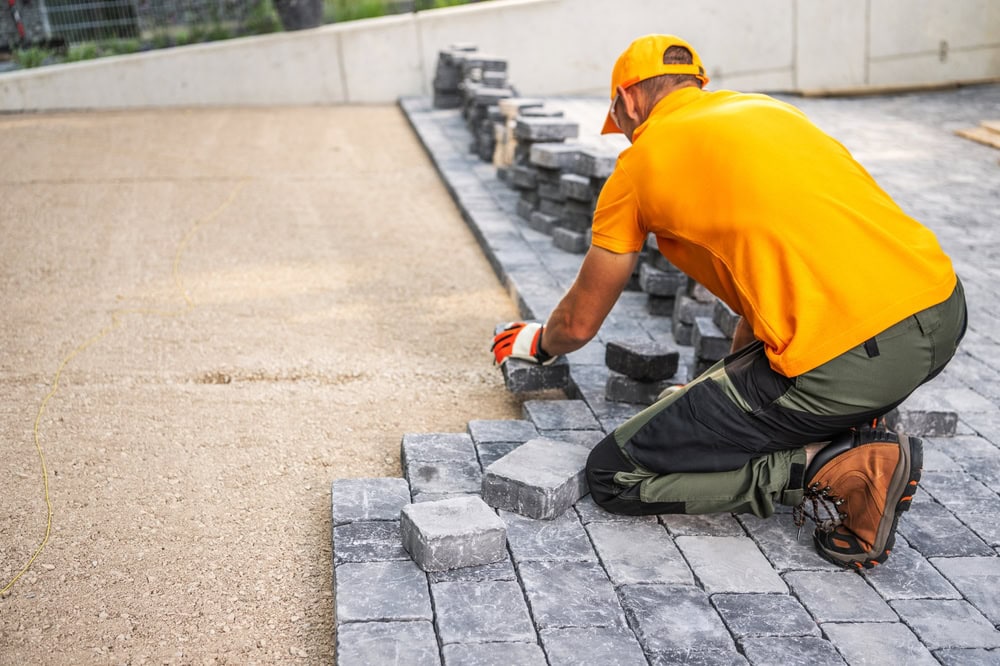
Drexel Hill homes are older. A lot of them were built in the 1940s and 1950s, and the original concrete slabs or brick patios that came with them have been cracking, heaving, and settling ever since. If your backyard looks like a project you’ve been putting off for years, you’re not alone and the fix isn’t just cosmetic. It starts with a properly built base.
Delaware County sees more than 40 freeze-thaw cycles every year. That means the ground under your patio is expanding and contracting constantly from November through March. A base that isn’t deep enough, compacted correctly, or graded to drain water away from your home will move. Pavers will shift. Slabs will crack. It’s not a question of if it’s a question of how fast. A patio built with the right base depth and compaction holds through those cycles year after year without giving you problems.
For most Drexel Hill homes, the backyard is a compact space maybe 30 by 40 feet, maybe less. That’s not a limitation. A well-designed patio on a modest footprint, planned for how your family actually uses the space, gets used every single day. A poorly planned one just takes up yard space you’re not enjoying.
We’re based in Aston, PA right here in Delaware County. Owner Renato Spennato has been building patios, walkways, and hardscaping for Drexel Hill and surrounding communities for over 15 years. The neighborhoods we work in most Drexel Hill, Lansdowne, Clifton Heights, Havertown are places we know well. That matters more than it sounds.
Working in Drexel Hill means understanding the permit process through Upper Darby’s Licenses and Inspections department, knowing how soil conditions near the Darby Creek corridor behave after a hard rain, and recognizing that the stone colonial homes in the Aronimink section need materials that complement their character not fight it. That’s the kind of local context that changes how a project gets designed and built.
We don’t use subcontractors. The same crew that starts your project finishes it. If something comes up after the job is done, you can reach the person who actually did the work.
It starts with a conversation about your space, how you want to use it, and what’s realistic for your property. For most Drexel Hill homes, that means working within a compact backyard footprint and thinking carefully about drainage especially if you’re in the Garrettford area near Darby Creek, where clay-heavy soil doesn’t drain quickly and water management has to be built into the design from the start.
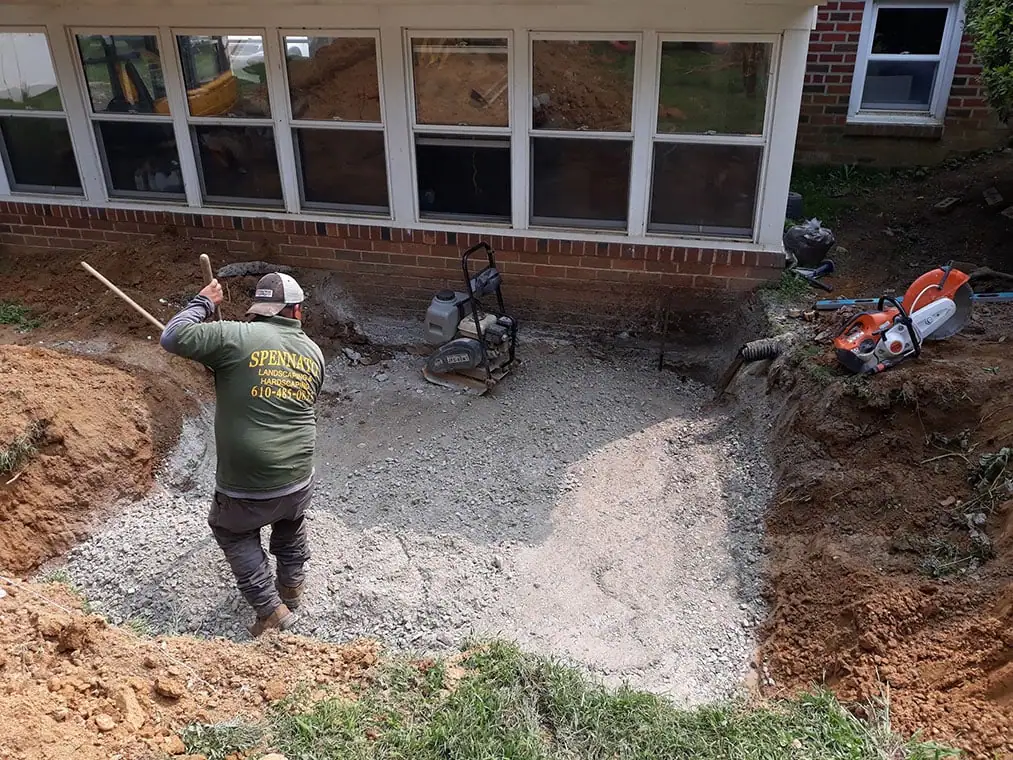
Once the design is locked in, the first physical step is excavation. The existing surface comes out, and the ground gets excavated to the depth needed for a proper aggregate base typically a minimum of five inches for frost-area installations like southeastern Pennsylvania. That base gets compacted in layers, not dumped in all at once. This is the part most homeowners never see, and it’s the part that determines whether your patio holds for five years or twenty-five.
Before any of this begins, we handle the building permit through Upper Darby Township’s Licenses and Inspections office. A new patio installation in Drexel Hill requires a permit skipping it means double fees and potential issues when you sell. That administrative piece gets handled for you, not handed off to you. After installation, the site gets cleaned up and you get a walkthrough of what was done and why.
Ready to get started?
Material selection isn’t just an aesthetic decision it’s a practical one. In Drexel Hill, where a large portion of the housing stock is stone colonial and brick construction, the patio material you choose either ties your outdoor space to your home’s character or works against it. Pennsylvania Bluestone and natural flagstone are natural fits for the stone colonials in the Aronimink section. Brick-pattern pavers complement the twin homes along Burmont Road and throughout the Garrettford area. Stamped or brushed concrete can be a smart, cost-effective option for homeowners who want a clean, durable surface without the higher price point of natural stone.
Interlocking concrete pavers are the most popular choice across Delaware County, and for good reason. They’re durable, they handle freeze-thaw cycles well when installed on a proper base, and if a single paver shifts or cracks years down the road, it can be replaced without tearing out the whole patio. That repairability matters in a climate like southeastern Pennsylvania’s.
Every project we complete includes proper grading and drainage slope built into the base, material selection guidance based on your home’s architecture and your budget, and permit management through Upper Darby Township. Most patio projects in Drexel Hill fall between $3,500 and $12,000 depending on size, material, and site conditions and you’ll know the full number before any work begins.

Yes Upper Darby Township requires a building permit for new patio installations in Drexel Hill. The application goes through Upper Darby’s Department of Licenses and Inspections at 100 Garrett Road, and there’s also a zoning review step before the building permit is issued. The fees themselves are relatively modest, but the process has real teeth: any work that starts without a required permit is subject to double the standard permit fee. That’s not a technicality it’s a penalty that shows up when you least expect it, often at resale.
The permit process also includes a final inspection and use-and-occupancy sign-off before the project is considered complete. We handle this entire process as part of the project. You don’t need to navigate the Upper Darby L&I office, track down the right forms, or figure out the zoning review timeline. It gets done, and you get confirmation when it’s closed out.
Most patio installations in Drexel Hill fall somewhere between $3,500 and $12,000, with the typical project landing in the $5,000 to $9,000 range for a 250 to 350 square foot paver patio. That range reflects the reality of most Drexel Hill backyards compact lots with modest but workable footprints. The main variables are square footage, material choice, and site conditions. Natural flagstone and Pennsylvania Bluestone sit at the higher end of the cost range. Interlocking concrete pavers are mid-range and the most common choice. Stamped or brushed concrete is typically the most affordable option.
What affects cost more than most homeowners expect is what’s happening underground. A site with poor drainage, clay-heavy soil, or an existing slab that needs full removal takes more labor and time than a clean, straightforward installation. That’s why a quote based on a real site visit is more useful than a ballpark number over the phone. You’ll get a clear, itemized estimate before anything is agreed to.
It depends on your home’s exterior, but there’s a general principle that holds: the patio material should feel like it belongs to the house, not like it was added on as an afterthought. For the stone colonial homes in the Aronimink section of Drexel Hill, natural flagstone and Pennsylvania Bluestone are consistently strong choices. They share the same visual weight and texture as the stone exterior and age gracefully with the home. For brick twins and Dutch Colonial revivals throughout Drexel Hill, brick-pattern pavers or tumbled concrete pavers in warm earth tones tend to complement the facade without competing with it.
That said, material selection isn’t only about aesthetics. Pennsylvania Bluestone and natural flagstone are beautiful, but they require a well-prepared base and proper joint material to hold up through Delaware County winters. Interlocking concrete pavers are more forgiving in terms of maintenance and repairability over time. If budget is a factor, a well-executed concrete patio in a finish that complements your home’s color palette can look intentional and clean. The right answer comes from looking at your specific house, your backyard conditions, and what you’re realistically going to use the space for.
Honestly, you often can’t tell on day one and that’s exactly the problem. A properly compacted aggregate base looks the same on the surface as a thin, under-prepared one when the pavers are freshly laid. The difference shows up after the first hard winter, when the ground has frozen and thawed repeatedly and the base either holds or it doesn’t. In Delaware County, that first real test usually comes by February.
What you can do before the job starts is ask specific questions: How deep is the excavation? How many inches of aggregate base are you laying? How is it being compacted by hand or with a plate compactor? A contractor who gives you clear, specific answers to those questions is doing the work correctly. A contractor who gets vague or dismissive is telling you something important. The minimum recommended base depth for frost-area patio installations in southeastern Pennsylvania is five inches of compacted aggregate. That’s not a preference it’s what the climate demands. We’ll walk you through exactly what’s going into the ground before the surface material goes down.
For a typical residential patio in Drexel Hill somewhere in the 250 to 400 square foot range the physical installation usually takes two to four days once the project is scheduled and materials are on-site. Larger projects with more complex designs, drainage work, or site preparation needs will take longer. The permit process through Upper Darby Township adds some lead time on the front end, since the zoning review alone can take up to 30 days from a completed submission. That’s why it matters to start the planning process early.
Spring and early summer are the busiest scheduling windows in Delaware County. If you’re hoping to have a patio ready for summer use, the time to start conversations is late fall or winter January and February specifically. That’s when scheduling is most flexible, when you have the most options for start dates, and when the permit process can run in parallel with finalizing the design. Waiting until April to start the process often means a June or July installation at the earliest.
The short answer is base failure and it’s almost always caused by one of three things: the base wasn’t deep enough, it wasn’t compacted properly, or drainage wasn’t built into the design. In southeastern Pennsylvania, the ground freezes and thaws more than 40 times in a typical winter season. Every freeze expands the soil slightly; every thaw contracts it. A base that can’t absorb that movement without shifting will transfer that movement directly to the pavers above it. You end up with uneven surfaces, trip hazards, and water pooling in the low spots.
Clay-heavy soil makes this worse. Parts of Drexel Hill particularly in the Garrettford area near the Darby Creek corridor sit on soil that holds water and drains slowly. When that soil gets saturated before a freeze, the expansion is more severe. Proper drainage slope, a well-graded base, and adequate base depth are not optional in this environment they’re what separates a patio that looks the same in year ten as it did in year one from one that’s already showing problems by the end of the first winter. This is the single most important thing to verify before you hire any patio contractor in Delaware County.
Useful Links
Other Services we provide in Drexel Hill