
Hear from Our Customers
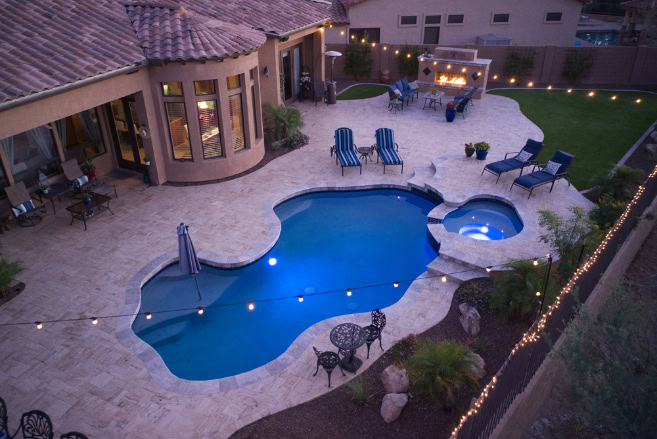
Most outdoor kitchens fail within a few years not because of bad luck, but because they weren’t built for where they’re sitting. In Upland, that means clay soil that shifts with every wet season, and winters that cycle above and below freezing more times than most homeowners realize. When a contractor skips proper base preparation or uses materials that can’t handle that kind of stress, you’re watching cracks form and veneer pop off before the thing is even broken in.
When it’s done right, none of that happens. You get a structure that holds its shape through year ten the same way it did on day one. The grill fires up on a Friday evening, there’s room to prep and pour and actually move around, and the backyard stops being the part of the house you walk past.
For Upland homeowners many of whom have owned their properties for a decade or more this isn’t an impulse decision. It’s a considered investment in a space you actually use. The return shows up at resale too. Homes with outdoor kitchens sell measurably faster, and the ROI on a well-built installation averages around 100% according to the National Association of Realtors. But the more immediate return is every weekend between Memorial Day and Labor Day that your backyard earns its keep.
We’re based in Aston less than seven miles from Upland and have been building outdoor kitchens and hardscaping projects throughout Delaware County for over 15 years. That’s not a regional company covering five counties from a call center. It’s a local crew that knows the clay soil conditions in southern Delaware County, understands the permit process at Upland Borough, and has worked on the kinds of older residential lots that define this part of the county.
What makes the experience different is the single-team model. The same crew that walks your yard during the consultation is the crew that shows up with tools. There are no subcontractors handed a scope of work they didn’t write. No third party who disappears when something needs a follow-up. The people who built your outdoor kitchen are the people you call afterward and we answer.
Renato Spennato stays personally involved in projects, which means there’s always someone accountable from the first conversation to the final walkthrough. In a community like Upland, that accountability isn’t a marketing line. It’s how we run the business.
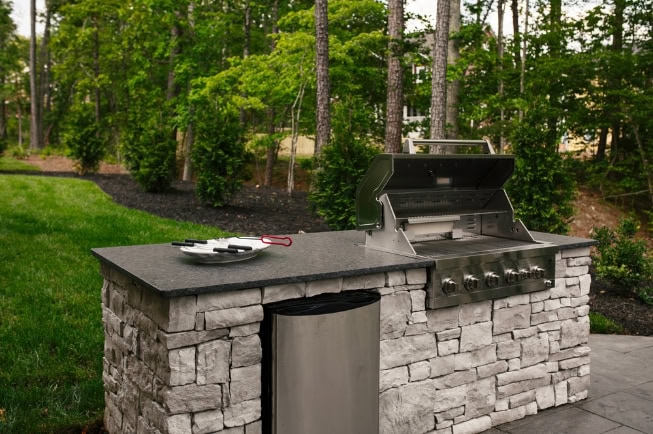
It starts with a real site visit, not a phone estimate. Upland’s lots are compact and most of the housing stock dates back to the early-to-mid 20th century, which means every yard has its own story settled grades, mature trees, old concrete that needs to go, drainage patterns that have shifted over decades. The consultation is where all of that gets assessed, so the design that comes out of it actually fits your specific backyard not a generic template.
From there, the design gets built around how you want to use the space. A clean grill station with counter space and a mini-fridge looks very different from a full setup with a pizza oven, sink, and bar seating and the right answer depends on your yard’s dimensions and how your family actually entertains. Once the design is agreed on, we pull all required permits from Upland Borough before any work begins. That includes building permits for the structure, gas permits if you’re running a line, electrical permits for lighting and appliances, and plumbing permits if a sink is part of the plan.
Construction follows a sequenced process: site prep and base work first, because the clay soil here demands proper gravel depth and drainage slopes before anything else goes in. Then the structural build, utility rough-ins, appliance installation, and finish work. You get a walkthrough at the end, not a handshake and a disappearing act. If you want your outdoor kitchen ready before the summer season, the conversation should start in winter masonry work can’t be done safely below 40°F, and contractors who are worth hiring fill up fast once spring arrives.
Ready to get started?
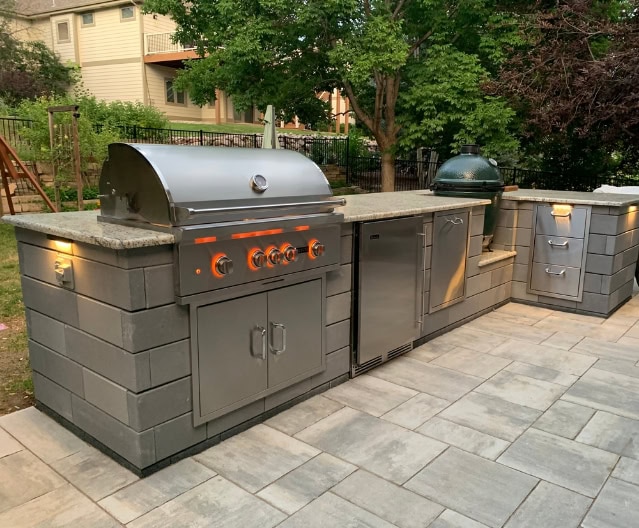
Every outdoor kitchen we build is specified for Delaware County’s four-season reality. That means frost-proof stone veneer, stainless steel appliances rated for outdoor exposure, marine-grade cabinetry, and base preparation deep enough to handle the freeze-thaw cycles that destroy cheaper builds within a few winters. These aren’t premium add-ons they’re baseline requirements for anything built in this part of Pennsylvania to actually last.
Upland’s lot sizes are modest, and our designs reflect that. You don’t need a sprawling multi-zone outdoor complex to get real function out of your backyard. A well-planned grill station, prep counter, and refrigeration setup can transform a compact yard into a space that gets used constantly without overbuilding or overwhelming the space you have. For homeowners who want more, a full outdoor kitchen with a pizza oven, integrated sink, bar seating, and dedicated lighting is absolutely achievable on a southern Delaware County lot when the design is done thoughtfully from the start.
Every project includes full permit management we handle the building, gas, electrical, and plumbing permits required by Upland Borough so you’re not coordinating four separate approvals on your own. The finished structure is fully code-compliant and documented, which matters when it comes time to sell. Unpermitted work creates real problems at closing, and it’s an avoidable one when your contractor pulls permits the right way from day one.

Yes, and depending on what’s included in your outdoor kitchen, you may need more than one. Upland Borough requires building permits for any permanent outdoor structure involving masonry or structural work. If you’re adding a gas line which most outdoor kitchens do that requires a separate gas permit and must be handled by a licensed plumber or gas fitter. Electrical work for lighting, outlets, or appliances requires its own permit, and if you’re adding a sink with running water, a plumbing permit is required on top of that.
This is one of the most common places homeowners get caught off guard. They hire a contractor who skips the permit process to move faster or keep the price down, and then they’re dealing with a stop-work order mid-project or a mandatory removal issue when they go to sell the house. We pull all required permits from Upland Borough before any work begins it’s part of the process, not an add-on. You’ll have a fully documented, code-compliant structure when the job is done.
The honest range is wide anywhere from around $13,000 on the lower end for a straightforward grill station setup to $40,000 or more for a fully built-out outdoor kitchen with a pizza oven, integrated sink, bar seating, refrigeration, and lighting. Where you land in that range depends on the size of the structure, the materials specified, which appliances you choose, and whether the project involves utility connections like gas and electrical.
For Upland homeowners specifically, site preparation can be a real cost factor. Older lots in this part of Delaware County often have clay soil that requires more gravel depth and drainage work than a newer, cleaner site would. If there’s existing concrete or old hardscape to remove first, that adds to the scope. The best way to get a number that actually reflects your project is a site visit not a ballpark over the phone. We provide detailed proposals with firm pricing so you know exactly what you’re agreeing to before any work starts.
This is the right question to ask before you commit to anything, because the wrong materials in a Delaware County winter will cost you significantly more over time than getting it right the first time. The core issue is the freeze-thaw cycle temperatures in this part of southeastern Pennsylvania cycle above and below freezing repeatedly throughout the winter, and any water that penetrates into masonry, grout joints, or a poorly prepared base expands when it freezes. Over several winters, that expansion destroys inferior materials from the inside out.
For stone veneer, you want products specifically rated as frost-proof not all veneer products are, and the difference shows up by year five. Countertops should be sealed granite, porcelain, or a material rated for outdoor freeze-thaw exposure. Cabinetry needs to be marine-grade or stainless steel standard wood cabinetry will not survive outdoor conditions here. Appliances should be stainless steel and specifically rated for outdoor installation. And the base preparation matters as much as any surface material proper gravel depth and drainage slope under the structure is what prevents frost heave from shifting or cracking the whole build.
From the initial consultation to a completed outdoor kitchen, most projects run four to eight weeks depending on scope, permit timelines, and scheduling. The permit process at Upland Borough adds time to the front end of the project permits need to be applied for and approved before construction can begin, and that review period varies. It’s one of the reasons starting the conversation in winter is genuinely useful if you want the kitchen ready by summer.
The construction phase itself once permits are in hand and materials are on site typically runs one to three weeks for most residential outdoor kitchen projects. More complex builds with multiple utility connections, custom masonry, and larger footprints take longer. Weather is also a real factor in this part of Pennsylvania: masonry and concrete work can’t be safely performed below 40°F, so a late-season cold snap can push the timeline. We give you a realistic completion date at the start and build the schedule around it not around what sounds good to close the sale.
Yes, and it’s actually one of the more common design scenarios in Upland and the surrounding southern Delaware County boroughs. The housing stock here developed in the early-to-mid 20th century, which means lots are compact by modern suburban standards. A well-designed outdoor kitchen doesn’t need a sprawling footprint to be genuinely functional it needs a layout that’s been thought through for the space available.
A focused setup grill station, prep counter, under-counter refrigeration, and bar seating along one edge can fit comfortably in a modest Upland backyard and still give you everything you actually use during a cookout. The key is designing around your yard’s real dimensions from the start, not scaling down a large design after the fact. Our process starts with a site assessment of your specific lot, including how the grade sits, where the drainage runs, and how the sun hits the space throughout the day. The design that comes out of that is built for your yard not a showroom floor.
It does, but the way it adds value in a community like Upland is worth understanding clearly. The National Association of Realtors puts the average ROI on an outdoor kitchen at around 100% meaning a well-built installation tends to return roughly what it cost when the home sells. Homes with outdoor kitchens also sell faster than comparable homes without them, which matters in a market where buyers are comparing older borough properties against newer construction available further out in Chester County.
That said, the more immediate return for most Upland homeowners isn’t financial it’s the years of actual use before the house ever goes on the market. A backyard that functions as a real outdoor living space gets used. Family cookouts, weekend evenings, gatherings that would have happened at a restaurant instead happen at home. For homeowners who’ve been in their properties for ten or fifteen years and are thinking about what the next chapter looks like, that quality-of-life return starts the day the kitchen is finished not the day the house sells. The financial upside at resale is real, but it’s the bonus, not the reason.
Useful Links