
Hear from Our Customers
The homes along Pennell Road and Concord Road in Village Green-Green Ridge weren’t built yesterday. Most of the housing stock in this part of Aston Township goes back to the mid-20th century, and a lot of those original concrete slabs have been cracking, heaving, and draining toward foundations for years. If that’s what you’re working with, you already know the problem. A properly installed patio one with the right base depth, the right compaction, and the right drainage slope fixes it for good instead of kicking it down the road another five years.
Beyond just replacing something broken, a well-designed patio genuinely changes how you use your property. Homeowners in Village Green-Green Ridge tend to be long-term owners, people who’ve been in their homes for a decade or more and are finally ready to invest in the outdoor space they’ve been putting off. That investment pays back. Professionally installed patios return more than 80% of their cost at resale, and paver patios specifically outperform plain concrete by 30 to 50% on ROI. But the more immediate return is simpler: you stop looking at a crumbling slab and start actually using your backyard.
Dense suburban lots don’t have to feel limiting, either. A lot of homeowners in this area assume their yard is too small for a real patio. It almost never is. The right design defined zones, appropriate scale, clean transitions to the lawn can make a modest backyard feel intentional and livable. That’s a design conversation worth having before you decide it can’t be done.
We’re based in Aston, PA. Not Delaware County broadly, not the greater Philadelphia region Aston. That means Village Green-Green Ridge isn’t a market we target from a distance. It’s the community we work in regularly, know well, and are directly accountable to. When something needs attention after a project is done, you’re not chasing down a contractor who’s 45 minutes away and hoping someone picks up.
We know the soil conditions in southern Aston Township. We know what happens to a patio base that wasn’t built to handle southeastern Pennsylvania’s freeze-thaw cycles. We’ve torn out more than a few installations in Village Green-Green Ridge that looked fine on day one and failed by year two because the base was wrong, the drainage slope was wrong, or both. That kind of ground-level experience doesn’t come from a service area map. It comes from actually doing the work here, year after year, and being close enough that the results follow us home.
It starts with a conversation about how you actually want to use the space not a sales pitch about materials. We look at your yard’s real dimensions, your drainage situation, how the space connects to your home, and what you’re trying to get out of it. From there, we put together a design and a detailed written estimate. You’ll know what it costs and why before any work begins. Most standard patio installations in Aston Township don’t require a permit, but if your project involves a retaining wall over four feet or a covered structure, we’ll tell you upfront and handle the guidance on what Aston Township’s Building Code Department requires.
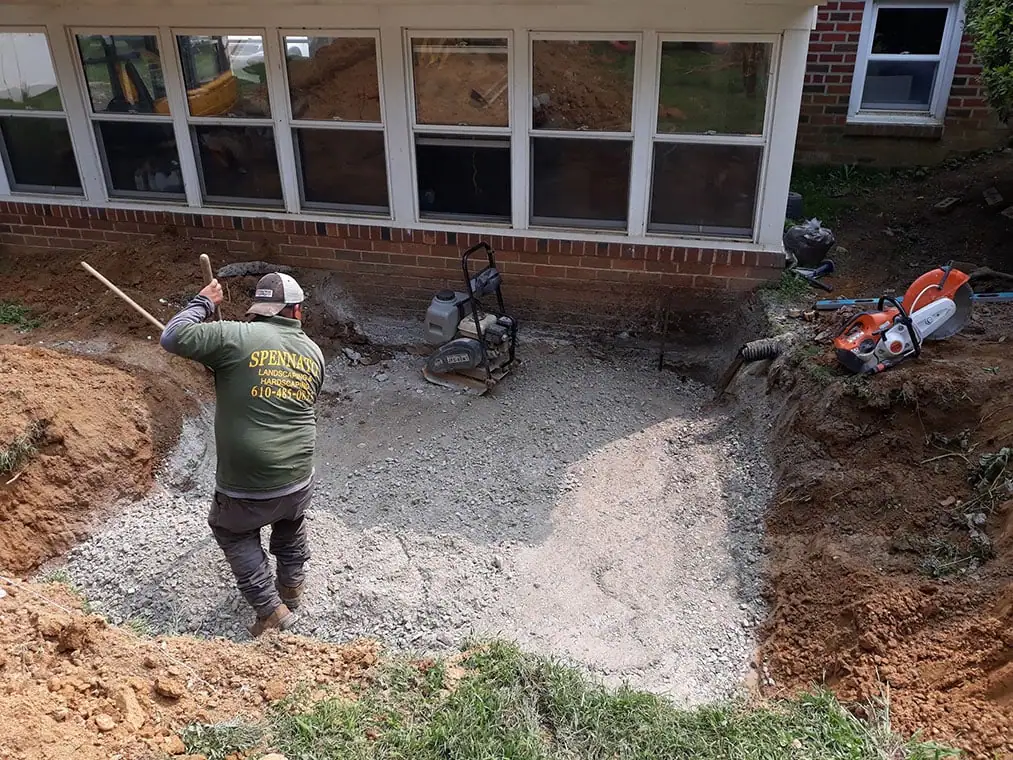
Once work starts, it’s one crew from start to finish. No rotating subcontractors, no one showing up who doesn’t know your project. The process begins with proper excavation the part most homeowners never see but that determines everything about how long the patio lasts. That means removing the old material if there’s a failing slab, compacting the subgrade, and building a base layer deep enough to handle the freeze-thaw cycles this area sees every winter. Drainage slope is set deliberately, away from your foundation, before a single paver or stone goes down.
The best time to start planning is earlier than most people think. April through October is the ideal installation window, but homeowners who reach out in the fall or winter get better scheduling availability and more attention than those who wait until April when every contractor’s calendar fills up at once. If you’re thinking about it, now is a reasonable time to have the conversation.
Ready to get started?
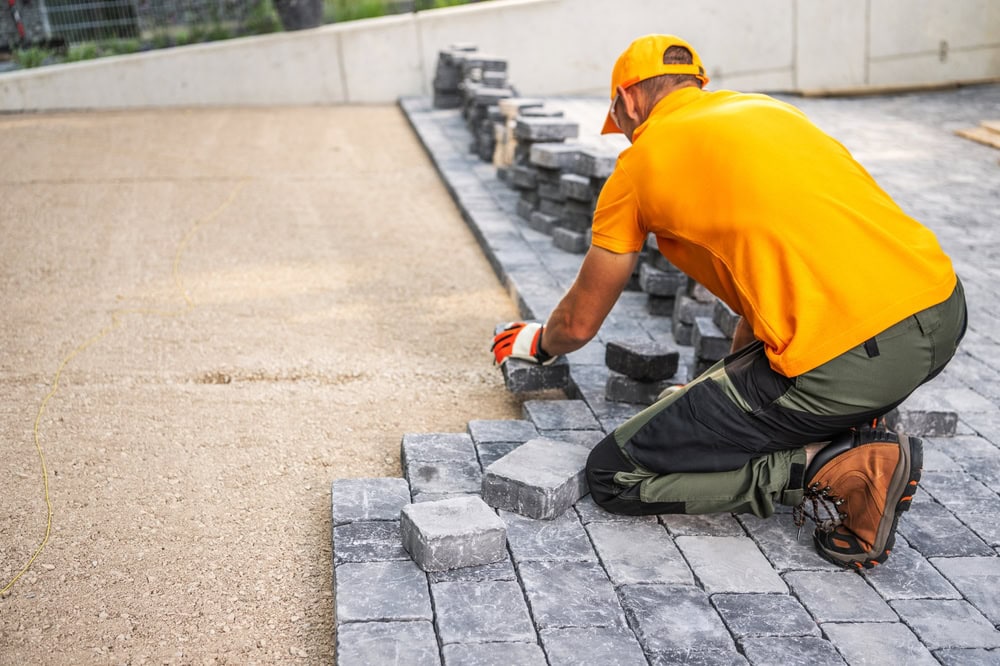
Paver patios are the most common choice for homeowners in Village Green-Green Ridge, and for good reason. They handle Pennsylvania’s freeze-thaw cycles better than poured concrete, they’re repairable if one section ever settles, and they hold their value better at resale. Paver installation runs roughly $12 to $25 per square foot depending on the material and pattern, with most full projects landing between $3,500 and $12,000. That range covers a lot of ground, and the honest answer is that the right number depends on your specific yard, your material choice, and what the base requires.
Flagstone is a strong option for homes in this area where the character of the neighborhood calls for something more natural-looking. Pennsylvania Bluestone in particular complements the established, older-home aesthetic common throughout southern Aston Township, and it holds up well when it’s installed correctly. Concrete patios are also available for homeowners who need a more budget-conscious starting point, though we’ll always be direct about the long-term trade-offs between materials so you can make a decision that actually fits your situation.
For homeowners considering a covered patio a pergola or shade structure over the patio surface that’s a natural conversation to have during the design phase. It changes how you use the space across the full year, not just the peak summer months. If that addition would require a permit under Aston Township’s residential building code, we’ll flag it early and walk you through what that process looks like. Nothing about your project should catch you off guard once work begins.

For most standard residential patio installations in Aston Township ground-level pavers, flagstone, or concrete without an attached structure a permit is typically not required. The Pennsylvania Uniform Construction Code governs what triggers a permit, and a basic patio surface generally falls below that threshold.
That said, there are situations where a permit does come into play. If your project includes a retaining wall four feet or higher, Aston Township requires an engineered design. If you’re adding a covered structure like a pergola or a roofed addition over the patio, that may trigger a residential building permit under the PA UCC. We’re familiar with Aston Township’s Building Code Department requirements and will tell you clearly at the start of your project whether any approvals are needed so there are no surprises mid-job.
This is one of the most common questions we hear from homeowners in Village Green-Green Ridge, and the answer almost always comes back to the base. Southeastern Pennsylvania experiences roughly 40 or more freeze-thaw cycles per year. Any water that gets into an improperly compacted base, a shallow aggregate layer, or an unsealed joint freezes, expands, and forces the surface material upward. That process repeats every winter until the patio is visibly uneven or sinking.
The fix isn’t a better surface material it’s a correctly built foundation. That means excavating to the right depth, compacting the subgrade properly, installing a base layer thick enough to handle frost penetration in this climate, and using polymeric sand in the joints to limit water infiltration. A patio built that way doesn’t heave. We’ve repaired enough failed installations in this part of Aston Township to know exactly what shortcuts cause the problem, and we don’t take them.
The honest range for patio installation in this area is $15 to $50 per square foot depending on material, with most complete projects falling between $3,500 and $12,000. Paver installations specifically run $12 to $25 per square foot. Those numbers move based on the size of the space, the material you choose, how much base preparation is needed, and whether you’re replacing an existing failed slab or starting fresh.
For Village Green-Green Ridge specifically, a lot of projects involve removing an old concrete slab before the new installation begins. That adds to the scope but also gives you the opportunity to correct whatever drainage or base issues caused the original slab to fail. We publish these ranges openly because we think you should know what you’re working with before you pick up the phone not after you’ve already sat through a two-hour sales consultation.
For the mid-20th century housing stock that makes up most of Village Green-Green Ridge, concrete pavers and natural flagstone particularly Pennsylvania Bluestone tend to be the strongest fits. Both materials complement the established character of the neighborhood aesthetically, and both perform well in this climate when they’re installed on a properly prepared base.
Concrete pavers are the most practical choice for most budgets. They’re durable, repairable, and offer a wide range of patterns and finishes that can match or enhance an older home’s exterior. Pennsylvania Bluestone is a step up in cost but brings a natural, timeless look that works especially well on properties where the landscaping has matured around it. Poured concrete is an option if budget is the primary constraint, but it’s worth understanding that concrete is harder to repair when it cracks and in this climate, some movement over time is realistic. We’ll walk you through the trade-offs honestly so the choice you make is the one that actually fits your home and your timeline.
This comes up constantly with homeowners in this area, and the answer is almost always yes. Village Green-Green Ridge is a dense community lots are modest, yards are real but not sprawling and a lot of homeowners have talked themselves out of a patio before they’ve even had a design conversation. The reality is that a well-designed compact patio can completely change how you use a small backyard.
The key is design that works with your actual dimensions instead of against them. A defined dining area, a separate seating zone, clean edging, and a thoughtful transition to the lawn can make a 200-square-foot patio feel purposeful and spacious rather than cramped. Small patio ideas aren’t a compromise they’re a different design challenge, and one we work through regularly in this neighborhood. If you’re not sure whether your space qualifies, the right move is to have someone come look at it before you assume it doesn’t.
The practical installation window in this part of Delaware County runs from April through October, when ground temperatures are consistently above freezing and base materials can be compacted correctly. Fall installations September and October are completely viable as long as the project wraps up before the first hard freeze, which in Aston Township’s Zone 7a climate typically arrives in late November.
Where most homeowners get caught is waiting until spring to start the conversation. By late February and March, contractor schedules in this area fill up quickly, and the homeowners who planned ahead in the fall or winter are already locked in. If you’re thinking about a patio for next season, reaching out now even just to talk through the design and get a number puts you in a much better position than trying to get on a schedule in April when everyone else had the same idea at the same time.
Useful Links
Other Services we provide in Village Green-Green Ridge