
Hear from Our Customers
Most outdoor kitchens in this region don’t fail because of bad design. They fail because they weren’t built for what Pennsylvania winters actually do to masonry and stone. When temperatures swing from the teens to the 60s repeatedly through a single winter, materials that weren’t specified for freeze-thaw cycling crack, heave, and deteriorate sometimes within the first five years. That’s what happens in Yeadon when a contractor builds for summer and ignores what comes after.
When we build an outdoor kitchen correctly for this climate with frost-proof materials, properly prepared bases, and stainless components rated for year-round exposure it doesn’t just survive winter. It looks and functions the same way a decade later. That’s the difference between a project that holds its value and one that becomes an expensive problem.
Beyond durability, a well-built outdoor kitchen genuinely adds to what your home is worth. The National Association of Realtors puts the ROI at around 100%, and homes with outdoor kitchens sell roughly 23% faster than comparable homes without them. In Yeadon, where the median home sits around $198,000, that return is real and proportionally meaningful. But more immediately you get a backyard that actually gets used, whether that’s a Sunday cookout with the family or hosting neighbors after a long week commuting into the city.
We’ve been building outdoor living spaces across Delaware County for over 15 years, which means we know the clay-heavy soil that affects drainage and base prep in Yeadon, the freeze-thaw patterns that determine which materials hold and which ones don’t, and the borough-level permit processes including Yeadon’s Code Department that every legitimate build has to go through.
What makes our approach different is the single-crew model. Every project we take on is handled by the same team from the first conversation through the final walk-through. No subcontractors being handed off mid-project, no communication gaps between trades, and no wondering who to call if something needs attention after the job is done. In a borough as close-knit as Yeadon, where word travels and neighbors notice, that kind of accountability isn’t optional it’s the baseline.
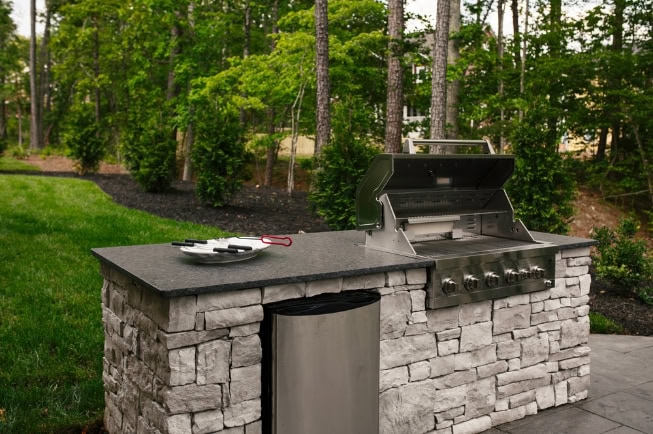
It starts with a real conversation about how you use your backyard not a sales pitch. How do you cook? How many people do you typically host? What does your space actually look like, and what’s already there? Yeadon’s housing stock is predominantly older brick twins and bi-levels with established yards that have their own drainage patterns, existing hardscaping, and space constraints. We design around all of that from the start, so what gets drawn up fits your actual property, not a generic template.
Once the design is agreed on, we handle the permit process with Yeadon Borough’s Code Department. That includes building permits for the structure itself and any required service equipment permits for gas, electrical, or plumbing connections. You don’t have to navigate that process yourself it’s part of what you’re hiring us for.
From there, construction follows a clear timeline with one crew on site. Masonry work in this region can’t be done safely below 40°F, so timing matters most builds run between May and September for optimal conditions. You’ll know what’s happening, when, and why at every stage. When the project is done, the same people who built it are still reachable.
Ready to get started?
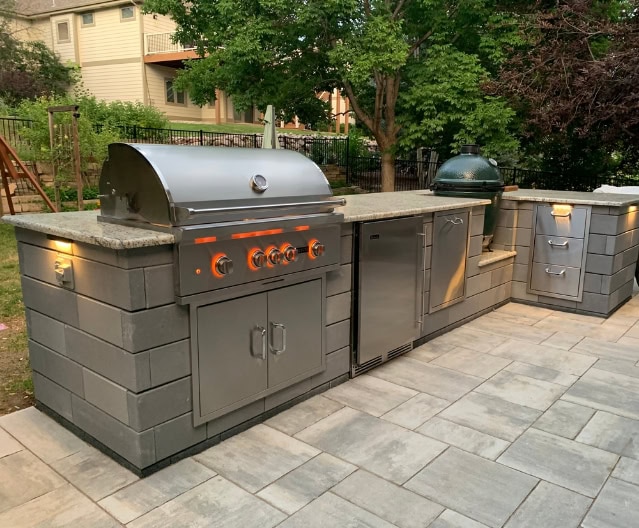
Not every outdoor kitchen needs a sprawling lot to be worth building. Yeadon’s yards are compact by Delaware County standards that’s just the reality of living in one of the densest boroughs in the county. But a smaller footprint doesn’t mean a lesser kitchen. It means the design has to be smarter: a grill station with integrated storage, a corner island that maximizes the available space, a countertop workspace positioned to work with how your back door opens. We design a kitchen that functions well in the space you have, not one that looks impressive in a photo but doesn’t fit how you live.
Every build we do includes material selection matched to Pennsylvania’s four-season climate. That means frost-proof stone veneer, stainless steel appliances built for outdoor exposure, marine-grade cabinetry, and base preparation that accounts for Delaware County’s clay soil and the frost heave risk that comes with it. These aren’t upgrades they’re the standard, because anything less won’t hold up here.
The range of what’s possible starts at a straightforward built-in grill setup and scales up to a full outdoor kitchen with a sink, refrigeration, prep space, and dedicated storage. The scope depends on your goals, your budget, and your yard. What doesn’t change is how we build it.

Yes and it’s worth taking seriously. Yeadon Borough has an active Code Department that enforces building permits for any new structure, and outdoor kitchens with gas, electrical, or plumbing connections require separate service equipment permits on top of the base building permit. Skipping this step isn’t just a regulatory risk it creates real problems when you go to sell the property. Unpermitted structures complicate title searches and home inspections, and buyers or their attorneys will flag them.
The permit process through Yeadon Borough involves submitting applications, providing plans, and scheduling inspections at various stages of the build. It adds time to the front end of a project, which is why starting the planning process in late winter or early spring before the build season opens up makes a real difference. We manage the entire permit process as part of the project, so you’re not navigating Yeadon’s Code Enforcement Office on your own.
The honest range for a quality outdoor kitchen in this area runs from around $10,000 on the lower end for a straightforward built-in grill station with basic storage, up to $30,000 or more for a full setup with a sink, refrigeration, countertop workspace, and premium stone finishes. What you spend depends on the scope of the build, the materials you choose, and how much infrastructure work is involved gas line runs, electrical connections, and drainage all affect the total.
In Yeadon specifically, it’s worth thinking about the investment relative to what it returns. At a median home value around $198,000, a well-built outdoor kitchen is a proportionally significant improvement but one with documented ROI. The bigger cost risk isn’t spending too much upfront. It’s spending too little on materials and construction quality, and then facing $3,000 to $8,000 in repairs within five years because the build didn’t hold up through Delaware County winters. Getting it right the first time is the better financial decision.
This is the question that separates a long-lasting build from an expensive mistake. Delaware County’s winters put real stress on outdoor masonry temperatures swing from the teens to the 60s repeatedly through a single season, and that freeze-thaw cycling destroys materials that weren’t specified for it. Standard concrete block, untreated stone veneer, and basic cabinetry will crack, spall, and degrade within a few years under those conditions.
What holds up here is frost-proof stone veneer, stainless steel appliances rated for outdoor and year-round exposure, marine-grade cabinetry that resists moisture and temperature swings, and a properly prepared base that accounts for Delaware County’s clay soil and prevents frost heave from shifting the structure over time. These material choices aren’t premium add-ons they’re the minimum standard for a build that’s going to look and function the same way in ten years as it does on day one. Any contractor who doesn’t talk about freeze-thaw performance when discussing materials is either not familiar with this climate or not thinking about your long-term interests.
Absolutely and honestly, smaller yards often produce better-designed kitchens because every decision has to be intentional. Yeadon’s lots are compact compared to many Delaware County communities, which is just the reality of living in a borough this dense. But a 15-by-20-foot backyard can accommodate a very functional outdoor kitchen when the layout is designed around how the space actually works: where the sun hits in the afternoon, how the yard connects to the back door, how many people you’re typically cooking for.
Corner island configurations, built-in storage that doubles as counter space, and grill stations with integrated side burners are all design approaches that maximize a smaller footprint without sacrificing function. The key is starting the design conversation with your real yard dimensions and your actual habits not a wish list built around a half-acre lot. Our process begins with a site visit and a conversation about how you use the space, which is the only way to design something that actually fits.
From the initial consultation to a completed outdoor kitchen, most projects in this area run between six and twelve weeks depending on scope, material lead times, and how quickly the permit process moves through Yeadon Borough’s Code Department. The construction phase itself once permits are approved and materials are on site typically takes one to three weeks for a standard build.
The bigger timing factor most homeowners don’t account for is the planning and permitting lead time. Masonry and concrete work can’t be done safely below 40°F, which limits the build season in Delaware County to roughly April through October. If you want a functional outdoor kitchen by Memorial Day weekend, you need to be in the planning and permitting process by February or March at the latest. Homeowners who start the conversation in April are usually looking at a July or August completion at the earliest. Starting early is the single most effective way to control your timeline.
This is a legitimate concern, and it comes up constantly in the contractor space. BBB complaint data for home improvement contractors consistently shows that unresponsiveness after project completion is one of the top drivers of negative reviews homeowners write a significant check, the project gets done, and then no one picks up the phone when a warranty issue surfaces six months later. In a borough as connected as Yeadon, that kind of reputation doesn’t stay quiet for long.
The structural answer to this problem is the single-crew model. When the same team handles your project from start to finish no subcontractors, no handoffs between trades the people who built your outdoor kitchen are the same people you call afterward. There’s no ambiguity about who’s responsible, and there’s no network of separate contractors to track down. Our owner-involved approach means the accountability doesn’t disappear when the project wraps up. That’s not a promise made in a sales conversation it’s how we’re set up to operate.
Useful Links