
Hear from Our Customers
Most homeowners in Village Green-Green Ridge don’t lack the space or the budget they’ve just never had a contractor who made the process feel worth it. The estimate came in vague, the timeline stretched into the following year, and the finished product looked nothing like what was discussed. We’re here to break that pattern.
When you put a well-built outdoor kitchen in a backyard near Pennell Road or Concord Road, something shifts. The family starts gathering outside instead of crowding into the kitchen. The weekend cookout stops being a production and starts being a routine. You’re not just adding a grill station you’re adding the most-used space in your home from April through October.
And because this is Delaware County not Florida, not Arizona what we build here needs to survive real winters. Temperatures swing from 15°F to the low 60s within the same season, and that freeze-thaw cycle is brutal on materials that weren’t chosen with it in mind. Stone veneer cracks. Mortar joints fail. Surfaces heave when the base wasn’t prepared for clay-heavy soil. A properly built outdoor kitchen, with the right materials and a correctly prepared base, doesn’t do any of that. It looks the same in March as it did when it was finished.
We’re based in Aston not “the greater Delaware County area,” not “serving southeastern Pennsylvania.” Aston. The same township that issues permits for your backyard project is the same office we’ve been working with for over 15 years. That’s not a talking point it’s just the reality of doing business where we live.
The crew that designs your outdoor kitchen is the same crew that builds it and the same crew you call if something ever needs attention afterward. We don’t hand off projects to subcontractors with a set of plans. Renato Spennato is personally involved in every project, which means the person whose name is on the business is the person accountable for the result.
For homeowners in Village Green-Green Ridge a community where 87% of residents own their homes and many have been here for decades that kind of accountability isn’t a bonus. It’s the baseline expectation. We meet it.
It starts with a conversation, not a catalog. The first step is a consultation where the focus is entirely on your yard its layout, its existing surface, how it drains, where the sun hits, and how you plan to use the space. A lot of Village Green-Green Ridge homes were built in the mid-20th century, and many backyards have an existing patio slab or concrete surface that needs to be evaluated before anything new goes on top of it. That assessment happens before a single material is selected.
From there, a design takes shape around your specific space not a pre-packaged configuration dropped into a yard it wasn’t designed for. Once the design is finalized and the scope is agreed on, we handle the permit applications through Aston Township’s Building/Code Department. If your outdoor kitchen includes a gas line, electrical connections, or a sink, those permits are required and pulling them correctly protects your investment at resale. You don’t navigate that process yourself.
Construction follows once permits are approved and conditions allow. Masonry work in Pennsylvania can’t be done safely below 40°F, so the active build window runs roughly April through October. Homeowners who start the consultation in fall or winter are typically first in the queue when the season opens which often means a finished kitchen by Memorial Day rather than a scramble in September.
Ready to get started?
The outdoor kitchen ideas that work in Delaware County aren’t always the ones that look best in a magazine. What works here is what survives here and that means every material choice is made with Pennsylvania’s climate in mind. We use frost-proof stone veneer, stainless steel appliances rated for outdoor exposure, marine-grade cabinetry, and base preparation that accounts for the clay-heavy soil common throughout this part of the county. Clay retains water. Water expands when it freezes. A base that wasn’t built for that will shift, and the structure above it will show it within a few winters.
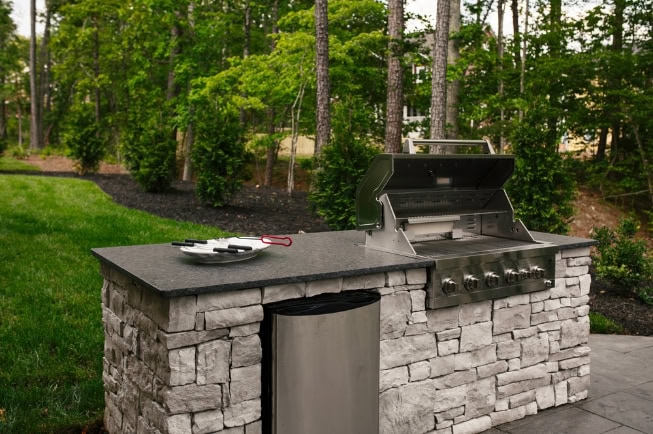
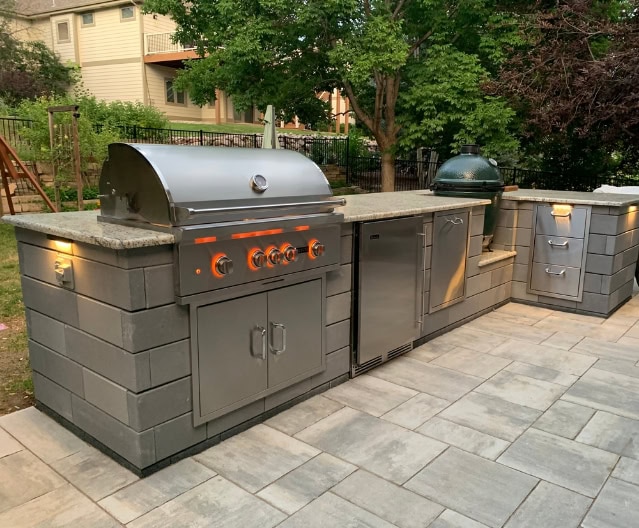
Builds range from a straightforward built-in grill island with a prep counter to a full L-shaped or U-shaped outdoor kitchen with a sink, refrigerator, bar seating, and a pizza oven. The scope is determined by your yard, your budget, and how you actually cook and entertain not by a package tier. Every project includes a detailed proposal with a clear scope, specified materials, and a firm timeline before any work begins. What you agree to is what gets built.
For Village Green-Green Ridge homeowners who’ve watched their property values more than double since 2000, this is also a smart equity play. Outdoor kitchens return between 55% and 100% of their cost at resale, and homes with them sell measurably faster in Delaware County’s competitive market. You get years of use out of it, and the investment follows you when you’re ready to move on.

Yes and it depends on what’s included in the build. Aston Township enforces Pennsylvania’s Uniform Construction Code, and any outdoor kitchen that involves a gas line, electrical connections, or plumbing for a sink requires permits from the Township’s Building/Code Department before work begins. A basic grill island with no utility connections may fall below the permit threshold, but the moment you add a built-in gas grill, outdoor lighting with dedicated circuits, or a sink with a drain, you’re in permit territory.
This isn’t something to skip to save time or money. Unpermitted work creates real problems when you go to sell your home buyers’ inspectors flag it, lenders sometimes won’t finance against it, and you may be required to remove or remediate the work before closing. We handle all permit applications on your behalf for projects in Village Green-Green Ridge, so the build is documented, inspected, and clean on paper from day one.
The range is wide, and that’s not a dodge it genuinely depends on the size, materials, and what’s included. A basic built-in grill island with a prep counter typically starts around $8,000 to $15,000. A mid-range outdoor kitchen with a sink, refrigerator, and bar seating runs $15,000 to $35,000. Fully equipped builds with a pizza oven, multiple appliances, and premium stone work can reach $50,000 or more.
For most Village Green-Green Ridge homeowners, the mid-range is the sweet spot and at a median home value of around $331,000, an investment in that range represents roughly 5 to 10 percent of your property’s value while adding measurable equity. The more important number than the upfront cost is what it costs to rebuild a failed outdoor kitchen which typically runs $3,000 to $8,000 when inferior materials or poor base preparation give out after a few Delaware County winters. Getting it built right the first time is the better math.
The freeze-thaw cycle in southern Delaware County is the main variable to design around. Temperatures in the Village Green-Green Ridge area regularly swing between the mid-teens and the low 60s within a single winter season, sometimes multiple times. That repeated expansion and contraction is what separates materials that last from materials that don’t.
For the structure itself, frost-proof stone veneer and concrete block construction are the standard for this climate they don’t absorb water the way some natural stones do, which means they don’t crack when that water freezes. For appliances, 304-grade stainless steel is the minimum for outdoor use; 316-grade is better if the kitchen is in a more exposed location. Marine-grade polymer cabinetry handles moisture and temperature swings without warping or delaminating. And the base the compacted gravel foundation beneath the structure is where a lot of cheaper builds fail. Delaware County’s clay-heavy soil retains water, so the base needs to be deep enough and properly drained to prevent frost heave. That’s not glamorous, but it’s what keeps the whole thing level five winters from now.
From the initial consultation to a finished outdoor kitchen, the realistic timeline for a mid-range build is six to twelve weeks but that window depends heavily on when you start the process. The active construction season for masonry in Pennsylvania runs roughly April through October, since mortar and concrete work can’t be performed safely below 40°F. We don’t push through cold weather to hit a deadline.
What that means practically is that homeowners who start the conversation in the fall or winter are in a much better position than those who call in May. By the time you’ve had a consultation, finalized a design, received a proposal, and allowed time for Aston Township to process the permit applications, you could easily be looking at a July or August start if you waited until spring. Starting in January or February typically means a Memorial Day or early summer completion. The consultation itself requires no commitment it’s just a conversation about your yard and what you’re thinking.
Often yes, but it depends on what’s already there. A lot of homes in Village Green-Green Ridge have existing concrete slabs or paver patios many of them original to the house, which puts them at 40 to 60 years old. Before building an outdoor kitchen on top of an existing surface, it needs to be evaluated for structural integrity, drainage slope, and whether it can support the weight of a masonry kitchen structure without settling or cracking.
If the existing slab is in good shape and properly graded, it can often serve as the base for a new outdoor kitchen with some preparation. If it’s cracked, settled, or draining toward the house, it typically needs to come out before anything new goes on top of it otherwise you’re building a new kitchen on a failing foundation. That assessment happens during the consultation, before any scope or pricing is discussed. It’s not always what homeowners want to hear, but it’s the honest answer that keeps the project from becoming a problem two years later.
It does especially in a market like Delaware County where buyers have started treating outdoor living space as a genuine amenity rather than a bonus. Industry data from the National Association of Realtors puts outdoor kitchen ROI at around 100 percent, and homes with outdoor kitchens sell roughly 23 percent faster than comparable homes without them. In a neighborhood where property values have more than doubled since 2000, a well-built outdoor kitchen fits naturally into the investment profile of a home that’s been maintained and improved over time.
The key word is well-built. An outdoor kitchen that was constructed without permits, with materials that have since cracked or stained, or on a base that has shifted and settled that’s a liability at resale, not an asset. Buyers’ inspectors will flag it, and you may end up discounting the sale price to account for the remediation. A properly permitted, properly constructed outdoor kitchen in Village Green-Green Ridge is the kind of improvement that holds its value because it was done correctly from the start.
Useful Links
Other Services we provide in Village Green-Green Ridge