
Hear from Our Customers
Most outdoor kitchen problems don’t show up on day one. They show up two winters later cracked stone veneer, a shifted countertop, a grill cabinet that’s rusting through because the materials were never rated for a Pennsylvania freeze-thaw cycle. In Sharon Hill, temperatures swing between 15°F and 60°F repeatedly through winter, and that cycle destroys inferior masonry faster than most homeowners expect. A build that cuts corners on materials or base prep can look fine in June and be crumbling by March.
When the work is done correctly proper base, frost-rated materials, drainage that actually accounts for Delaware County’s clay-heavy soil you get a backyard setup that performs the same way in year twelve as it did in year one. No cracking, no shifting, no calling a contractor who no longer picks up the phone. Just a functional, durable outdoor space you can actually use.
Sharon Hill’s housing stock is older, and most backyards here are modest in size. That’s not a limitation it’s a design challenge that we solve. A well-designed compact outdoor kitchen on a Sharon Hill lot can do everything a sprawling setup does on a half-acre property, just smarter. The right layout makes the space feel bigger, not smaller, and keeps the investment proportional to the property.
We’re based in Aston, PA about eight to ten miles southwest of Sharon Hill along the Chester Pike corridor. Delaware County is not part of a broader service area. It is the only place we work, which means every project we take on is in the same county, on the same soil, through the same winters. That kind of focus builds a different level of familiarity than a regional contractor stretched across five counties.
We’ve been doing this for over 15 years in Delaware County, and the Route 13 corridor communities Sharon Hill, Folcroft, Glenolden, Collingdale, Norwood are neighborhoods we know well. We understand the lot sizes, the older housing stock, the permit requirements at Sharon Hill Borough Hall on Sharon Avenue, and what it takes to build something here that actually lasts.
One crew handles your project from the first conversation to the final walk-through. Not a rotating cast of subcontractors. The same people who design your outdoor kitchen are the ones who build it and the ones you reach if anything comes up afterward.
It starts with a consultation where we come to your property, look at the actual space, and talk through what you want to use it for. Not a phone call with a generic quote a real site visit where we assess the grade, the drainage, the existing surface conditions, and how your backyard layout shapes the design options. Sharon Hill lots tend to be smaller and more enclosed than what you’d find in the outer townships, so the design conversation here is about maximizing what you have, not upsizing for the sake of it.
From there, we move into design and material selection. We walk you through what works for this climate frost-rated stone, marine-grade cabinetry, stainless steel appliances built for outdoor exposure and what doesn’t. You’ll see a detailed proposal with clear scope, materials, and timeline before anything is agreed to. The price you sign off on is the price you pay.
Once design is locked, we handle the permits. Sharon Hill Borough requires building permits for any outdoor structure, plus separate trade permits for gas, electrical, or plumbing connections. That process takes up to 15 business days through the borough office on Sharon Avenue, and we manage all of it. Construction begins once permits are approved, and the same crew that designed the project builds it start to finish, no handoffs, no gaps.
Ready to get started?
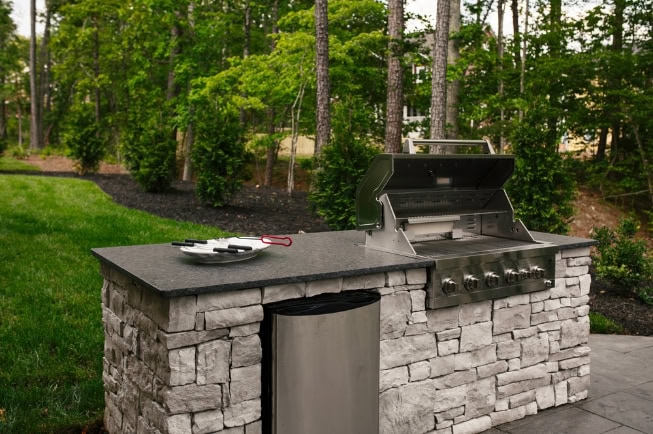
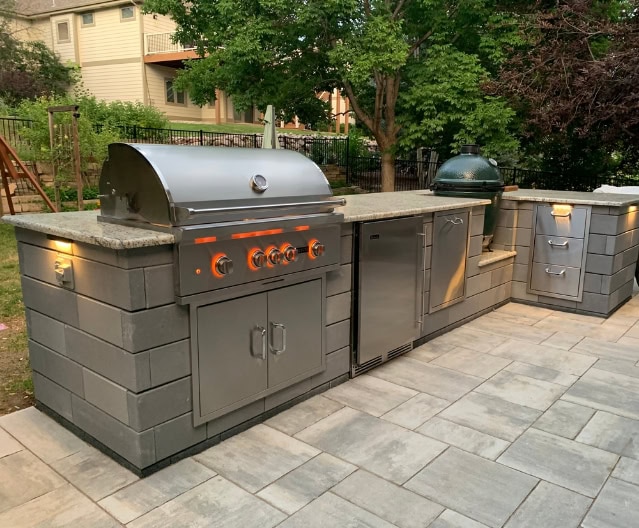
Outdoor kitchens in Sharon Hill don’t need to be large to be worth building. Some of the most functional setups we’ve built are compact a built-in grill, a prep counter, smart storage, and a small bar area that makes a modest backyard feel like a real outdoor living space. Others go further: full kitchens with sinks, refrigeration, pizza ovens, and covered seating areas. The scope depends on your space, your budget, and how you actually plan to use it not on what looks impressive in a brochure.
Every build we create accounts for what Delaware County winters actually do to outdoor materials. That means masonry with compressive strength exceeding 5,000 psi, countertop materials rated for freeze-thaw exposure, and base preparation that addresses the clay soil common throughout eastern Delaware County boroughs. These aren’t upgrades they’re the baseline for anything that’s going to last here.
If you’re thinking about selling in the next five to ten years, it’s worth knowing that outdoor kitchens consistently return between 55% and 200% of investment at resale, with homes that have them selling faster than comparable properties without. For Sharon Hill homeowners who’ve built equity over years of ownership, that’s not a small consideration. A quality outdoor kitchen is both something you get to enjoy now and something that holds its value when it matters.

Yes and it’s not optional. Sharon Hill Borough requires a building permit for any outdoor structure, which includes the masonry or framing involved in a built-in outdoor kitchen. If your project includes a gas line connection, a sink, or electrical outlets, those each require separate trade permits on top of the building permit. The borough’s process takes up to 15 business days from a complete application, and contractors must provide proof of General Liability and Workers’ Compensation insurance naming Sharon Hill Borough as the certificate holder before work can begin.
Skipping permits isn’t a shortcut it’s a liability. Non-permitted structures can trigger mandatory removal orders, complicate your homeowner’s insurance, and create serious problems when you go to sell the property. Delaware County municipalities have been increasingly diligent about flagging unpermitted work during resale inspections. We handle the entire permit process for you, including all documentation Sharon Hill Borough requires, so your investment is protected from the start.
The range is wide, and that’s not a dodge it genuinely depends on what you’re building. A clean, functional grill station with a built-in grill, prep counter, and storage typically starts around $5,000 to $10,000. A mid-range outdoor kitchen with a sink, refrigeration, and seating area generally runs $15,000 to $30,000. Full custom builds with multiple appliances, premium stone, covered structures, and bar seating can reach $50,000 to $80,000 or more.
For most Sharon Hill homeowners, the realistic sweet spot is somewhere in the $15,000 to $30,000 range a build that’s genuinely functional, built with materials rated for Delaware County winters, and designed to fit the actual dimensions of the backyard. What you want to avoid is a low-bid project that uses materials not rated for freeze-thaw conditions. In this climate, that kind of build often needs partial reconstruction within five to seven years, which ends up costing more than doing it right the first time.
This is one of the most important questions to get right before you build. Delaware County winters are harder on outdoor masonry than most homeowners realize temperatures cycling repeatedly between roughly 15°F and 60°F create a freeze-thaw pattern that expands and contracts the ground and any materials sitting on it. Stone or masonry that isn’t frost-rated will crack. Countertops not designed for outdoor temperature swings will fail. Cabinetry that isn’t marine-grade will deteriorate quickly once moisture gets in.
The materials that hold up here are frost-proof stone veneer, masonry products with compressive strength above 5,000 psi, stainless steel appliances rated for outdoor exposure, marine-grade cabinetry, and countertop materials specifically designed for four-season climates. Base preparation matters just as much Delaware County’s clay-heavy soil expands when wet and contracts when dry, and without a properly prepared base, even good materials can shift and crack over time. We spec every build for these conditions specifically, not for a milder climate.
From the first consultation to a completed build, you’re typically looking at several weeks to a few months, depending on the scope of the project. The permitting process in Sharon Hill Borough alone takes up to 15 business days once a complete application is submitted. Add material procurement time especially for custom stone or specialty appliances and construction itself, and a realistic timeline for most projects is six to twelve weeks from signed proposal to finished build.
The most common mistake homeowners make is starting the process too late. If you want your outdoor kitchen ready for Memorial Day weekend or the start of summer, the planning conversation needs to happen in February or March at the latest. Starting in April and expecting a May completion isn’t realistic when you account for permits and lead times. The earlier you start, the more options you have on design, on materials, and on scheduling.
Absolutely and this comes up often with homeowners in Sharon Hill and the surrounding boroughs along the Route 13 corridor. The housing stock in this part of Delaware County is older and denser than what you’d find in the outer townships, and most backyards here are modest. That’s a design constraint, not a dealbreaker. The key is designing for how you actually use the space rather than trying to fit a layout built for a larger lot into a smaller one.
A well-designed compact outdoor kitchen a built-in grill, a prep counter, smart storage, and maybe a small bar or seating area can function just as well as a sprawling setup on a bigger property. In some ways it functions better, because everything is within reach. We start every project with a site visit specifically because the design has to work with your actual yard dimensions, grade, and access not a standard template. Smaller backyards in Sharon Hill just require more intentional design, and that’s something we do from the start.
It creates real problems and they tend to surface at the worst possible time, usually when you’re trying to sell the house. Sharon Hill Borough enforces its permitting requirements, and non-permitted structures can be flagged during resale inspections. When that happens, you’re typically looking at two options: retroactively permit the work (which requires inspections that may not pass) or remove the structure entirely. Neither is cheap, and neither is a situation you want to be in after already paying for the build.
Beyond resale, there’s the insurance angle. Homeowner’s insurance policies often exclude coverage for structures built without permits. If something goes wrong a fire from an improperly installed gas line, for example an unpermitted outdoor kitchen can create a coverage dispute that leaves you holding the bill. The permit process in Sharon Hill exists for practical reasons, and a contractor who skips it is passing that risk directly onto you. We pull every required permit before work begins, every time, because your investment deserves that protection.
Useful Links
Other Services we provide in Sharon Hill