
Hear from Our Customers
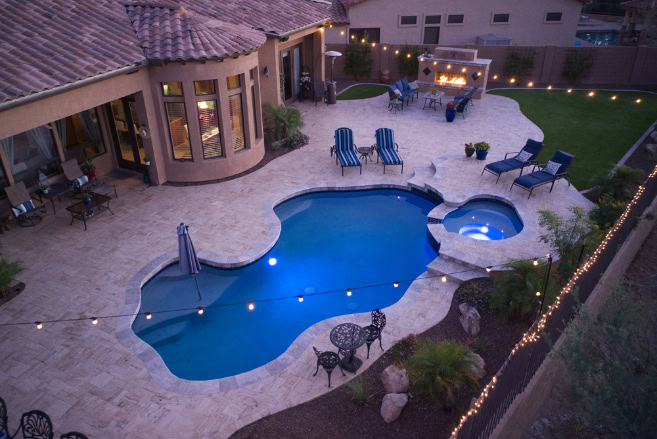
A well-built outdoor kitchen does not just give you a place to grill. It gives you a reason to use your backyard consistently, comfortably, and for years to come. Think weekend mornings with a built-in griddle, summer evenings with neighbors around, fall afternoons where the food comes off the smoker and nobody wants to go inside. That shift in how you use your home is what a real outdoor kitchen delivers.
The majority of homes in Folcroft were built in the 1940s, ’50s, and ’60s and most of those backyards have never been touched since. No hardscaping, no structure, no infrastructure. That means when you install an outdoor kitchen here, you are not upgrading something that already exists. You are creating something entirely new, from the ground up. Getting the base right, the drainage right, and the materials right from day one is what separates a space that lasts 20 years from one that needs to be torn out after five winters.
Darby Creek runs along the southern edge of Folcroft, and the drainage patterns in this area are real not theoretical. An outdoor kitchen built without proper grading and water management on a Folcroft property will show the damage within a few seasons. Frost-heaved pavers, cracked masonry, waterlogged bases. Doing it right means accounting for those conditions before a single block is laid, not after the problems show up.
We are based in Aston a few miles down the road from Folcroft and have been working exclusively in Delaware County for over 15 years. Not a regional franchise. Not a company that lists your borough on a service area page and sends out whoever is available. The same experienced crew that handles the consultation handles the build, and the same people who built your outdoor kitchen are the ones you call if anything ever needs attention afterward.
That matters in a community like Folcroft. A contractor who disappears after the final check gets noticed. Our entire model is built around the opposite of that one team, clear communication, and a finished project that looks exactly like what was discussed from the start.
Working in the inner-ring Delaware County boroughs for this long means understanding the conditions here: the postwar housing stock, the drainage patterns near Darby Creek, the Folcroft Borough permit process, and the freeze-thaw reality that destroys inferior outdoor construction every winter. That local knowledge is not something you can fake.
It starts with a consultation a real conversation about how you use your backyard, what you want the space to do, and what your budget looks like. There are no packages being pushed. The design that comes out of that conversation is shaped by your yard, your lifestyle, and your goals. A shaded south-facing lot in Folcroft gets treated differently than an open one. A homeowner who entertains large groups gets a different layout than one who wants a quiet cooking station for the family.
Once the design is finalized, we handle the permit process with Folcroft Borough filing the plans, coordinating with the Planning Commission, and managing inspections so you do not have to learn the borough’s code or chase down approvals. This step matters more than most homeowners realize. Folcroft’s position within Philadelphia International Airport’s designated hazard area means height restrictions apply to any covered outdoor structure, and a contractor who does not know that will create compliance problems you will eventually have to solve at your own expense.
Construction begins with site preparation: grading, drainage engineering, base compaction, and utility routing for gas, water, and electrical connections. From there, the masonry goes up, the appliances go in, and the finish work gets done all by the same team. The final step is a walk-through where everything gets tested and explained before anyone signs off. Pennsylvania’s build season runs from mid-April through October, so homeowners who start the conversation in January or February can realistically have their outdoor kitchen finished before Memorial Day.
Ready to get started?
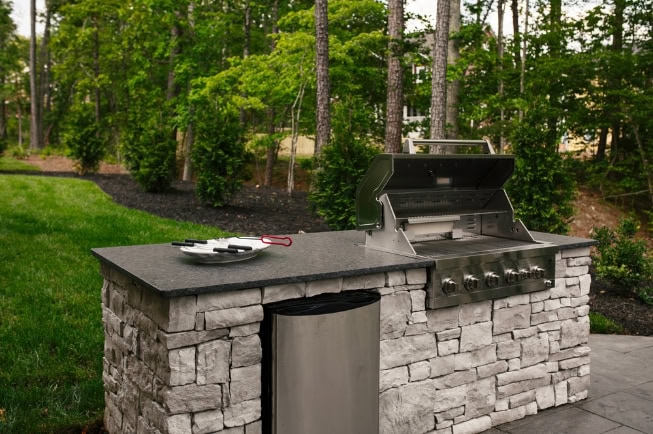
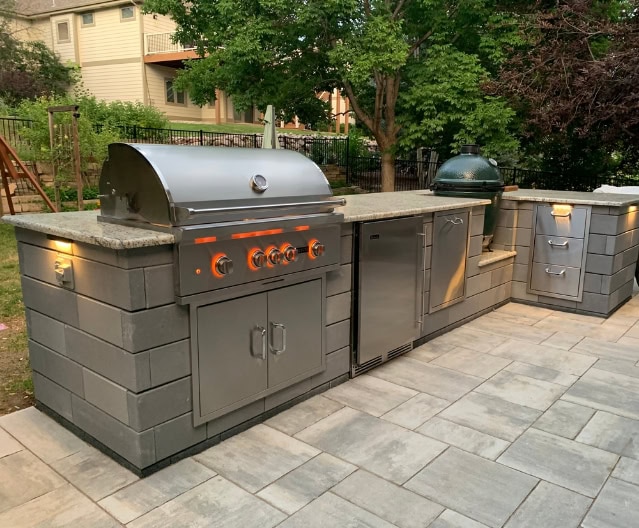
Every outdoor kitchen we build in Folcroft starts with the same question: what do you actually want to do out here? Some homeowners want a clean, high-quality grill station with a prep counter and a side burner functional, durable, and well-built without overcomplicating it. Others want a full outdoor kitchen setup with a built-in grill, a sink, a refrigerator, bar seating, and a covered structure overhead. The design process works around your answer, your yard’s dimensions, and your budget not a catalog.
Materials are selected specifically for Delaware County’s four-season climate. Frost-proof stone veneer, stainless steel appliances rated for outdoor exposure, marine-grade cabinetry, and properly compacted base layers that resist the freeze-thaw cycles that hit this area every winter. These are not premium upgrades they are the baseline for any outdoor kitchen that is going to hold up in Pennsylvania. Cutting corners on materials here does not save money. It just moves the cost to a future reconstruction project.
Because most Folcroft properties are working from unimproved postwar backyards, the site preparation phase is often the most critical part of the entire build. Drainage, grading, and base work done correctly from the start is what makes the difference between a 20-year structure and a 5-year problem. That foundation work is built into every project not offered as an add-on.

Yes in most cases, you do. Folcroft Borough has its own zoning code and Planning Commission, and any outdoor kitchen that involves structural masonry, a gas line connection, electrical work, or a covered structure will require a building permit before construction begins. Skipping the permit process is not a shortcut it creates real problems at resale and potential liability from unpermitted gas or electrical work that an inspector or buyer’s attorney will find.
There is also a detail specific to Folcroft that most homeowners are not aware of: the borough falls within the airport hazard area affected by Philadelphia International Airport, and Pennsylvania Act 164 of 1984 applies height restrictions to structures built here. For most standard outdoor kitchen builds, this does not create an issue but if you are planning a pergola, a shade structure, or any covered element above the cooking area, the design needs to account for those restrictions from the start. We manage the entire permit process, including any coordination required by the borough’s Planning Commission, so this does not become your problem to navigate.
Most outdoor kitchen projects in Folcroft fall somewhere between $15,000 and $35,000, depending on the size of the space, the appliances selected, and how much site preparation the property requires. A straightforward grill station with a prep counter and quality masonry will come in at the lower end of that range. A full outdoor kitchen with a sink, refrigerator, bar seating, and a covered structure will push toward the higher end.
One cost factor that is particularly relevant for Folcroft properties is site preparation. Because the majority of homes here were built in the 1940s through 1960s, most backyards have never been hardscaped there is no existing base to build on. That means grading, drainage engineering, and base compaction are part of the project from the start. On properties near the southern end of the borough, where Darby Creek’s drainage patterns affect the ground, that site work is not optional it is what keeps the structure sound through Pennsylvania winters. A contractor who gives you a low quote without accounting for site prep is not saving you money. They are just moving the cost to a future repair.
The freeze-thaw cycle is the real test for any outdoor structure in Delaware County. Temperatures swing from the mid-teens to the 60s repeatedly through winter, and that expansion-and-contraction cycle destroys materials that were not chosen with it in mind. Ceramic tile cracks. Certain stone veneers absorb water and split. Improperly compacted bases heave and shift, taking the structure above them with it. Reconstruction after a failed outdoor kitchen typically runs $3,000 to $8,000 which is why material selection matters from day one.
What holds up: frost-proof stone veneer rated for freeze-thaw exposure, stainless steel appliances built for outdoor use, marine-grade cabinetry that does not absorb moisture, and a base layer of properly compacted gravel that allows drainage and resists frost heave. These are not luxury choices they are the standard for any outdoor kitchen that is going to survive more than a few winters in Pennsylvania. Every build we complete in Folcroft uses materials and base methods selected specifically for this climate, not for a mild-winter market where contractors can cut corners without immediate consequences.
From the initial consultation to a finished, walk-through-ready outdoor kitchen, most projects take between six and twelve weeks depending on the complexity of the design, how quickly permits are processed through Folcroft Borough, and the current project schedule. The permit review process through the borough typically adds a few weeks to the timeline before construction can begin, which is why starting the planning conversation early matters.
Pennsylvania’s hardscaping season runs from roughly mid-April through October. Masonry and base work cannot be done safely below 40°F, and rushing construction in cold or wet conditions creates exactly the kind of structural problems that lead to early failures. Homeowners who want their outdoor kitchen ready for Memorial Day weekend need to be in the planning process by January or February at the latest. Projects that start in May or June risk missing the summer entirely. The earlier you start the conversation, the more flexibility there is in scheduling and the more time the design process has to produce something you are genuinely happy with before a single block is laid.
Yes and this question comes up often in Folcroft, where the postwar housing stock means most lots are modest in size. A well-designed outdoor kitchen does not require a large backyard. It requires a design that fits the space you have rather than one pulled from a catalog that assumes unlimited square footage. A compact grill station with a prep counter, a small refrigerator, and seating for four or five people can be built in a relatively tight footprint and still completely transform how you use the space.
The key is the design conversation at the start of the process. A south-facing yard with afternoon sun gets treated differently than a shaded lot. A yard that slopes slightly toward the back property line needs drainage addressed in the layout. A yard that is 20 feet deep requires a different configuration than one that is 40 feet deep. Our consultation process starts with your actual yard its dimensions, its drainage patterns, its sun exposure and produces a design that works within those constraints rather than ignoring them. The result is a space that gets used, not a structure that overwhelms the yard or sits awkwardly because it was never designed for that specific property.
It does and in Folcroft specifically, the timing makes it a particularly sound decision. The borough has seen some of the strongest home appreciation rates in Delaware County in recent years, and buyers in this market are increasingly expecting upgraded outdoor spaces. A well-built outdoor kitchen adds functional square footage to a home that buyers can see and evaluate immediately. Industry data puts the return on investment for outdoor kitchens between 55% and 100% at resale, with homes featuring outdoor kitchens selling faster than comparable properties without them.
For Folcroft homeowners specifically, there is an additional layer to this. Most homes in the borough are 60 to 80 years old and have never had their outdoor spaces improved beyond basic lawn maintenance. An outdoor kitchen installation on one of these properties is not a marginal upgrade it is often the first real outdoor living investment the property has ever seen. That kind of visible, functional improvement stands out in a neighborhood where most backyards are still plain and unimproved. If you are planning to stay in your home for the next 10 to 20 years, you get the full benefit of the space every season. If you eventually sell, the investment comes back to you in a market that is trending in the right direction.
Useful Links